
Delrin vs. Nylon: Which Engineering Plastic Should You Choose?
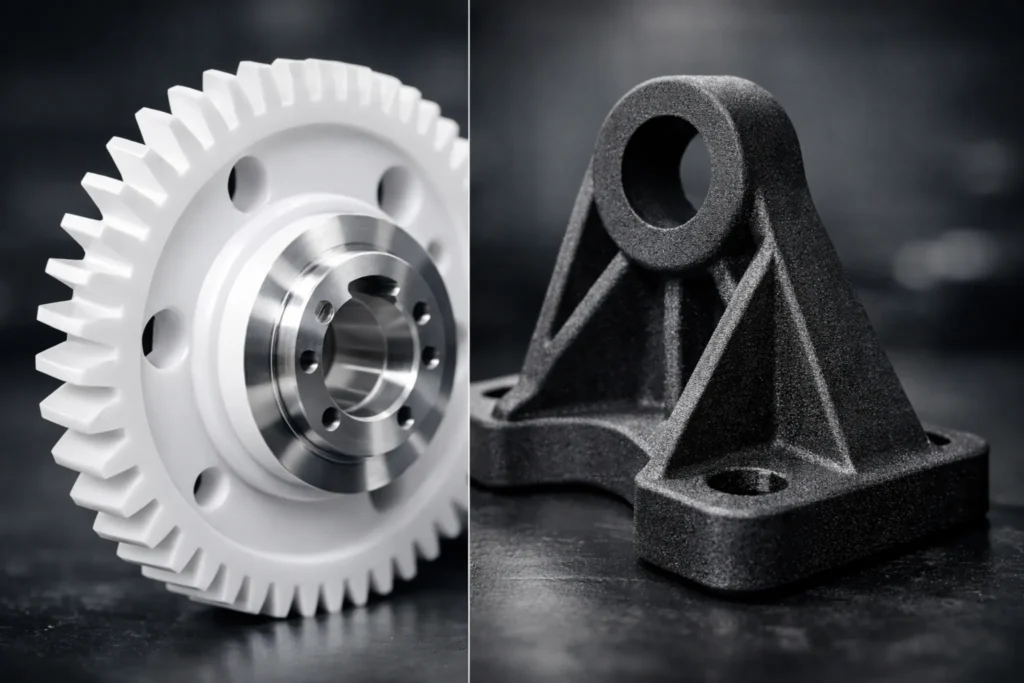
Choose Delrin® (acetal homopolymer, POM-H) first when tight tolerances must hold as humidity changes.
Choose Nylon 6/6 first when you need the ductility, flexibility, or reinforced and heat stabilized grades that unfilled acetal doesn’t offer.
Both are widely used for gears, bushings, rollers and other mechanical parts, and neither is universally better.
The deciding factor is usually moisture: on the data sheets reviewed for this guide, unfilled Nylon 6/6 absorbs roughly 7.0–8.5% water by weight at saturation, versus about 0.9% for POM-H.
The sections below show what the numbers say and where the exact grade changes the answer.
Quick Answer: Delrin or Nylon?
| Property (73°F / 23°C) | Delrin (POM-H) stock shapes | Nylon 6/6, unfilled (dry) | What it means in practice |
| Water absorption at saturation (ASTM D570) | ~0.90% [1] [5] | 7.0–8.5% [2] [3] | Nylon swells with humidity far more, POM-H is steadier but not dimensionally invariant. |
| Tensile yield strength | 10,500–11,000 psi (72–76 MPa) [1] | ~12,000 psi (83 MPa) [2] [3] | Nylon’s dry number is higher, but it falls with moisture and temperature. |
| Tensile modulus | 350,000–450,000 psi (2.4–3.1 GPa) [1] | 350,000–425,000 psi (2.4–2.9 GPa) [2] [3] | Dry stiffness overlaps; nylon stiffness drops as it absorbs moisture [13]. |
| Notched Izod impact (ASTM D256) | 1.0–1.2 ft-lb/in [1] | 0.6–1.0 ft-lb/in [2] | No dry datasheet impact advantage for nylon, its toughness rises with moisture [13] |
| Elongation at break | 25–40% [1] | 40–50% [2] | Nylon is more ductile at break. |
| Dynamic coefficient of friction vs. steel | 0.12–0.35, depending on grade and test [1][6] [7] | 0.25–0.26 [2] [3] [8] | Ranges overlap. Compare at your load, speed and counterface. |
| Heat deflection temperature at 264 psi | 242–257°F [1] | 194–200°F [2] | Under load, the POM-H sheet lists the higher figure. |
| Long-term service temperature (supplier-defined) | 185–190°F [1] | Listed up to 220°F on one MoS₂-filled PA66 shape [9]; definitions vary | Not comparable across suppliers. Nylon 101 lists 6,000 psi tensile at 150°F, half its room temperature value [13]. |
Values are representative figures from the extruded and cast stock-shape data sheets listed under Technical Sources, at 73°F (23°C); nylon values are dry-as-molded. They are not design values. Injection-molding resin data differ (for example, Delrin 500 lists 72 MPa yield and 3,200 MPa modulus under ISO 527 [4]). Verify the current datasheet for your exact grade, test method and conditioning before using any number.
What Are Delrin and Nylon?
Delrin, POM and acetal: what the terms mean
- POM = polyoxymethylene, the polymer family.
- Acetal = the common industry name for POM materials. In practice, “acetal” is often used to mean the copolymer and “Delrin” the homopolymer.
- POM-H = acetal homopolymer. POM-C = acetal copolymer.
- Delrin® = a brand name for POM-H.
So “Delrin is POM” is broadly right; “all acetal is Delrin” is not. The difference matters in practice:
What is Nylon?
Nylon is a family of polyamides (PA), not one material. Common engineering types are Nylon 6, Nylon 6/6, and specialty grades glass-filled, heat-stabilized, lubricated (for example MoS-filled) and impact modified.
A standard unfilled 6/6 shape and a glass-filled, heat-stabilized grade can behave very differently, so “nylon” alone is not a sufficient specification.
Why moisture affects them so differently
Both are semi crystalline.
In nylon, the amorphous regions absorb water, which bonds to the polymer chains and pushes the crystalline regions apart. Parts swell and lose strength and stiffness, while elongation and toughness increase.
POM-H lacks nylon’s water attracting amide groups and absorbs far less about 0.9% at saturation.
Which Handles Moisture Better (Nylon or Delrin)?
Nylon: large, grade-dependent swings
Saturation absorption for unfilled PA66 shapes is listed at 7.0% to 8.5%.
24-hour absorption is listed at 0.3–1%.
A PA6 injection-molding grade lists 10% saturation under ISO 62, so those numbers should not be compared directly.
A nylon part that spends its life at ambient humidity will leave the dry state, and its dimensions, stiffness, strength, toughness and creep behavior change with it.
Delrin: low uptake, but not dimensionally invariant
POM-H is listed at about 0.90% saturation absorption, and POM-C at 0.8–0.9%.
That is a large difference from nylon, but dimensions still move with temperature, residual stress from machining, part geometry and loading.
Engineering takeaway
For tight shaft fits, precision holes, sliding fits, gears and alignment features that must hold through humidity changes, compare moisture dependent dimensional data for the exact grades.
If a nylon part will see humidity, compare conditioned data rather than dry data.
How Do They Compare Mechanically?
Strength and stiffness
Dry Nylon 6/6 lists a higher yield strength (about 83 MPa versus 72–76 MPa for POM-H), while dry stiffness overlaps (2.4–3.1 GPa versus 2.4–2.9 GPa) [1] [2] [3].
The more useful question is which property actually limits your component: tensile strength, creep, fatigue, impact, wear, dimensional stability, temperature or chemical exposure.
Creep and fatigue
POM-H data sheets list creep resistance and fatigue endurance among the material’s key benefits [1] [7], and Delrin is widely used for gears, cams and repeatedly actuated parts.
Nylon sheets also list fatigue resistance [2]. Creep and fatigue life depend on stress, temperature, frequency, geometry and grade, and for nylon on its moisture condition, so use grade specific curves for long term or high cycle parts rather than a family level claim.
Impact and toughness
Compare notched and unnotched impact at your operating temperature and moisture condition, and account for stress concentrations in the part.
Delrin 500T is a toughened homopolymer whose impact resistance DuPont describes as similar to Delrin 100. It trades strength and stiffness for that toughness: about 55 MPa yield and 2,300 MPa modulus, against 72 MPa and 3,200 MPa for Delrin 500.
“Standard Delrin” and “nylon” do not represent every grade in either family.
Friction, wear and PV limits
Both materials are used in sliding applications, and performance depends on load, sliding speed, temperature, counterface material and finish, lubrication and grade. Rather than assuming either is “self-lubricating,” compare wear data measured by the same method.
Glass-filled nylon changes the comparison
Glass reinforcement can significantly change strength, stiffness, creep, dimensional behavior, thermal performance and wear, and it can make a grade unsuitable against certain mating surfaces or in high speed sliding.
Check the specific grade’s wear data and the supplier’s recommendation for the mating material.
How Do Delrin or Nylon Compare on Temperature, Chemicals and UV?
Temperature
Supplier service temperature figures depend on how each supplier defines them.
Protolabs lists a continuous service temperature of 185–190°F for POM-H [1].
Röchling lists 220°F for its MoS-filled PA66 shape [9].
Under load, the heat deflection temperature at 264 psi is 242–257°F for POM-H and 194–200°F for Nylon 6/6 on the Protolabs sheets [1][2].
Check the same temperature curve for any Delrin grade you compare, since both materials lose strength as temperature rises.
Do not select by melting point. POM-H melts near 347°F and PA66 near 491–500°F [1] [2], yet both lose strength far below those temperatures.
Reinforced and heat stabilized nylons can extend the usable range substantially, and Delrin also has specialty grades, so check continuous and peak temperature, load at temperature, creep, and the grade’s own service temperature guidance.
Chemical compatibility
POM-H is listed as resistant to hydrocarbons, solvents and neutral chemicals [1], and nylon is commonly used with oils, greases and cleaning agents [8].
Nylon can be vulnerable to certain strong acids, and Delrin has lower resistance to strong bases than copolymer acetal [12].
Compatibility depends on the exact chemical, concentration, temperature, exposure time, stress level and grade, so check the manufacturer’s chemical resistance data rather than relying on a family level statement.
UV and outdoor exposure
Neither standard Delrin nor standard nylon should be assumed suitable for long term outdoor exposure. UV can cause surface degradation, color change, embrittlement and loss of mechanical performance.
Both families offer UV-stabilized grades, so specify one and check the manufacturer’s weathering data.
How Does Grade Selection Change the Comparison?
Comparing “Delrin vs. Nylon” is often less useful than comparing a specific Delrin grade against a specific nylon grade under your operating conditions.
| Family | What changes (sourced values) | Investigate when… |
| Delrin 500 (general purpose, medium viscosity) | About 72 MPa yield, 3,200 MPa modulus and 9 kJ/m² notched Charpy (ISO, injection-molding resin) [4]. Delrin 500P is a medium viscosity homopolymer with improved processing [19]. | You need balanced stiffness, strength and processability. |
| Delrin 500T (toughened) | About 55 MPa yield and 2,300 MPa modulus, impact resistance similar to Delrin 100 [15]. | You need Delrin’s moisture behavior but the part sees impact loading. |
| Delrin viscosity families (100, 500, 900) | Delrin 100 is a high viscosity homopolymer [18] and 500 is medium viscosity [19]; lower viscosity grades such as the 900 series are used for easier filling of thin wall or multi cavity tools. | The process (molding versus machining stock) and wall thickness drive grade choice. |
| Copolymer acetal (POM-C) | Yield 8,800–9,500 psi, saturation absorption 0.8–0.9%, service temperature 180–210°F on the Protolabs sheet [10], avoids the centerline porosity concern noted for thick POM-H sections [12]. | Sections are thick, or strong-base resistance matters more than peak strength. |
| Nylon 6 vs. Nylon 6/6 | Values depend on form and test method as much as polymer: a PA6 injection-molding grade lists 10% saturation under ISO 62 [16], while PA66 shapes list 7.0–8.5% under ASTM D570 [2] [3]. | Compare within the same form, test method and conditioning; treat “Nylon” alone as an incomplete specification. |
| Glass-filled, heat-stabilized and lubricated nylon | Reinforcement changes strength, stiffness, heat capability and wear behavior. Lubricated grades exist: Röchling’s MoS-filled PA66 lists dynamic friction of 0.23 and no FDA, NSF or USDA approval [9]. | Stiffness or heat capability is the limiting requirements |
Which Is Better for CNC Machining and 3D Printing?
CNC machining
Both are machinable: the POM-H shape data list good machinability with high stiffness and fatigue strength [7], and the PA66 data list good machinability as well [8]. The difference is control.
For nylon, precision work depends on moisture condition, stock condition and machining heat. Use grade and machine-specific cutting recommendations rather than a single universal speed.
for more details see our: machining Delrin guide, nylon for machining and, for fume hazards, laser cutting Delrin.
3D printing
Nylon is the established material for SLS and MJF, while POM/Delrin is rarely used in mainstream additive processes because of its processing behavior.
One caveat: powder bed “nylon” is typically a PA12 or PA11 type polyamide, not Nylon 6/6. One SLS data sheet lists density of 1.00–1.01 g/cm³, 24-hour moisture absorption of 0.07–0.48% and tensile modulus of about 1,500–1,600 MPa for unfilled powders [17], versus 1.14 g/cm³ and 2.4–2.9 GPa dry for Nylon 6/6 stock [2].
Do not transfer Nylon 6/6 values to printed parts. See our Delrin 3D printing guide.
Post-processing
Nylon can be dyed and annealed. Delrin’s low surface energy makes bonding, coating and painting harder. If either is part of your process, test the actual surface treatment or adhesive system on the actual grade.
Machining Delrin Components for a Current Project?
Skip the shop-floor trial and error. Upload your STEP, IGES, or DXF files for an instant manufacturability review, tight-tolerance verification, and fast production quotation.
Request a Precision Machining Quote →🔒 NDA Compliant • 1 to 10,000+ Production Parts • Fast Turnaround
Where Are Delrin and Nylon Commonly Used?
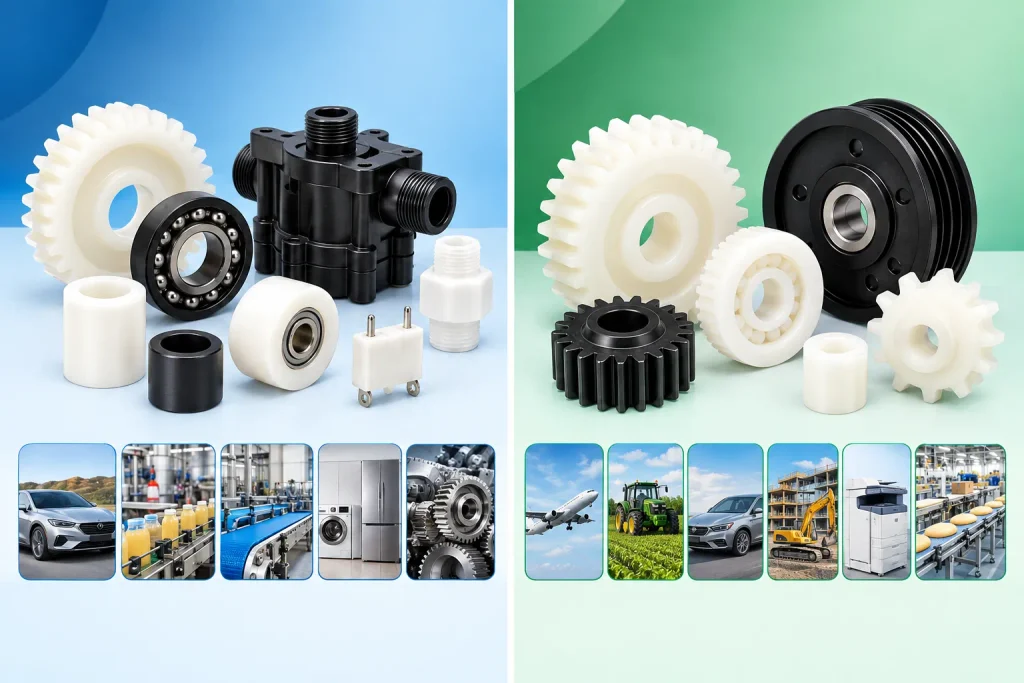
- Delrin / POM-H: pump and valve components, gears, bearings, bushings, rollers, fittings and electrical insulator parts [1]. Target industries include automotive, food engineering, conveyor technology, home appliances and gear manufacturing [7],.
- Nylon 6/6: bearings, gears, sheaves and sprockets. Target industries include aircraft, agricultural machinery, automotive, construction, business machines, food processing and conveyor technology [2].
The correct grade often matters more than the material family.
Who Should Use This Comparison?
| Role | Focus on | Ask for |
| Design engineers | The limiting property: load, creep, fatigue, impact, temperature, moisture, chemicals, service life. | Grade-specific data at the service condition, dry and conditioned for nylon. |
| Manufacturing engineers | Machinability, chip formation, shrinkage and warpage, moisture conditioning of nylon stock, tooling, secondary operations. | Grade-specific processing guidance and the stock condition. |
| Procurement | Exact designation, grade, reinforcement, certification, supplier qualification, lead time, current cost. | The ASTM D6778 and D6100 designations (Delrin 150 sheets list POM0111 and S-POM0111 [5] [6] and the supplier datasheet. |
| Buyers | Material family, exact grade, reinforcement, color, dimensions, environment, required certification. | A specification that names all of these; “Delrin” or “Nylon” alone does not identify what to buy. |
How Do You Choose by Requirement?
| If the primary requirement is… | Investigate first | Check before deciding |
| Dimensional stability in changing humidity | POM-H grades | Moisture and thermal expansion data for the exact grades, part geometry. |
| Ductility or toughness in moist service | Conditioned nylon; toughened Delrin (500T) | Notched and unnotched impact at your temperature and moisture condition. |
| High stiffness | POM-H; reinforced nylon | Dry versus conditioned modulus; stiffness at temperature. |
| Long-term load | Grade-specific creep data | Stress, temperature and time; conditioned data for nylon. |
| Repeated mechanical cycling | Grade-specific fatigue data | Stress amplitude, temperature and frequency. |
| Sliding or wear | PV limit, wear factor and friction data | Counterface, load, speed, lubrication, and the same test method for both. |
| Elevated temperature | Exact grades, compared at temperature | Heat deflection, strength at temperature, the supplier’s service-temperature definition. |
| CNC precision machining | POM-H and conditioned nylon stock | Tooling, chip formation and dimensional inspection. |
| SLS or MJF printing | Powder-bed nylon (typically PA12- or PA11-type) | The print provider’s datasheet, not Nylon 6/6 values. |
| Outdoor use | UV-stabilized grade of either material | Manufacturer weathering data. |
| Chemical exposure | Exact grade plus chemical data | Concentration, temperature and exposure time. |
| Food contact or medical use | A certified grade | Documentation for the exact grade and color. |
| Lowest cost | Current supplier quotations | Total manufactured-part cost, not price per kilogram. |
This table is a selection framework, not a ranking. The limiting requirement should decide which family and grade deserve further investigation.
Delrin vs Nylon: Which Costs Less?
Nylon often has a lower raw material price than Delrin, but material price is only one input to part cost. Machining or cycle time, scrap, tooling, rework, dimensional control requirements, production volume, certification and lead time all contribute.
Compare current quotations for the exact grades and the complete manufactured part cost, not price per kilogram.
When Are Neither the Right Choice?
- High temperature under structural load: investigate PEEK or other high performance polymers, or reinforced and heat stabilized nylon, once the load and temperature exceed what available Delrin or nylon grades can carry.
- Aggressive chemicals: choose a material selected for that chemistry rather than assuming Delrin or nylon will remain compatible.
- Extreme wear or unlubricated low friction: UHMW-PE, PTFE based materials or tribological compounds may deserve consideration; see UHMW vs. Delrin.
- Thick sections in POM-H: consider copolymer acetal if centerline porosity is a concern [12].
- Regulated food, drinking-water or medical use: compliance is grade and color specific. The natural Delrin 150 data sheet lists FDA 21 CFR 177.2480 and NSF 51/61 [5].
The black Delrin 150 sheet lists neither [6], and Röchling’s MoS-filled PA66 lists no FDA, NSF or USDA approval [9]. Specify the exact certified grade and verify current documentation.
Final Decision Checklist
| Check | What to compare |
| 1. Moisture | Will the part see humidity, water or condensation? Compare moisture absorption and dimensional change for the exact grades. |
| 2. Impact | Drops, shock or sudden loads? Compare notched and unnotched impact at temperature and moisture condition. |
| 3. Temperature | Continuous temperature, peak temperature and load at temperature. Compare heat deflection and strength at temperature. |
| 4. Load and creep | Long term loading? Compare creep data at your stress, temperature and time. |
| 5. Friction and wear | Sliding, rotating or bearing use? Compare PV limit, wear factor and friction at your load, speed and counterface. |
| 6. Nylon condition | If nylon will see humidity, compare dry-as-molded and conditioned data, not the dry sheet alone. |
| 7. Manufacturing | CNC, molding, extrusion or printing? Choose the grade for the actual process. |
| 8. Chemicals | Exact chemical, concentration, temperature and exposure time. |
| 9. Certification | Food, drinking water, medical or regulated use? Specify the exact certified grade and check the documentation. |
| 10. Procurement | Can the exact grade be sourced at the quantity, location, lead time and price you need? |
How to read technical data
The important question is not only what number a datasheet shows, but which grade, test method and condition produced it.
| Data area | What to verify |
| Tensile strength and modulus | Exact grade, test method (ASTM D638 or ISO 527) and conditioning (dry or 50% RH). |
| Impact strength | Test specimen, notch, temperature and conditioning. |
| Friction and wear | Counterface, load, speed, lubrication and the test method (for example ASTM D3702). |
| Moisture absorption | Test method (ASTM D570 or ISO 62), exposure time and temperature. |
| Service temperature | The supplier’s definition and the exact grade. |
| Creep and fatigue | Stress, temperature, time or cycles, and specimen geometry. |
| Chemical resistance | Chemical, concentration, temperature and exposure time. |
Frequently Asked Questions
Is Delrin better than Nylon?
Neither is universally better. Delrin (POM-H) is usually investigated first when dimensional stability in changing humidity matters.
Nylon 6/6 is investigated when ductility, toughness in moist service, or reinforced and heat stabilized grades matter. The exact grade and operating conditions decide.
Which is stronger, Delrin or Nylon?
On dry stock shape data sheets, unfilled Nylon 6/6 lists about 12,000 psi (83 MPa) tensile yield versus roughly 10,500–11,000 psi (72–76 MPa) for POM-H. But nylon’s strength and stiffness fall as it absorbs moisture, so compare conditioned nylon data and the property that actually limits your part.
Does Delrin absorb more water than Nylon?
No. On the data sheets reviewed, POM-H absorbs about 0.9% water by weight at saturation, while unfilled Nylon 6/6 absorbs about 7.0–8.5% (ASTM D570). Exact values vary by grade and test method.
Which is cheaper, Delrin or Nylon?
Nylon often has a lower raw material price, but total part cost also depends on machining or cycle time, scrap, tooling, certification and lead time. Compare current quotations for the exact grades.
Is Delrin suitable for outdoor use?
It can be, but standard grades should not be assumed suitable for long term UV exposure. Specify a UV stabilized grade and check the manufacturer’s weathering data.
Can Delrin or Nylon be used for food or medical applications?
Only specific certified grades. For example, the natural Delrin 150 data sheet lists FDA 21 CFR 177.2480 and NSF 51/61, while the black grade’s sheet lists neither. Verify current documentation for the exact grade and color.
Related Guides
- Delrin® (POM): Properties, Grades, Applications & Material Selection Guide
- Delrin vs. acetal
- Delrin vs. ABS
- Delrin vs. Teflon
- UHMW vs. Delrin
- HDPE vs. Delrin
- Glass-filled Nylon
- Nylon for machining
- Nylon injection molding
Technical Sources
Values in this guide come from the manufacturer and supplier data sheets below, reviewed September 2026. Stock-shape sheets and injection-molding resin sheets report different values; always verify the current datasheet for your exact grade before using a number for design, qualification or procurement.
[1] Protolabs — POM-H (Acetal Homopolymer) CNC material data sheet (2026)
[2] Protolabs — Nylon 6/6 CNC material data sheet (2026)
[3] Mitsubishi Chemical Advanced Materials — Nylon 101 (extruded, unfilled Type 66) ASTM data sheet
[4] Delrin 500 NC010 product information (DuPont, ISO data, injection-molding resin)
[5] Trident Plastics — Delrin 150 NC010 (POM-H natural, extruded shapes) technical data
[6] Trident Plastics — Delrin 150 BK (POM-H black, extruded shapes) technical data
[7] Ensinger / Polymershapes — DELRIN 511 series acetal homopolymer stock shapes data sheet
[8] Ensinger — TECAMID 66 natural (unfilled PA66) product data
[9] Röchling — Sustamid 66 MO (extruded, MoS₂-filled nylon) product data
[10] Protolabs — POM (acetal copolymer) CNC material data sheet (2026)
[11] Protolabs — POM plastic guide (terminology: acetal, POM-H, POM-C, Delrin)
[12] Craftcloud — Delrin (POM-H) CNC material guide (centerline porosity, base resistance)
[13] W.S. Hampshire — Dry versus conditioned nylon explained
[15] Material Data Center — Delrin 500T BK602 (toughened medium-viscosity homopolymer)
[16] Aquafil — ECONYL ECO 27 (PA6 injection-molding grade) technical data sheet
[17] arrk — SLS material datasheet (powder-bed nylon properties)
[18] UL Prospector — Delrin 100 BK602 (high-viscosity homopolymer)
[19] UL Prospector — Delrin 500P BK602 (medium-viscosity homopolymer)
Last Reviewed : September 2026

Usama Ayub is the founder of PlasticSpec and a polymer manufacturing engineer with eight years of hands-on industrial experience in PET, PA6, and PA66 fiber and filament yarn production. He writes material property and selection guides for Delrin, Nylon, PEEK, PTFE, UHMW, Polycarbonate, and ABS.