
UHMW (Ultra-High Molecular Weight Polyethylene): Properties, Applications, Grades & Selection Guide
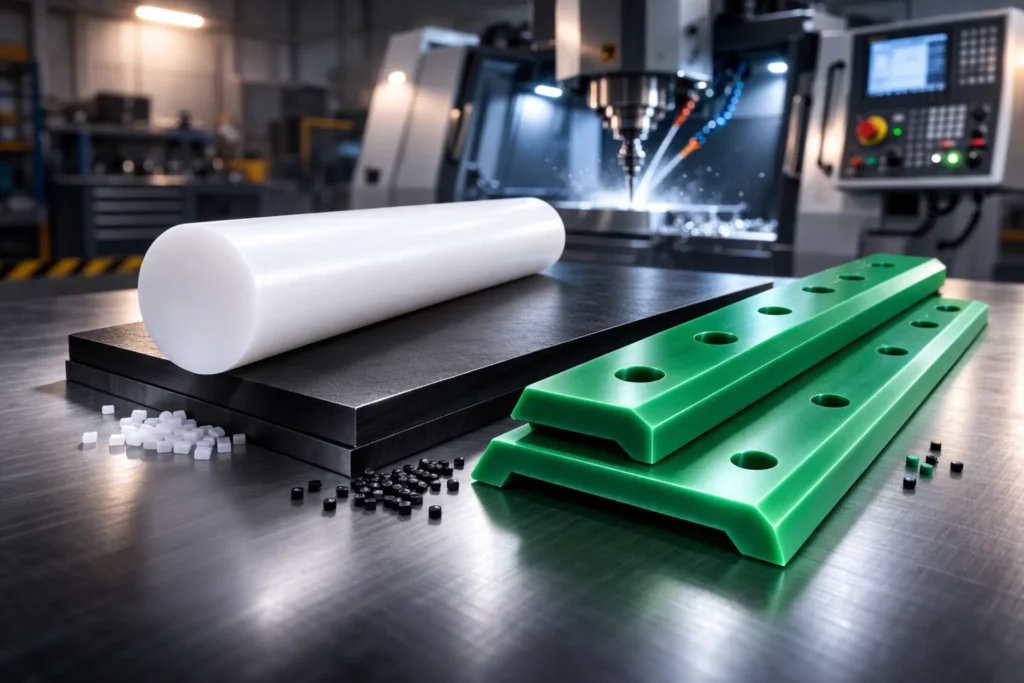
UHMW is the industrial “super-plastic” engineered for extreme impact, zero-friction movement, and maximum abrasion resistance in the world’s harshest environments.
What Is UHMW? (Quick Definition)
UHMW (Ultra-High Molecular Weight Polyethylene) is a high-density thermoplastic featuring extremely long polymer chains that result in a material with unparalleled impact strength and near-zero friction.
- Extreme Wear Resistance: Outlasts carbon steel 15:1 in abrasive sliding environments.
- Self-Lubricating: Lowest coefficient of friction of any thermoplastic besides PTFE.
- Indestructible: Highest impact strength of any plastic; it does not break, it deforms.
How UHMW Differs from Standard Polyethylene (HDPE)
While both belong to the same family, the difference lies in Chain Length:
| Feature | HDPE (Standard) | UHMW (Industrial) |
| Molecular Weight | 100k – 500k g/mol | 3.5M – 7.5M g/mol |
| Impact Strength | Moderate | Highest of all Thermoplastics |
| Abrasion Resistance | Good | Excellent (Industry Leading) |
| Primary Use | Bottles, Pipes, Jugs | Wear Strips, Liners, Gears |
Bottom Line: HDPE is for packaging; UHMW is for engineering.
UHMW Material Properties
UHMW’s dominance in industrial engineering is due to its extreme molecular weight, which creates a material that is effectively unbreakable and self-lubricating.
Density & Molecular Weight
- Density: 0.93 – 0.94 g/cm³. It is light enough to float in water.
- Molecular Weight: 3.5M to 7.5M g/mol. These ultra-long chains provide the superior intermolecular strength that distinguishes it from standard plastics.
Tensile Strength & Impact Resistance
- Tensile Strength: 3,000 – 6,000 psi at yield.
- Impact Strength: No Break. Using the Izod Impact test, UHMW is the only thermoplastic that does not break; it simply deforms, absorbing massive kinetic energy without failure.
Abrasion & Wear Resistance
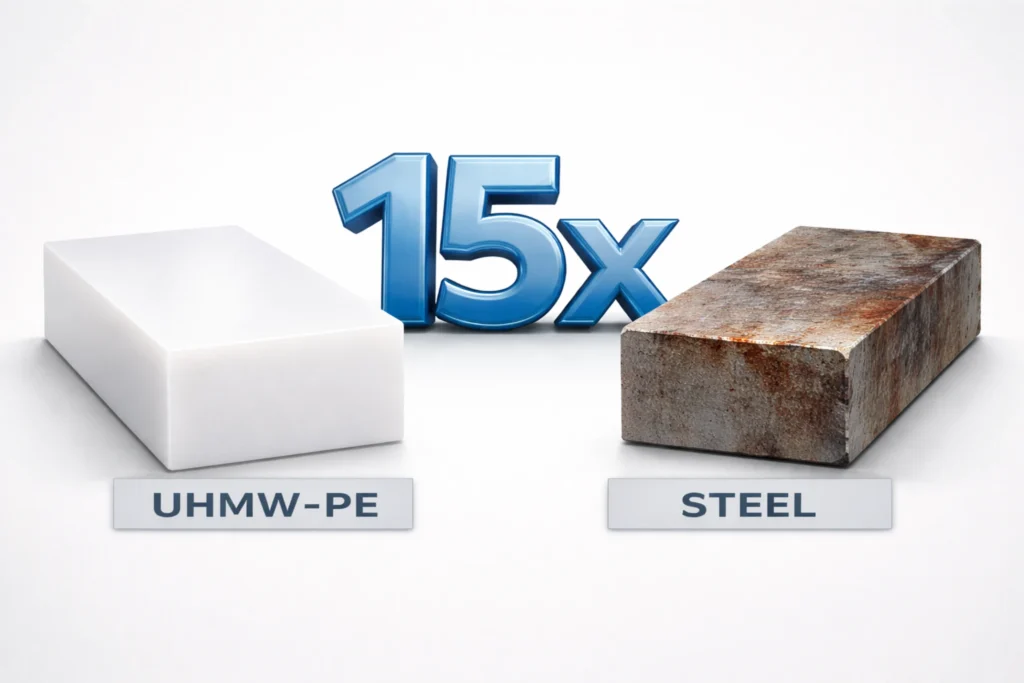
- Performance: Outlasts carbon steel 15-to-1 in sliding abrasion.
- Value: It is the industry standard for lining chutes and hoppers where grit, sand, or gravel would rapidly destroy metal surfaces.
Coefficient of Friction
- Static/Dynamic: 0.10 – 0.22.
- Comparison: Its slickness is comparable to PTFE (Teflon) but with significantly higher mechanical durability. It enables “dry” movement in conveyors without external grease.
Temperature Resistance (Max & Min Service Range)
- Low End: -450°F (-267°C). It remains ductile and impact-resistant in cryogenic environments.
- High End: 180°F (82°C) continuous; 200°F (93°C) intermittent. Critical: It has a low melting point; do not use in high-heat zones.
Chemical Resistance Profile
- Resistance: Highly inert to concentrated acids, alkalis, and organic solvents.
- Risk: Weakened only by strong oxidizing acids (e.g., nitric acid) and certain aromatic hydrocarbons.
Water Absorption & Dimensional Stability
- Absorption: <0.01%. It is virtually waterproof.
- Benefit: Unlike Nylon (PA 66, PA 11), UHMW will not swell or change dimensions when submerged, making it ideal for marine and subsea applications.
Electrical Insulation Properties
- Dielectric Strength: ~2,300 V/mil.
- Usage: Excellent insulator for high-voltage components, though specialized Anti-Static grades are required if static buildup is a fire risk.
UV Resistance & Outdoor Performance
- Standard Grade: Poor; natural (white) UHMW will yellow and become brittle under direct sunlight.
- Black/UV Grade: Excellent. Carbon-black additives stabilize the material for decades of outdoor use in dock fenders or snowplow blades.
UHMW Grades & Variations
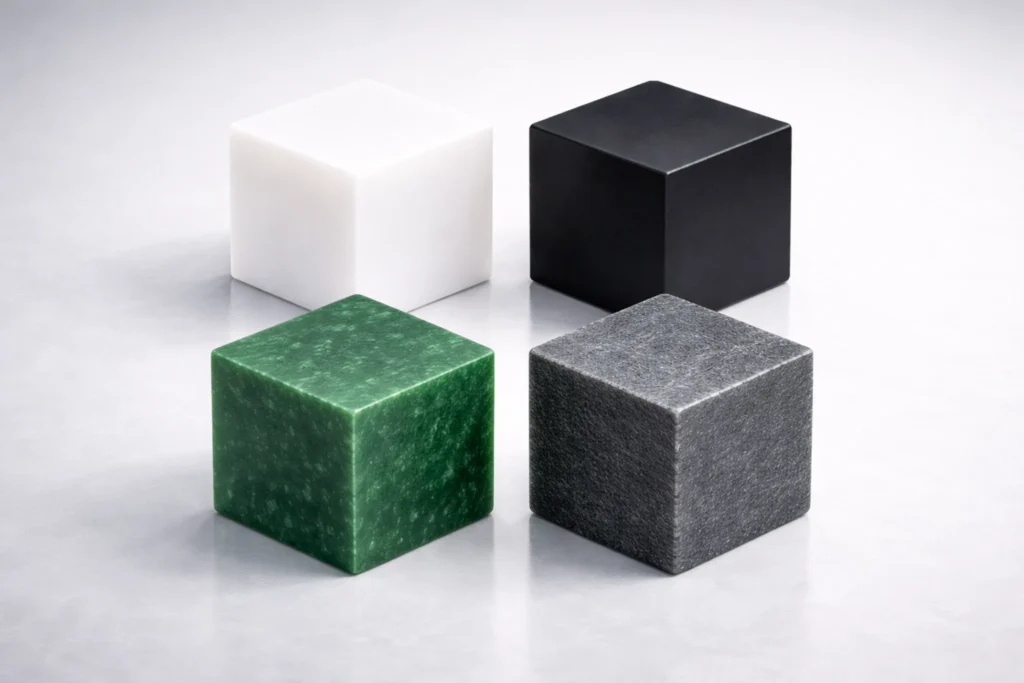
Selecting the correct grade is critical for balancing performance requirements against project budget.
Virgin UHMW
- Composition: 100% pure molecular chains with zero additives or regrind.
- Best For: Applications requiring maximum impact strength and purity.
- Key Benefit: Highest possible physical properties and consistent performance.
- Color: Natural (Opaque White).
Reprocessed UHMW
- Composition: A blend of virgin and recycled (regrind) UHMW.
- Best For: Low-cost industrial wear strips, chute liners, and non-critical components.
- Key Benefit: 30-40% lower cost than virgin while maintaining ~90% of the abrasion resistance.
- Color: Usually Black or Green (mottled).
Black (UV-Stabilized) UHMW
- Composition: Virgin or reprocessed resin infused with carbon black additives.
- Best For: Outdoor marine dock fenders, snowplow blades, and agriculture equipment.
- Key Benefit: Prevents UV degradation and embrittlement from direct sunlight exposure.
Glass-Filled UHMW
- Composition: Reinforced with 10-25% glass fibers.
- Best For: Structural parts requiring higher dimensional stability and stiffness.
- Key Benefit: Significantly reduces “cold flow” (deformation under load) compared to standard grades.
Anti-Static & Conductive UHMW
- Composition: Impregnated with conductive carbon particles.
- Best For: Electronics assembly lines, grain elevators, and explosive environments.
- Key Benefit: Safely dissipates static electricity to prevent spark-induced fires or equipment damage.
FDA & Food-Grade UHMW
- Composition: Specifically certified virgin material (FDA 21 CFR 177.1520).
- Best For: Meat processing tables, bottling star wheels, and food packaging.
- Key Benefit: Non-toxic, non-porous, and resistant to harsh cleaning chemicals.
- Note: Reprocessed grade is NEVER food safe.
UHMW vs Other Plastics (Quick Comparisons)
Engineers often mistake UHMW for other common thermoplastics. Use this comparison matrix to select the material that matches your mechanical load and environment.
| Feature | UHMW | HDPE | PTFE (Teflon) | Nylon (PA6) | Acetal (Delrin) |
| Primary Strength | Impact/Abrasion | Cost/Formability | Heat/Chemical | Load Bearing | Precision/Rigidity |
| Friction Coeff. | 0.15 (Ultra-Low) | 0.25 (Moderate) | 0.05 (Lowest) | 0.28 (Moderate) | 0.20 (Low) |
| Moisture Abs. | <0.01% | <0.01% | <0.01% | 7.0% (High) | 0.20% (Low) |
| Max Temp | 180°F | 160°F | 500°F | 210°F | 180°F |
HDPE vs UHMW
- The Difference: Molecular weight. UHMW has 10x the chain length of HDPE.
- When to Choose UHMW: When the part faces high-speed sliding or heavy impact.
- When to Choose HDPE: For simple containers, piping, or light-duty spacers where cost is the primary driver.
- The Difference: PTFE (Teflon) handles 2.5x more heat but is “soft” and deforms under load.
- When to Choose UHMW: When you need mechanical durability. PTFE will wear out quickly in abrasive environments where UHMW thrives.
- When to Choose PTFE: Only if temperatures exceed 200°F or for extreme chemical immersion.
Nylon vs UHMW
- The Difference: Nylon is significantly stiffer but absorbs water, causing it to swell and lose dimensional accuracy.
- When to Choose UHMW: For wet environments or subsea parts.
- When to Choose Nylon: For gears or bearings that must carry heavy static loads without “cold flowing” (creeping).
- The Difference: Acetal is the “bridge” between Nylon and UHMW. It is rigid like Nylon but more moisture-stable.
- When to Choose UHMW: For extreme impact and high-wear liners.
- When to Choose Acetal: For close-tolerance CNC parts (like small gears or valves) where precision dimensions are more important than impact strength.
Common UHMW Applications by Industry
UHMW is the primary choice for any application where sliding friction destroys metal or other plastics.
Conveyor Systems & Wear Strips
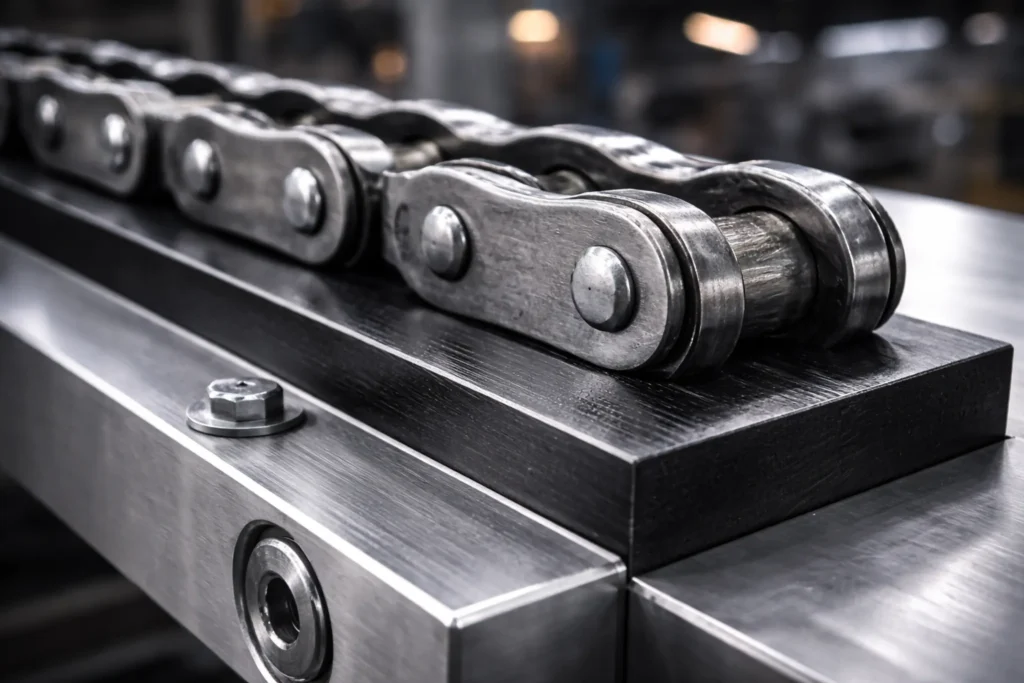
- Application: Guide rails, wear strips, and chain beds.
- Value: Eliminates the need for grease. Its self-lubricating nature reduces motor drag and energy consumption by up to 20%.
Chute & Hopper Liners
- Application: Heavy-duty liners for coal, gravel, and grain.
- Value: Prevents “bridging” (material sticking). Its 15:1 abrasion resistance over steel ensures the hopper structure outlasts the equipment’s lifespan.
Marine & Dock Fenders
- Application: Fenders, pilings, and dock face plates.
- Value: Impervious to salt water and marine borers. UV-stabilized grades provide 20+ years of maintenance-free service in direct sunlight.
Food Processing Equipment
- Application: Meat cutting boards, scrapers, and mixing paddles.
- Value: FDA-compliant and non-porous. It does not harbor bacteria and withstands aggressive high-pressure steam cleaning and sanitizers.
Medical & Orthopedic Implants
- Application: Artificial hip and knee joint replacements.
- Value: Medical-grade UHMW is biocompatible and has the lowest wear rate of any orthopedic material, significantly extending the life of the implant.
Packaging & Bottling Lines
- Application: Star wheels, timing screws, and diverter arms.
- Value: High-speed impact absorption reduces noise levels in bottling plants and prevents glass breakage or container damage.
Snowplow & Outdoor Equipment
- Application: Snowplow cutting edges, salt spreader discs, and skid shoes.
- Value: Unlike steel, UHMW does not damage decorative pavement or driveways and resists freezing, preventing “ice-clumping” on the blade.
Advantages of UHMW
UHMW provides a unique combination of physical and chemical properties that make it the cost-performance leader for high-wear industrial applications.
- Extreme Impact Strength: It has the highest impact resistance of any thermoplastic; it absorbs massive energy without cracking, even at cryogenic temperatures.
- Zero Moisture Absorption: With a rate of <0.01%, UHMW does not swell or degrade in water, ensuring permanent dimensional stability in marine or subsea environments.
- Superior Slide Properties: Its self-lubricating surface (coefficient of friction 0.10–0.22) eliminates the need for grease, reducing maintenance and contamination risks.
- Exceptional Wear Life: In sliding abrasion tests, UHMW outlasts carbon steel by a factor of 15-to-1, significantly extending equipment service life.
- Chemical Inertness: It is highly resistant to corrosive chemicals, concentrated acids, and alkalis, making it ideal for harsh processing environments.
- Noise Reduction: The material’s high vibration-damping capacity lowers decibel levels in high-speed bottling and packaging lines.
- Lightweight Efficiency: At roughly 1/8th the weight of steel, it reduces the power required to move mechanical parts and simplifies manual handling during installation.
Limitations of UHMW
While UHMW is an industrial powerhouse, it has specific physical thresholds. Ignoring these limitations leads to mechanical failure, particularly in high-heat or high-precision environments.
Low Heat Tolerance
- The Limit: Maximum continuous service temperature is 180°F (82°C).
- The Risk: Beyond this point, UHMW loses its crystalline structure, leading to rapid softening and structural deformation.
- Pro-Tip: If your environment exceeds 200°F, you must switch to PTFE or PEEK.
Poor Adhesion & Bonding
- The Limit: UHMW is chemically inert with near-zero surface energy.
- The Risk: Standard industrial glues, epoxies, and paints will not stick to it.
- Pro-Tip: Use mechanical fasteners (bolts, screws) or specialized Corona/Flame treatment if bonding is mandatory.
UV Sensitivity (Unless Stabilized)
- The Limit: Natural (white) UHMW is susceptible to photo-oxidation.
- The Risk: Long-term exposure to direct sunlight causes surface yellowing, brittleness, and eventual cracking.
- Pro-Tip: Always specify Black (UV-Stabilized) grades for any outdoor or marine application.
Dimensional Expansion Issues
- The Limit: High Coefficient of Linear Thermal Expansion (approx.1.1×10-4 in/in/°F).
- The Risk: UHMW expands and contracts significantly more than steel. Large sheets can buckle or “oil-can” if constrained too tightly.
- Pro-Tip: Use slotted mounting holes and allow for 1/8″ of clearance per 12″ of material length to accommodate thermal movement.
Machining & Fabrication of UHMW
UHMW requires specific machining techniques due to its low melting point and high thermal expansion. Standard metalworking speeds will cause the material to melt rather than cut.
CNC Machining Characteristics
- Tooling: Use high-speed steel (HSS) or carbide tools with sharp, high-positive rake angles. Dull tools cause “fuzzing” rather than clean chips.
- Feeds & Speeds: Run at high feed rates and moderate spindle speeds to dissipate heat into the chip.
- Coolant: Compressed air is preferred. If using liquids, avoid high-oil content fluids which can stain some grades.
Welding Methods
- Technique: Only Hot Air Welding or Butt Fusion (Mirror Welding) are effective.
- Constraint: Because of its high molecular weight, UHMW does not “flow” like HDPE. It reaches a “gel state” rather than melting into a liquid, making standard extrusion welding difficult.
- Pro-Tip: Mechanical fastening is 90% more reliable than welding for structural UHMW joints.
Thermal Expansion Considerations
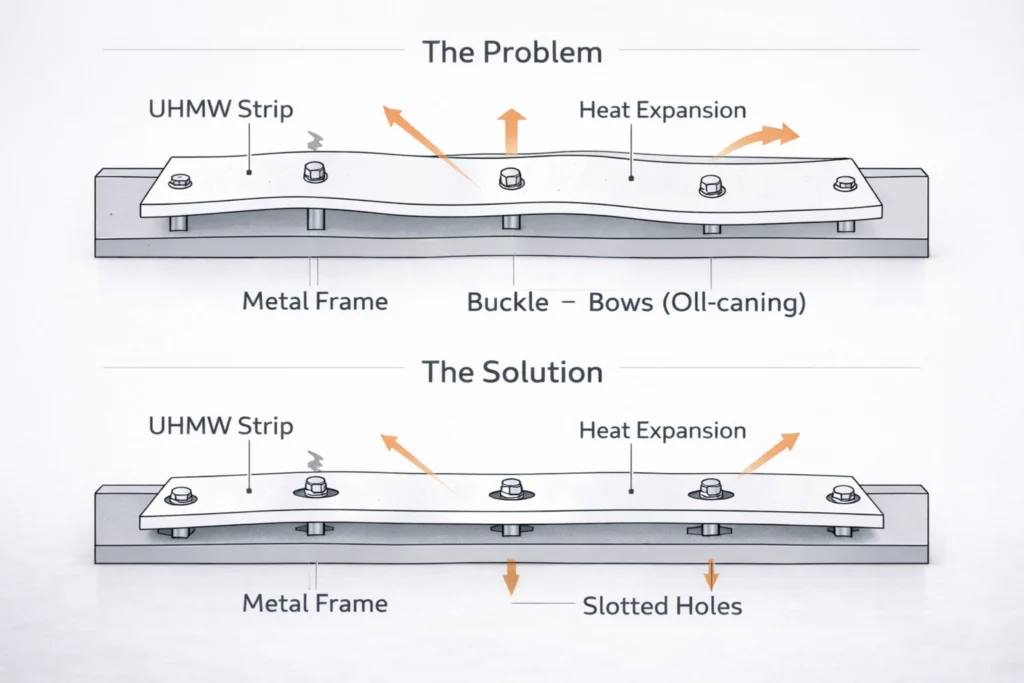
- The Math: UHMW expands 5x more than steel. A 10-foot rail can grow by 1/2 inch with a 40°F temperature shift.
- The Fix: Always use slotted mounting holes. Never “trap” a long UHMW wear strip between two fixed points, or it will buckle (oil-can) within 24 hours of a temperature change.
Surface Finish Limitations
- Expectation: You cannot achieve a “mirror finish” on UHMW. Its naturally waxy surface always retains a slight matte texture after machining.
- Burr Removal: UHMW is prone to heavy burring. Use specialized deburring tools or a sharp razor; sanding is ineffective as it simply “smears” the plastic.
Is UHMW Food Safe?
Yes. Natural (Virgin) UHMW is one of the most widely used plastics in the food and beverage industry due to its chemical purity and non-porous surface.
FDA Compliance
- Standard: Virgin UHMW meets FDA 21 CFR 177.1520 regulations.
- Safety: It is chemically inert, meaning it will not leach odors, tastes, or toxins into food products.
- Warning: Reprocessed (Recycled) UHMW is not FDA compliant and should never touch food.
USDA Approval
- Scope: Specifically approved for use in federally inspected meat and poultry plants.
- Durability: It withstands aggressive “wash-down” cycles using high-pressure steam and caustic sanitizers without degrading or absorbing moisture.
Hygienic Design Considerations
- Surface: Its non-stick properties prevent food buildup, reducing the risk of bacterial colonies (biofilms).
- Staining: While chemically resistant, UHMW can be physically “scratched” by metal knives. Over time, these micro-scratches can harbor debris.
- Maintenance: Replace cutting surfaces or wear components if deep grooving occurs to maintain sanitary standards.
Cost & Availability
UHMW is one of the most cost-effective engineering plastics (Glass Filled Nylon, PC-ABS)on the market, offering high performance-to-price ratios for wear-heavy industrial environments.
Sheet & Rod Pricing Factors
- Grade Impact: Virgin UHMW carries a premium; Reprocessed (Recycled) grades are typically 30–40% cheaper and ideal for non-food industrial liners.
- Volume: Standard 4′ x 10′ sheets and 10′ rods are the most economical. Custom small-lot orders often incur significant “cut-to-size” fees.
- Color: Natural (White) and Reprocessed (Black/Green) are stock items. Specialty colors or high-performance fillers (MoS2, Oil, Glass) increase costs by 20–50%.
Thickness & Custom Fabrication Costs
- Raw Material: Prices scale linearly by weight. A 1″ sheet costs approximately double a 1/2″ sheet.
- Fabrication: While the material is inexpensive, CNC machining time is the primary cost driver. Simple rectangular wear strips are cheap; complex star wheels or gears require high-precision labor.
- Tolerance: Specifying tighter-than-standard tolerances (e.g., ±.005″) significantly increases fabrication time and scrap rates.
Life-Cycle Cost vs Metal Alternatives
- Initial Cost: UHMW is often cheaper than Stainless Steel or Bronze but more expensive than basic Carbon Steel.
- Maintenance Savings: Because it is self-lubricating, you save thousands in grease and manual labor over the equipment’s life.
- Down-Time Reduction: With a 15:1 wear ratio over steel in sliding applications, UHMW reduces machine teardowns, making its Total Cost of Ownership (TCO) the lowest in the industry for abrasive environments.
Frequently Asked Questions About UHMW
Is UHMW stronger than steel?
No, in terms of tensile strength. However, UHMW is superior to steel in impact energy absorption and sliding abrasion resistance. It will not dent or crack under blows that would deform or fracture carbon steel.
What is the maximum temperature for UHMW?
The absolute maximum continuous service temperature is 180°F (82°C). Brief intermittent exposure up to 200°F (93°C) is possible, but the material will lose structural integrity and “melt” rapidly beyond these points.
Does UHMW absorb water?
No. UHMW has a moisture absorption rate of <0.01%. It is virtually waterproof, ensuring it remains dimensionally stable and does not rot, swell, or degrade when permanently submerged in fresh or salt water.
Is UHMW UV resistant?
Natural (White) UHMW is not. Standard grades will yellow and become brittle under sunlight. For outdoor use, you must specify Black UV-Stabilized UHMW, which contains carbon black to prevent molecular breakdown from UV radiation.
Can UHMW be glued?
Effectively, no. Because of its extremely low surface energy (waxy surface), standard industrial adhesives and epoxies will not bond to UHMW. Assembly requires mechanical fasteners (bolts/screws) or specialized, expensive surface etching treatments.
How long does UHMW last?
In abrasive sliding applications, UHMW typically lasts 10 to 15 times longer than carbon steel. Its lifespan depends on the friction speed and load, but as a wear liner, it often provides 10+ years of maintenance-free service.
Final Verdict: Is UHMW the Right Material for Your Application?
UHMW is the undisputed industry standard for extreme impact and sliding wear. To finalize your decision, use this definitive “Go/No-Go” matrix:
| CHOOSE UHMW IF… | AVOID UHMW IF… |
| You need zero-maintenance lubrication. | Continuous heat exceeds 180°F (82°C). |
| The part faces sand, grit, or gravel abrasion. | You require high-precision (±.001″) tolerances. |
| You are lining chutes, hoppers, or truck beds. | The part must support a heavy static load (creep). |
| The environment is sub-zero or cryogenic. | You need to glue or paint the surface. |
| You require FDA/USDA food safety compliance. | The part is structural and must be ultra-rigid. |
Summary: If your project demands a material that is tougher than steel in impact, slicker than Nylon in friction, and completely waterproof, UHMW is your winner. For high-heat or high-load structural precision, consider PTFE or Acetal instead.

Usama Ayub is the founder of PlasticSpec and a polymer manufacturing engineer with eight years of hands-on industrial experience in PET, PA6, and PA66 fiber and filament yarn production. He writes material property and selection guides for Delrin, Nylon, PEEK, PTFE, UHMW, Polycarbonate, and ABS.
Pingback: Delrin (Acetal) | Properties, Grades and How to Decide