
3D Printing ABS for Prototyping: When to Move to Injection Molding or CNC
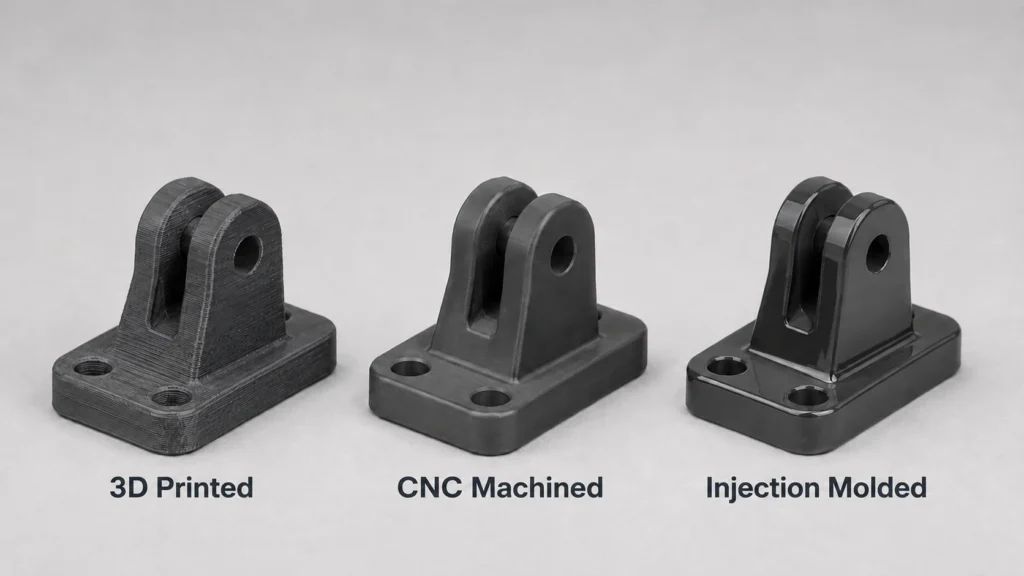
FDM-printed ABS is not the same material as CNC-machined or injection-molded ABS, same resin, different mechanical behavior. If your prototype needs to validate more than fit and form printing it can quietly mislead you.
This guide breaks down exactly where FDM ABS falls short, and gives you a clear framework for when to move to CNC or injection molding.
Why FDM-Printed ABS Doesn’t Match Production-Grade ABS
Layer Adhesion and Anisotropic Strength
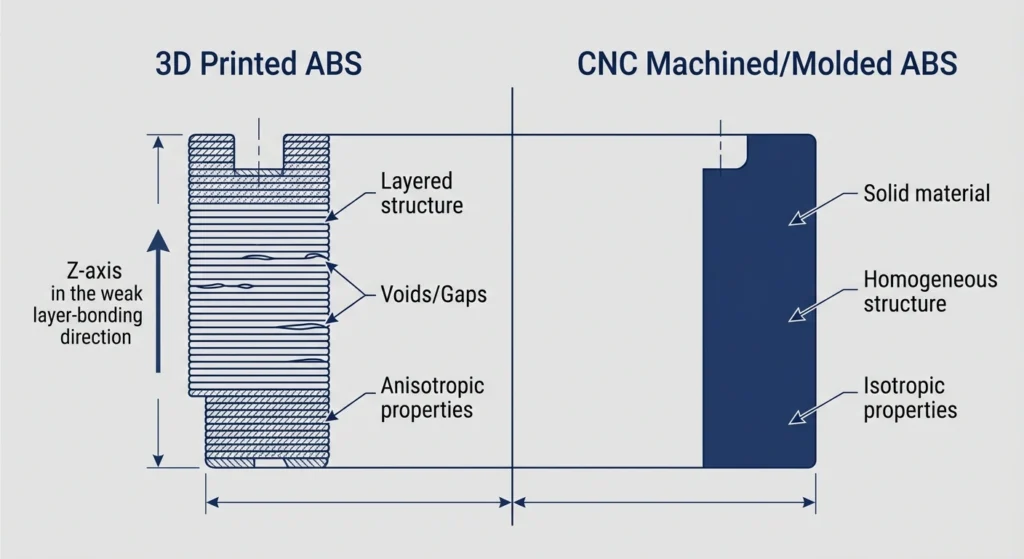
- FDM parts are built layer by layer, bonding between layers (Z-axis) is weaker than bonding within a layer (XY-axis).
- This creates directional weakness that doesn’t exist in molded or machined parts, which are mechanically uniform in every direction.
- A part that passes a load test in one orientation can fail the same load applied along the Z-axis.
Print Porosity vs. Solid Material Density
- Standard FDM infill leaves internal voids even “high infill” settings don’t produce fully dense material.
- CNC-machined and injection-molded ABS are fully dense, with no internal gaps affecting strength or fatigue life.
- This is the biggest hidden gap between prototype and production performance, porosity doesn’t show up on a caliper check.
Surface Finish and Dimensional Tolerance Gaps
- Typical FDM tolerance: ±0.2–0.5 mm, depending on printer calibration and part geometry.
- CNC and injection molding routinely hold ±0.05–0.1 mm.
- A prototype that “fits” at FDM tolerances may not fit once toleranced parts are machined or molded this is a common source of late-stage assembly surprises.
FDM ABS vs. CNC-Machined ABS vs. Injection-Molded ABS — Property Comparison
Comparison Table
| Property | FDM-Printed ABS | CNC-Machined ABS | Injection-Molded ABS |
| Tensile strength (relative) | Lowest, direction-dependent | Full bulk material strength | Full bulk material strength |
| Dimensional tolerance | ±0.2–0.5 mm | ±0.05–0.1 mm | ±0.05–0.1 mm (tooling-dependent) |
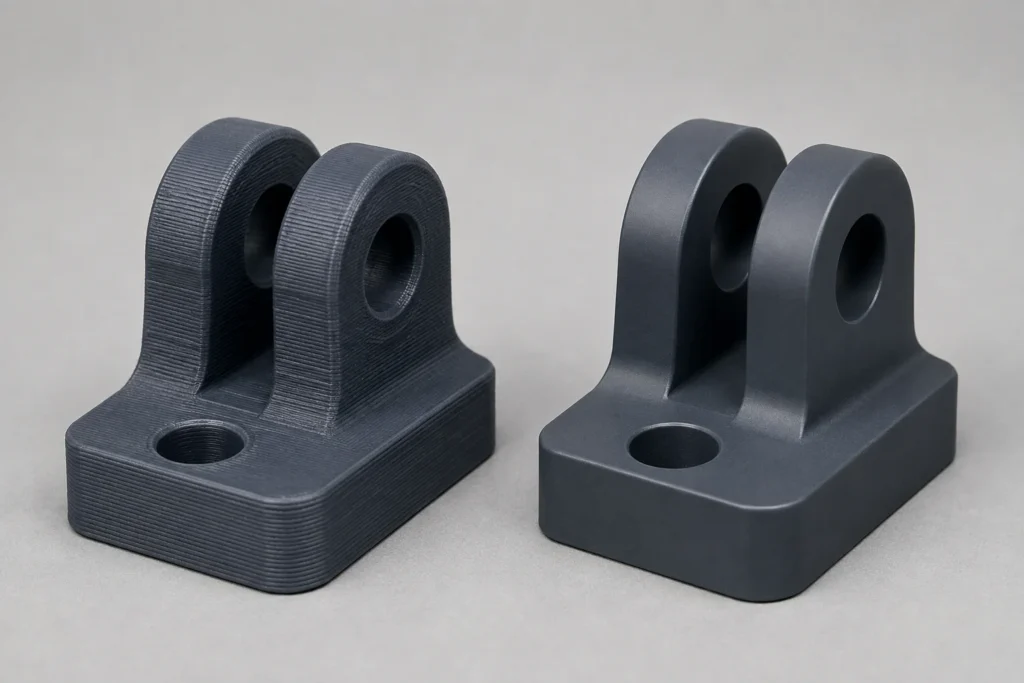
| Surface finish | Visible layer lines | Smooth, machined finish | Smooth, mold-finish dependent |
| Isotropic strength | No | Yes | Yes |
| Best for | Form/fit checks, early iteration | Functional prototypes, low volume | Production volume |
What the Data Means for Functional Testing
- A part that survives handling and basic fit-checks as an FDM print has not been validated for real mechanical load, the material behind it isn’t the material you’ll ship.
- If your test plan includes drop testing, load bearing, or fatigue cycling, run that testing on CNC-machined or molded samples, not FDM prints otherwise you’re validating the wrong material.
5 Signs Your ABS Prototype Needs to Move Beyond FDM
- Part Will See Real Mechanical Load or Fatigue Cycling: directional weakness and porosity make FDM results unreliable here.
- Tight Tolerances or Assembly Fit Requirements: if mating parts need to hold ±0.1 mm or tighter, FDM can’t get you there.
- Part Needs Isotropic Strength (No Directional Weak Points): any application where load direction isn’t predictable or controlled.
- Surface Finish or Cosmetic Requirements: visible layer lines aren’t acceptable for customer-facing or sealing surfaces.
- You’re Moving Toward Volume Production: FDM doesn’t scale economically past very low unit counts.
Decision Framework — FDM vs. CNC vs. Injection Molding
Quick-Reference Decision Table
| Situation | Recommended Method |
| Early concept, form/fit check only | FDM printing |
| Functional test, 1–50 units | CNC machining |
| Cosmetic/consumer-facing prototype | CNC machining |
| Production volume 500+ units | Injection molding |
| Tight tolerance + moderate volume | CNC machining (bridge production) |
CNC Machining ABS — What Changes From FDM Prototyping
Moving from a printed prototype to a machined part changes your tolerance, strength, and finish baseline immediately, full process details, speeds/feeds, and tooling notes are covered in our [Machining ABS Plastic guide]. At the decision level, here’s what matters:
- Tolerances tighten from FDM’s ±0.2–0.5 mm down to ±0.05–0.1 mm, design your fits accordingly.
- Cost per part sits higher than FDM at very low volumes but stays relatively flat as quantity increases, unlike injection molding’s steep upfront tooling cost.
- Lead time is longer than FDM (days vs. hours) but far shorter than injection molding tooling lead times.
Injection Molding ABS — When Tooling Cost Makes Sense
Once volume and design finality justify tooling investment, injection molding becomes the economical choice, for full process depth, DFM guidelines, and tooling considerations, see our [ABS Plastic Injection Molding guide]. At the decision level:
Break-Even Volume — Tooling Cost vs. Per-Part Savings
- Tooling cost is the dominant expense at low volume; per-part cost drops sharply as volume rises.
- The break-even point where molding beats CNC on total cost depends on part complexity and tooling design, but generally falls in the low-hundreds-to-thousands unit range.
Design-for-Manufacturability Changes Needed From a Printed Prototype
- Draft angles: FDM parts often have none; molds require them for part ejection.
- Wall thickness uniformity: printed prototypes frequently have inconsistent walls that will cause sink marks or warping when molded.
- Tool access: undercuts and internal geometry that print fine may not be moldable without added tooling complexity or cost.
Cost and Lead Time Comparison Across All Three Methods
Comparison Table
| Method | Tooling Cost | Cost per Part (low volume) | Cost per Part (high volume) | Typical Lead Time |
| FDM printing | None | Low | Low (doesn’t scale down) | Hours–days |
| CNC machining | None | Moderate–high | Moderate (stays flat-ish) | Days |
| Injection molding | High (tooling) | Very high (amortized) | Very low | Weeks (tooling) then fast |
Common Mistakes When Transitioning From FDM Prototype to Production
Assuming FDM Test Results Predict Molded/Machined Part Performance
A part that passed testing as an FDM print can still fail in production material, porosity and anisotropic strength mean the two aren’t mechanically equivalent.
Not Redesigning for the New Process
Draft angles, wall thickness, and tool access requirements are specific to molding and machining a design that printed successfully often isn’t moldable or machine able as-is without changes.
Skipping a Bridge Production Run
- Jumping straight from FDM prototype to full injection-mold tooling skips a validation step.
- Using CNC-machined parts as an interim “bridge” production run lets you validate production-equivalent material and fit before committing to tooling cost.
FAQ
Can I Use My FDM Prototype Design Directly for Injection Molding?
Not usually. FDM designs typically lack draft angles and consistent wall thickness that injection molding requires, expect a design-for-manufacturability pass before tooling.
How Much Stronger Is CNC-Machined ABS Than 3D-Printed ABS?
CNC-machined ABS is fully dense and isotropic, so it reaches the material’s full bulk strength in every direction. FDM parts are weaker along the layer (Z) axis due to layer adhesion limits and internal porosity.
What Volume Justifies Injection Molding Over CNC Machining?
It depends on part complexity and tooling cost, but injection molding generally becomes more economical than CNC machining once volume reaches the low hundreds to thousands of units, since tooling cost amortizes across a larger unit count.

Usama Ayub is the founder of PlasticSpec and a polymer manufacturing engineer with eight years of hands-on industrial experience in PET, PA6, and PA66 fiber and filament yarn production. He writes material property and selection guides for Delrin, Nylon, PEEK, PTFE, UHMW, Polycarbonate, and ABS.