
Delrin vs Teflon: Friction, Strength, Temperature, and Machining Differences
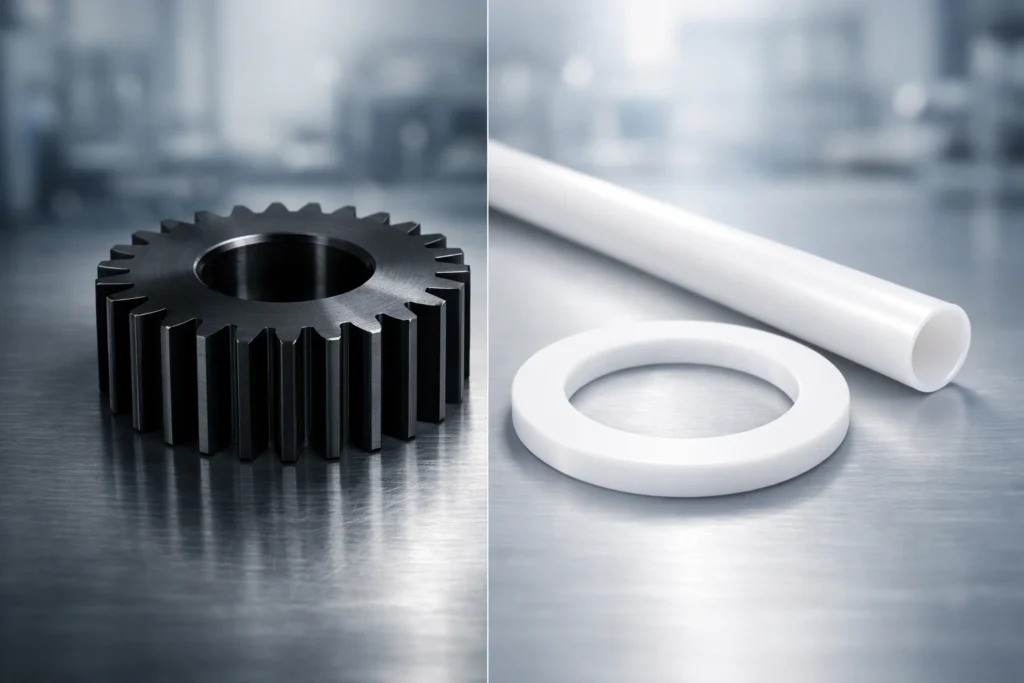
Quick Answer: When to Choose Delrin vs Teflon
Choose Delrin (POM) if your application requires mechanical strength, rigidity, and precision. It is the industry standard for gears, high-load bearings, and parts that must hold tight tolerances.
Choose Teflon (PTFE) if you need extreme heat resistance or chemical inertness. It is the superior choice for seals exposed to corrosive acids, and environments reaching up to 260°C (500°F).
| Feature | Winner for Strength | Winner for Low Friction | Winner for Heat |
| Material | Delrin (POM) | Teflon (PTFE) | Teflon (PTFE) |
| Key Reason | High tensile strength & stiffness. | Lowest friction of any solid. | Stable up to 260°C. |
Delrin vs Teflon: Key Differences at a Glance
The following data represents standard grades for both materials. Use this table to immediately identify the performance ceiling of each polymer.
| Property | Delrin (POM-H) | Teflon (PTFE) | Engineering Impact |
| Tensile Strength | 9,500 – 10,000 psi | 2,500 – 4,000 psi | Delrin is 3x stronger under load. |
| Coefficient of Friction | 0.20 (Static) | 0.04 (Static) | Teflon is the “gold standard” for slip. |
| Max Service Temp | 185°F (85°C) | 500°F (260°C) | Teflon handles extreme heat environments. |
| Water Absorption | 0.22% (Low) | <0.01% (Zero) | Teflon is superior for submerged parts. |
| Flexural Modulus | 420,000 psi | 72,000 psi | Delrin is significantly stiffer/more rigid. |
| Chemical Resistance | Good (Sensitive to Acids) | Excellent (Inert) | Teflon survives almost all chemicals. |
| FDA Compliant | Yes (Select Grades) | Yes (Broadly) | Both are safe for food-contact use. |
Already know which material your application requires? Get Delrin (POM) or PTFE parts machined to your exact specifications — instant online quote, no phone calls, no minimum order quantity.
Material Overview
What Is Delrin (POM)?
Delrin is the brand name for Polyoxymethylene (POM) homopolymer, a high-crystalline engineering plastic. Often referred to as “Plastic Metal,” it was designed specifically to replace zinc, brass, and aluminum in precision components.
- Composition: A formaldehyde-based polymer with a highly uniform crystalline structure.
- Key Identification: Known for its high stiffness, low moisture absorption, and excellent dimensional stability.
- Common Grades: Delrin 150 (Standard Extrusion), Delrin 100 (High Toughness), and Delrin 500 (General Purpose).
- Primary Value: It maintains its shape and mechanical properties under constant stress and fatigue.
What Is Teflon (PTFE)?
Teflon is the brand name for Polytetrafluoroethylene (PTFE), a synthetic fluoropolymer. It is world-renowned for being one of the most chemically inert and thermally stable materials in existence.
- Composition: A carbon-fluorine based polymer. The carbon-fluorine bond is one of the strongest in organic chemistry, making it nearly impossible for other molecules to react with it.
- Key Identification: Known for its extreme slipperiness (ultra-low friction), high heat threshold, and universal chemical resistance.
- Common Grades: Virgin PTFE (Purest form, FDA compliant), Mechanical Grade (Regrind for non-critical parts), and Glass-Filled (Added for wear resistance).
- Primary Value: It provides a “permanent” non-stick surface and acts as a fail-safe in corrosive or high-temperature environments where other plastics melt or dissolve.
Mechanical Strength Comparison
Tensile Strength
Tensile strength measures a material’s resistance to being pulled apart.
- Delrin (POM): Boasts a high tensile strength of approximately 10,000 psi (69 MPa). It behaves like metal, stretching very little before reaching its yield point.
- Teflon (PTFE): Significanty weaker, typically ranging between 2,500 – 4,000 psi (17-28 MPa).
Impact Resistance
This determines how well a material absorbs energy during a sudden blow without cracking.
- Delrin: Exceptional. It has high “toughness,” meaning it can withstand repeated impacts (e.g., in a conveyor belt gear) without shattering.
- Teflon: While Teflon doesn’t “shatter” (it is too soft), it deforms easily. An impact that Delrin would bounce back from will leave a permanent dent or “bruise” in Teflon.
Load-Bearing Capability
Load-bearing relates to “Creep” (the tendency of a solid material to move slowly or deform permanently under the influence of persistent mechanical stresses).
- Delrin: Features excellent creep resistance. It can hold a heavy load for long periods without losing its original shape, making it ideal for bushings and threaded fasteners.
- Teflon: Highly susceptible to “Cold Flow.” Even at room temperature, if you put a heavy weight on Teflon, it will eventually “ooze” or flatten out.
Friction and Wear Performance
Coefficient of Friction
The Coefficient of Friction (COF) indicates how much force is required to move one surface over another. Lower numbers represent higher “slipperiness.”
- Teflon (PTFE): Boasts the lowest COF of almost any solid material, typically between 0.05 and 0.10. Under specific high-load conditions, it can drop as low as 0.04, making it nearly as slick as ice on ice.
- Delrin (POM): Offers a very low COF compared to most plastics, usually 0.20 to 0.25 but it cannot match Teflon’s extreme lubricity.
Dry-Running Wear Resistance
Dry-running refers to components that must operate without external grease or oil. Both materials are self-lubricating, but they fail in different ways.
- Delrin: Excels in high-cycle, dry-running environments because of its hardness. It resists abrasion and maintains its shape even after millions of cycles, making it the standard for high-speed gears and rollers.
- Teflon: While incredibly slick, pure Teflon has poor wear resistance in high-load dry conditions. It is soft and can be “scraped” away by a rougher counter-surface.
Sliding Applications
Choosing the right material depends on the PV (Pressure-Velocity) limit of your assembly.
- Choose Delrin for:
- High-Load/High-Speed: Precision gears, conveyor rollers, and heavy-duty bushings.
- Dimensional Integrity: Parts that must slide but also keep a precise fit.
- Choose Teflon for:
- Low-Load/Extreme Slip: Non-stick guide rails, chemical valve seats, and seals that cannot tolerate any “drag”.
- Silent Operation: Teflon is often used to eliminate the “squeak” in sliding assemblies where Delrin might produce more noise.
Temperature Resistance
Maximum Continuous Service Temperature
This metric defines the highest temperature at which a material can operate indefinitely without losing its mechanical properties.
- Teflon (PTFE): 500°F (260°C). Teflon is an industry outlier. It maintains its stability and non-stick properties from cryogenic temperatures (-400°F) up to its extreme ceiling of 500°F.
- Delrin (POM): 185°F to 212°F (85°C to 100°C). Delrin’s structural integrity begins to degrade rapidly above boiling point. If your environment exceeds 212°F, Delrin will soften, lose its “spring-like” quality, and eventually fail.
Thermal Expansion Behavior
How much does the part grow or shrink as the temperature changes?
- Delrin: Features a moderate Coefficient of Linear Thermal Expansion (CLTE). Because it is a rigid crystalline plastic, it holds its dimensions relatively well within its operating range, but it is sensitive to moisture-induced swelling.
- Teflon: Has a high rate of thermal expansion. It expands and contracts significantly more than Delrin. This makes it difficult to maintain tight tolerances in assemblies that experience wide temperature swings.
- Engineering Rule: If you need a part to stay the exact same size while the temperature fluctuates between 50°F and 150°F, Delrin is more reliable.
Performance in High-Heat Environments
The “Failure Mode” of each material is distinct:
- Teflon in High Heat: Remains chemically stable. It does not ignite easily and does not release toxic fumes until it reaches approximately 400°C (750°F). It is the preferred choice for fire-safe or high-purity heat applications.
- Delrin in High Heat: Since it is formaldehyde-based, overheating Delrin can cause it to “outgas” formaldehyde vapors, which are acrid and hazardous.
Chemical Resistance
Resistance to Fuels and Oils
Both materials perform exceptionally well in petroleum-based environments, but for different reasons.
- Delrin (POM): Highly resistant to gasoline, diesel, and motor oils. It is a top choice for automotive fuel system components because it does not swell when exposed to hydrocarbons.
- Teflon (PTFE): Impervious to all fuels and lubricants. It provides an extra layer of safety in high-performance racing or aerospace fuel lines where zero degradation is mandatory.
Resistance to Acids and Solvents
This is where the materials diverge sharply. Using the wrong one here leads to immediate part failure.
- Teflon: Virtually universally resistant. It is unaffected by strong acids (Nitric, Sulfuric), bases, and aggressive solvents. Only molten alkali metals and elemental fluorine can attack it.
- Delrin: Vulnerable to strong acids (pH < 4) and oxidizing agents. Exposure to even mild mineral acids will cause Delrin to “chalk” and lose structural integrity. It handles many solvents and neutral chemicals well but fails in acidic environments.
Outdoor and UV Stability
Long-term exposure to sunlight (UV radiation) can make plastics brittle or cause them to “yellow.”
- Teflon: Naturally UV stable. It can remain outdoors for decades without losing its mechanical properties or changing color. It does not require UV stabilizers.
- Delrin: Standard Delrin is sensitive to UV light. Prolonged outdoor exposure will cause “crazing” (surface cracking) and brittleness.
Machining and Manufacturing
CNC Machining Behavior
The way these plastics respond to cutting tools determines lead times and tool wear.
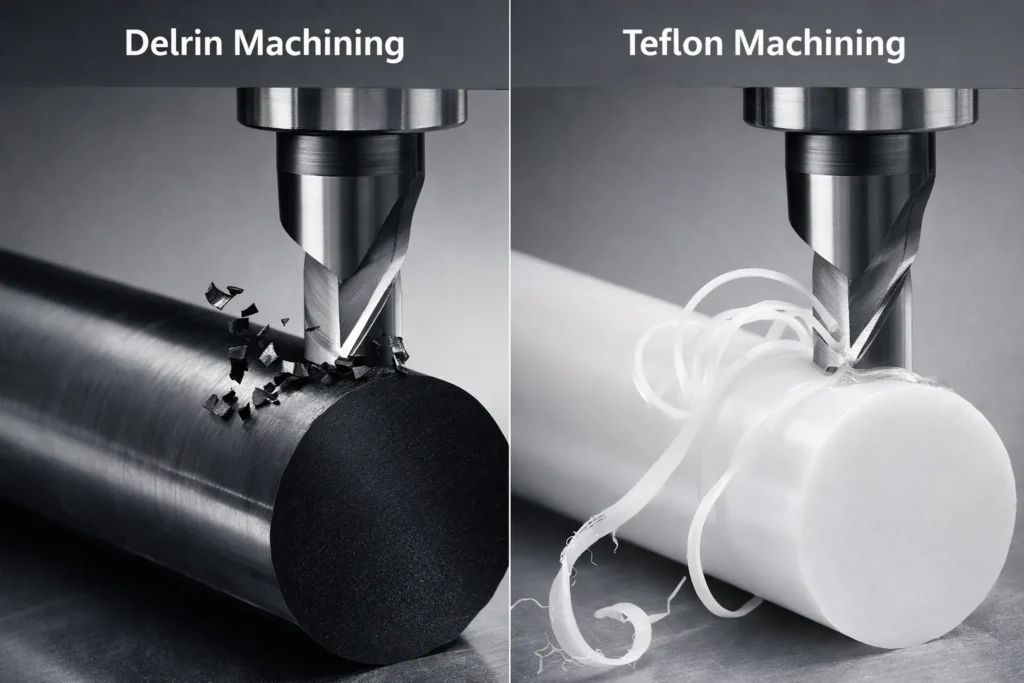
- Delrin (The Favorite): Known for its superior machinability. It produces small, brittle chips that clear the cutting zone easily, preventing “bird-nesting.” It allows for high spindle speeds and aggressive feed rates without melting.
- Teflon (The Challenge): Extremely soft and “gummy.” It produces long, continuous stringy chips that can wrap around the spindle. Because it is a thermal insulator, heat builds up at the tool tip, causing the material to smear or “gum up” if not cooled properly.
Dimensional Stability
This refers to a material’s ability to maintain its intended size after machining and during service.
- Delrin: Features excellent memory. Once machined to a dimension, it stays there. Its high stiffness allows for the creation of thin-walled parts and fine threads that won’t distort.
- Teflon: Prone to stress relaxation. Teflon “creeps” even at room temperature. If you clamp it too hard in a vise, it will deform; once released, it may not return to its original shape.
- Critical Comparison:
- Delrin: Achieves tolerances of ±0.001″ (0.025mm) easily.
- Teflon: Difficult to hold tighter than ±0.005″ without specialized fixtures and cooling.
Surface Finish Quality
The aesthetic and functional smoothness of the final part.
- Delrin: Naturally machines to a smooth, semi-matte finish. It can be polished to a high gloss or textured with bead blasting. Because it is hard, it doesn’t “burr” heavily, leading to cleaner edges.
- Teflon: Often results in a “fuzzy” or slightly torn surface if tools aren’t razor-sharp. While it is naturally slippery, the visual finish is usually duller and more prone to scratching during handling.
Typical Applications
Where Delrin Is Commonly Used
Delrin is the industry standard for high-performance mechanical parts that must maintain tight tolerances under physical stress.
- Precision Gears & Sprockets: Chosen for high fatigue resistance and quiet operation compared to metal gears.
- Bearings and Bushings: Ideal for high-load, low-speed applications where lubrication is difficult to maintain.
- Electrical Insulators: Used in connectors and housings due to its high dielectric strength and low moisture absorption.
- Automotive Components: Fuel sender units, door handle mechanisms, and window lift brackets.
- Consumer Goods: Zippers, guitar picks, and high-quality knife handles where “hand-feel” and durability matter.
Where Teflon Is Commonly Used
Teflon is reserved for “mission-critical” environments where high heat, aggressive chemicals, or absolute non-stick properties are required.
- Gaskets and Seals: Used in the oil, gas, and chemical industries because it will not degrade when exposed to corrosive fluids.
- Lab and Medical Equipment: Tubing, stopcocks, and manifolds that must remain chemically inert and withstand high-heat sterilization (autoclaves).
- Non-Stick Surfaces: Guide rails for food processing and conveyor liners where “stiction” must be zero.
- Aerospace & Defense: Wiring insulation (PTFE is a superior insulator at high altitudes) and hydraulic hose liners.
- Valve Seats: Used in ball valves to ensure a smooth, leak-proof turn even after years of inactivity.
Cost Comparison
Raw Material Cost
The cost of raw stock (sheets, rods, and tubes) varies significantly based on the polymer’s complexity and the brand name.
- Delrin (POM-H): Generally lower in price. It is a high-volume industrial plastic with efficient global production. Standard Delrin 100 and 150 or 500 grades provide the best “strength-to-dollar” ratio.
- Teflon (PTFE): Typically 2x to 4x more expensive than Delrin. The extraction and processing of fluoropolymers are more resource-intensive.
Manufacturing Cost
The “hidden” cost of a part is determined by how fast it can be machined and the rate of scrap.
- Delrin (High Efficiency):
- Machining Speed: Can be cut at much higher SFM (Surface Feet per Minute).
- Tool Life: Non-abrasive nature extends the life of cutting tools.
- Yield: Brittle chips make automated “lights-out” manufacturing possible, reducing labor costs.
- Teflon (Higher Overhead):
- Machining Speed: Requires slower speeds to prevent melting/smearing and “stringy” chip management.
- Setup: Often requires custom soft-jaws or fixtures to prevent deforming the part during clamping.
- Scrap Rate: Holding tight tolerances is harder, often leading to more rejected parts in high-precision runs.
Advantages and Limitations
Delrin Advantages and Limitations
Delrin (POM) is the “workhorse” of the mechanical world, but it has specific chemical and thermal vulnerabilities.
- Key Advantages:
- High Fatigue Endurance: Can withstand millions of load cycles without cracking.
- Excellent Spring-Back: Ideal for snap-fit assemblies and clips.
- Low Moisture Absorption: Maintains size and shape in humid environments.
- Superior Machinability: Allows for the most complex geometries and finest threads.
- Critical Limitations:
- Poor Acid Resistance: Rapidly degrades in even mild acidic environments (pH < 4).
- UV Sensitivity: Becomes brittle and “chalky” when exposed to direct sunlight (unless black grade).
- Flammability: Highly flammable and can release formaldehyde gas if melted.
Teflon Advantages and Limitations
Teflon (PTFE) is the “specialist” for extreme environments, but its mechanical softness is its primary drawback.
- Key Advantages:
- Broad Chemical Inertness: Unaffected by almost all industrial chemicals and solvents.
- Exceptional Thermal Ceiling: Remains stable from -400°F to +500°F.
- Universal Non-Stick: Prevents “stiction” and adhesive buildup in processing lines.
- High Dielectric Strength: Outstanding electrical insulator for high-frequency applications.
- Critical Limitations:
- Mechanical “Creep”: Deforms permanently under heavy static loads (Cold Flow).
- Low Wear Resistance: Pure Teflon can be easily abraded by rough counter-surfaces.
- Difficult to Bond: Almost nothing sticks to it, making it nearly impossible to use with standard industrial adhesives.
Can’t Choose? The Hybrid Solution: Delrin 100AF (PTFE-Filled Acetal)
In high-performance engineering, you often need Delrin’s structural rigidity combined with Teflon’s ultra-low friction. This is where standard grades fail, and Delrin 100AF becomes the “Master Piece” solution.
What is Delrin 100AF?
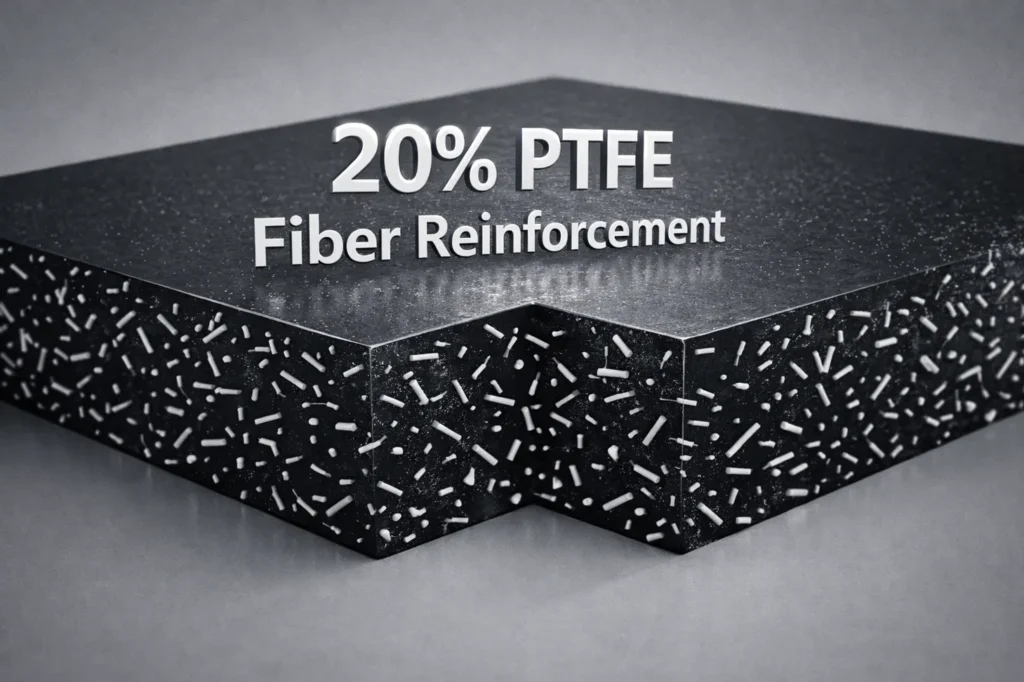
Delrin 100AF is a unique thermoplastic composite consisting of Delrin 100 resin uniformly dispersed with 20% PTFE (Teflon) fibers.
Unlike “internally lubricated” plastics that use silicone or oil, Delrin 100AF uses actual Teflon fibers locked into the acetal matrix. This creates a material that is structurally a homopolymer but tribologically a fluoropolymer.
Benefits of the Hybrid:
By combining these two powerhouses, Delrin 100AF eliminates the primary weaknesses of both individual materials:
- Eliminates “Stiction”: It provides the smooth, “slip-stick” free movement of Teflon without the “mushiness” or deformation.
- Higher PV Limits: It can handle higher Pressure-Velocity (PV) loads than pure Teflon, meaning it won’t melt or “smear” under high-speed friction.
- Dimensional Integrity: Unlike pure Teflon, 100AF maintains its shape under load and can be machined to precise tolerances.
- Self-Lubricating for Life: Because the PTFE fibers are distributed throughout the entire part, the lubricity never “wears off”—new Teflon fibers are exposed as the surface wears down.
When to Use It:
Delrin 100AF is the premium choice for specific mechanical “pain points” where standard plastics fail:
- High-Load Sliding Bearings: Where you need a bearing to support a heavy shaft but cannot use external grease.
- Precision Valve Components: Where a smooth, repeatable “click” or movement is required without any initial drag.
- Conveyor Wear Strips: In high-speed bottling or packaging lines where standard Delrin might “squeal” and Teflon would wear out too fast.
- Quiet Gears: When noise reduction is critical, the PTFE fibers dampen the mechanical vibration of gear teeth.
Frequently Asked Questions
Is Delrin stronger than Teflon?
Yes. Delrin is significantly stronger than Teflon. Delrin has a tensile strength of approximately 10,000 psi, whereas Teflon typically ranges between 2,500 and 4,000 psi. Delrin is a rigid, structural “plastic metal,” while Teflon is soft and prone to deforming under heavy loads (creep).
Which material has lower friction?
Teflon (PTFE) has the lower friction. With a coefficient of friction as low as 0.04, Teflon is one of the most slippery solid materials in existence. While Delrin is considered “low friction” (approx. 0.20) compared to other plastics, it cannot match the ultra-slick, non-stick performance of Teflon.
Can Delrin replace Teflon?
Only in mechanical applications. Delrin can replace Teflon if the primary goal is structural strength or wear resistance in temperatures below 185°F. However, Delrin cannot replace Teflon in environments involving strong acids, extreme heat (above 212°F), or where universal chemical inertness is required.
Which material handles higher temperatures?
Teflon is the winner for heat. Teflon can operate continuously at temperatures up to 500°F (260°C). In contrast, Delrin begins to lose its mechanical integrity and may soften or outgas at temperatures exceeding 185°F to 212°F (85°C to 100°C).

Usama Ayub is the founder of PlasticSpec and a polymer manufacturing engineer with eight years of hands-on industrial experience in PET, PA6, and PA66 fiber and filament yarn production. He writes material property and selection guides for Delrin, Nylon, PEEK, PTFE, UHMW, Polycarbonate, and ABS.
Great content! Keep up the good work!