
Delrin (Acetal/POM) vs. ABS: Strength, Machining, Cost & Selection Guide
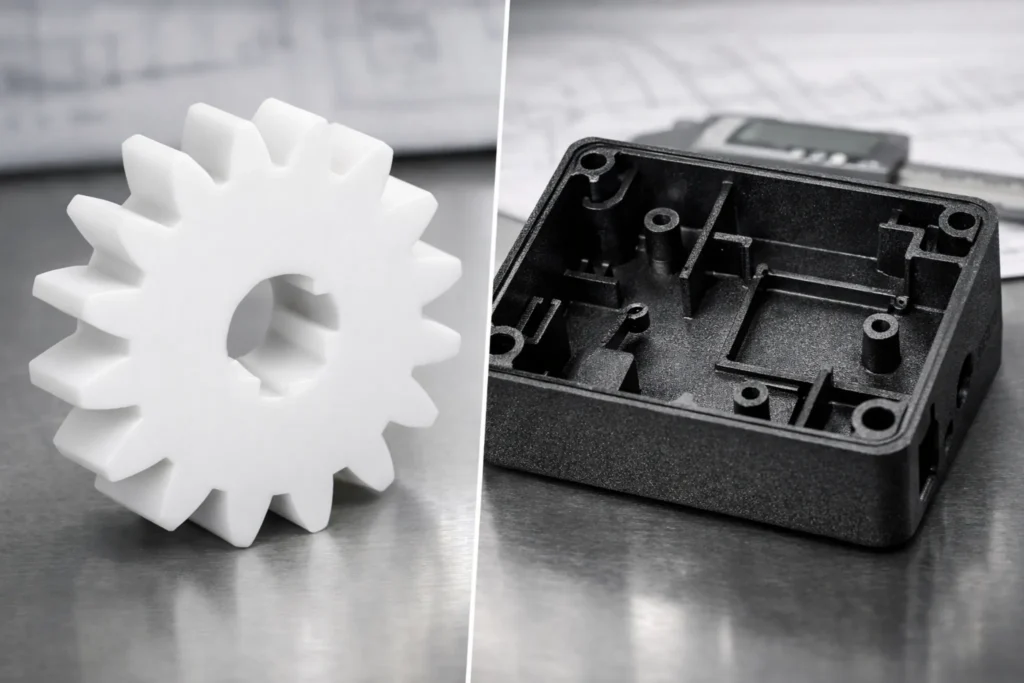
Choosing between Delrin® (POM-H) and ABS depends on what the part actually needs to withstand: mechanical load, impact, heat, friction, moisture, chemicals, or manufacturing constraints.
Delrin (Acetal) is stronger, more dimensionally stable, and better for precision moving parts like gears and bushings.
ABS is more impact resistant, easier to mold, and better for housings and cosmetic components.
Choose Delrin for mechanical wear; choose ABS for impact and cost efficiency.
Quick Decision Summary: Delrin vs. ABS
| Requirement | Delrin / POM-H | ABS | What the data indicates |
| Tensile strength (yield) | 10,500–11,000 psi [1] | ≥5,600 psi [2] | POM-H is substantially higher on Protolabs’ matched sheets. |
| Notched impact strength | 1.0–1.2 ft-lb/in [1] | 7.7–8.0 ft-lb/in [2] | ABS is substantially higher, roughly six to seven times. |
| Heat deflection temperature (264 psi) | 242–257°F [1] | Not listed on the same sheet; ~190°F on a separate CNC ABS sheet [11] | POM-H appears higher, but confirm both figures use the same test load before treating this as exact. |
| Typical positioning | Precision mechanical plastic | General-purpose engineering plastic | Different application emphasis. |
| Friction/wear applications | Strong fit | More limited, application dependent | POM-H has an extensive gear/bushing/bearing grade history [1][12]. |
| Painting/gluing | More difficult without surface treatment | Easier, commonly painted and bonded | ABS has the advantage for finished housings and cosmetic parts [12]. |
Do not make the final decision from the polymer name alone, both are available in multiple grades with substantially different properties, shown below.
Understanding the Materials: Brand vs. Chemistry
What Is Delrin?
Delrin® is DuPont’s brand for acetal homopolymer (POM-H), available across standard, toughened, lubricated and reinforced grades. Properties vary meaningfully within that one brand name:
| Delrin grade | Tensile yield | Tensile modulus | Notched impact |
| 100 (high viscosity) | 69 MPa (10.0 ksi), ASTM D638 [5] | 2,900 MPa (ISO) [5] | ~2.2 ft-lb/in at 23°C (120 J/m), ASTM D256 [5] |
| 500P (medium viscosity) | 71.0 MPa (10.3 ksi), ISO 527 [4] | 3,100 MPa (450 ksi) [4] | 4.3 kJ/m² at 23°C, ISO 180/1A, not ASTM-comparable [4] |
| 900P (low viscosity) | 71 MPa (10.3 ksi), ISO 527 [7] | 3,300 MPa (479 ksi)[7] | 7.0 kJ/m² at 23°C, ISO 180, not ASTM-comparable [8] |
| 500T (toughened) | Not published on the sheet reviewed | 2,300 MPa, well below 500P’s 3,100 MPa [9] | Described as toughened; specific Izod figure not published on the sheet reviewed [9] |
| 100ST (super-toughened) | 45 MPa — well below standard grades | 1,400 MPa, roughly half of 500P’s [6] | Not published on the sheet reviewed; the large modulus drop indicates a much larger toughness trade than 500T [6] |
Mixed test methods above (ISO vs. ASTM) are not directly comparable to each other or to ABS’s ASTM D256 figures. This is exactly why “Delrin is X times tougher/weaker than ABS” should be checked against same method data, shown in the Impact Resistance section below.
What Is ABS?
ABS (acrylonitrile-butadiene-styrene) is not one material but a broad family, with grades formulated for different combinations of impact strength, flow, heat resistance, flame retardance and UV stability.
Protolabs’ own comparison of standard versus flame-retardant ABS makes the point concretely: standard ABS lists 7.7 ft-lb/in notched Izod at 73°F, while its flame-retardant grade lists 4.0 ft-lb/in at the same temperature, a real property trade within the “ABS” name, not just a marketing distinction [3].
Side-by-Side Comparison Table
| Property | Delrin / POM-H | ABS | Source |
| Tensile strength (yield) | 10,500–11,000 psi (generic POM-H); 11,000 psi for Delrin 150 specifically | ≥5,600 psi (generic); 6,100 psi for standard ABS | Protolabs [1] [2] ; Trident [10]; Protolabs ABS comparison [3]. |
| Notched impact strength | 1.0–1.2 ft-lb/in (generic POM-H); 2.0 ft-lb/in for Delrin 150 | 7.7–8.0 ft-lb/in (generic/standard) | Protolabs [1] [2]; Trident [10] |
| Heat deflection temperature | 242–257°F at 264 psi (generic); Delrin 150 lists 257°F at 264 psi and 336°F at the lower 66 psi load | ~190°F on a separate CNC ABS sheet, confirm test load before comparing directly | Protolabs [1]; Trident [10]; ARRK [11] |
| Tensile modulus | 2,900–3,300 MPa across standard Delrin grades | 301,000–340,000 psi (2.1–2.3 GPa) | Material Data Center, Plasticker [5][7]; Protolabs [2] |
| Melting point | ~347°F / 175°C, a true melting point (semi-crystalline) | No true melting point, amorphous; softens gradually, Vicat ~221°F on one sheet | Protolabs [1]; ARRK [11] |
| Typical mechanical positioning | Gears, bushings, bearings, precision components | Housings, structural prototypes, consumer/electrical components | Protolabs, Craftcloud[1] [12] |
| Painting/gluing | More difficult without surface treatment | Commonly painted and bonded directly | Craftcloud [12] |
Key Material Differences Explained
Chemical Structure and Polymer Family
Delrin is an acetal homopolymer. ABS is a different polymer family built from acrylonitrile, butadiene and styrene.
Within the acetal family itself, Celanese’s technical literature distinguishes homopolymer from copolymer: homopolymers like Delrin generally have somewhat better short term mechanical properties, while copolymers offer a wider processing window and better long term performance in hot water and certain chemical environments [12].
Strength and Load-Bearing Capacity
| Property | ABS | Delrin / POM-H | Relative result |
| Tensile strength | ≥5,600 psi [2] | 10,500–11,000 psi [1] | POM-H is roughly 85–95% higher on these matched sheets. |
| Tensile modulus | 301,000–340,000 psi [2] | 350,000–450,000 psi [1] | Delrin grades are generally stiffer. |
| Heat deflection temperature | ~190°F [11] | 242–257°F at 264 psi [1] | POM-H is higher at a comparable load, though the ABS figure’s exact test load should be confirmed. |
POM-H provides substantially higher tensile strength and heat deflection capability than representative CNC ABS. But tensile strength alone doesn’t determine whether a part survives impact, fatigue, creep, wear or chemical exposure.
The actual grade, temperature, geometry, stress concentration and loading duration still need to be evaluated.
Impact Resistance
Impact data produces nearly the opposite result from strength:
| Material | Notched Izod impact | Test method |
| ABS (standard) | 7.7 ft-lb/in at 73°F [3] | ASTM D256 |
| ABS (flame-retardant) | 4.0 ft-lb/in at 73°F, 1.0 at −40°F [3] | ASTM D256 |
| POM-H (generic, Protolabs) | 1.0–1.2 ft-lb/in [1] | ASTM D256 |
| Delrin 150 (extruded, natural) | 2.0 ft-lb/in at 73°F [10] | ASTM D256 |
| Delrin 100 (high viscosity) | ~2.2 ft-lb/in at 23°C, 1.8 at −40°C [5] | ASTM D256 |
On ASTM D256 data specifically, standard ABS has roughly four to seven times the notched impact value of the various POM-H grades shown here, depending on which Delrin grade is the comparison point.
That doesn’t mean every ABS grade beats every Delrin grade, flame retardant ABS gives up nearly half its impact strength, and Delrin also offers toughened grades (500T, 100ST) specifically developed for better impact performance, though ASTM method Izod figures for those two weren’t published on the sheets reviewed [9] [6].
Engineering implication: if sudden impact is the dominant failure mode, standard POM-H should not be selected merely because its tensile strength is higher.
Wear and Friction Performance
POM has a long application history in sliding and wear components.
Protolabs lists gears, bearings, bushings and rollers among common acetal applications, describing it as an engineering thermoplastic for precision parts requiring high stiffness, low friction and dimensional stability [1].
Delrin 150’s own sheet reports a wear factor of 55 × 10⁻¹⁰ in³·min/ft·lb·hr under ASTM D3702 testing [10] — a concrete number rather than a generic “low friction” claim.
| Requirement | Delrin/POM | ABS |
| Standard use in gears | Extensive | More application-dependent |
| Standard use in bushings | Extensive | More application-dependent |
| Documented wear-factor data | Available (ASTM D3702)[10] | Not found on the sheets reviewed |
Dimensional Stability and Tolerance Capability
Dimensional stability shouldn’t be reduced to an unsupported claim like “Delrin always holds ±0.001 inch.” The achievable tolerance depends on machine capability, stock condition, geometry, thermal expansion, machining parameters, moisture, post-machining relaxation and inspection method, not the polymer name.
Delrin’s coefficient of linear thermal expansion is commonly cited around 4.7–6.8 × 10⁻⁵ in/in/°F for POM-H stock[1], broadly similar in order of magnitude to ABS’s.
The correct engineering statement is that Delrin/POM is attractive for precision mechanical parts because of its low moisture sensitivity and predictable behavior, but the achievable tolerance must still be established for the actual machining process and part geometry.
Moisture and Environmental Resistance
POM-H absorbs roughly 0.90% moisture at saturation on Protolabs’ sheet [1], low enough that it’s commonly specified where dimensional stability through humidity changes matters.
ABS also has relatively low moisture uptake compared with strongly hygroscopic polymers like nylon, but moisture absorption isn’t the same as chemical compatibility or dimensional stability under every environmental condition.
| Environmental concern | Delrin/POM | ABS |
| Moisture sensitivity | Generally low (~0.90% at saturation) [1] | Generally low |
| Precision applications | Strong fit | Possible, more process-dependent |
| Long-term environmental qualification | Required for the specific grade | Required for the specific grade |
Chemical Resistance
Neither material should be treated as universally chemically resistant.
Celanese’s acetal guidance notes that copolymer acetal generally has improved resistance to hot water and alkaline environments compared with homopolymer acetal like Delrin[12].
ABS chemical resistance is also grade dependent and can be compromised by certain solvents, especially under stress.
The correct qualification for either material: check the exact resin grade against the actual chemical, concentration, temperature and exposure time, not a generic resistance chart.
UV Stability and Weathering
“ABS” and “Delrin” should each not be treated as having one outdoor weathering performance. Both families include specialized UV-stabilized and weatherable grades distinct from their standard formulations.
The correct outdoor comparison is between the actual weatherable grade on each side, using the manufacturer’s own weathering data.
| Requirement | What to verify |
| UV exposure | Confirm a UV/weathering-stabilized grade, not the standard resin. |
| Color retention | Supplier weathering data for the exact color and grade. |
| Mechanical retention | Post-weathering tensile/impact data, not just initial properties. |
| Long-term outdoor service | Application-specific qualification testing. |
Heat Resistance Comparison
The clearest numerical comparison available uses matched Protolabs data: POM-H lists 242–257°F heat deflection temperature at 264 psi, well above ABS’s figure of roughly 190°F found on a separate CNC ABS sheet [1] [11].
Delrin 150’s own sheet illustrates why the exact test load matters: its HDT is 257°F at the standard 264 psi load, but 336°F at a much lighter 66 psi load [10].
The same material, two very different-sounding numbers, depending only on how hard the test pushes on it. Any single “Delrin HDT” figure quoted without its test load should be treated as incomplete.
HDT itself should not be interpreted as a guaranteed continuous use temperature, it’s a standardized deformation-under-load measurement.
Actual service temperature depends on stress, duration, geometry, grade and environment.
Machining Comparison: CNC & Fabrication
Which Is Easier to Machine?
Both materials can be CNC machined.
Delrin tends to produce clean, predictable chips and is widely used for precision machined components [1] [12].
ABS machines successfully but needs attention to cutting heat, tool sharpness and chip evacuation to avoid smearing. See our detailed machining Delrin guide for parameters.
| CNC factor | ABS | Delrin/POM |
| Machinability | Easy to machine | Well suited to precision machining |
| Typical use | Prototypes, housings, structural components | Precision mechanical parts, gears, bushings |
| Surface finishing | Easy to paint/glue | More difficult to bond/finish without treatment [12] |
Tool Wear and Chip Formation
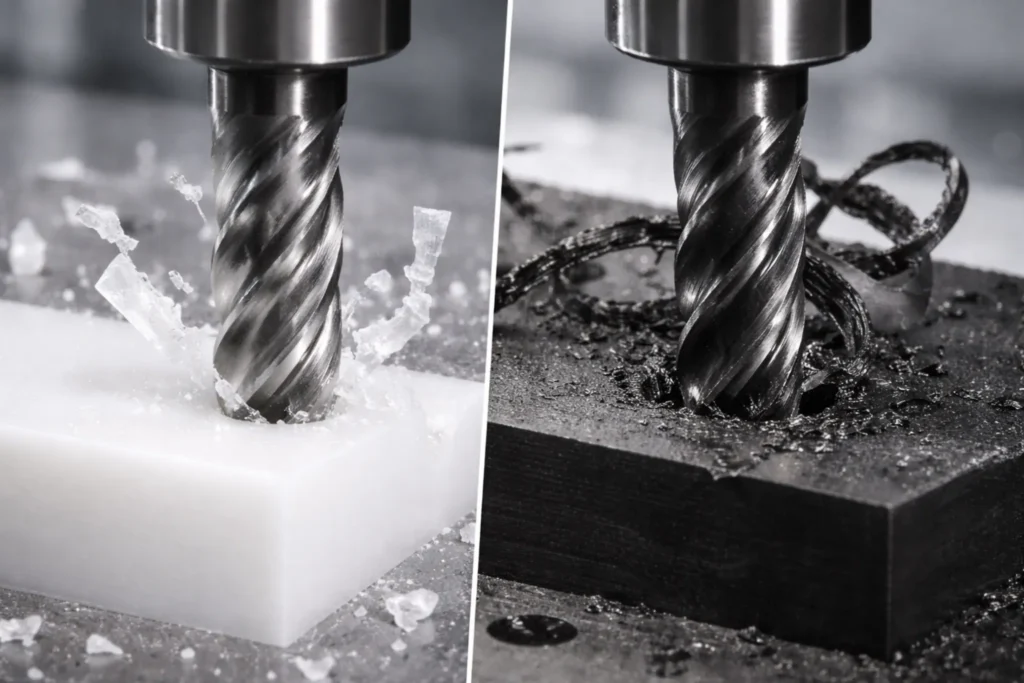
Machining behavior is affected by tool geometry, cutting speed, feed, depth of cut, coolant and part geometry.
Delrin’s stiffness and machinability make it widely used for machined precision components, but neither material should be assigned a universal tool life value. Optimize cutting conditions for the exact resin grade rather than assuming a fixed advantage either way.
Tolerance Control
Tolerance is a manufacturing capability, not an inherent material property. A “±0.001 inch is guaranteed” shouldn’t appear as a claim for either material.
Dimensional change can come from thermal expansion, moisture, residual stress and post machining relaxation, and the machine, tool, stock condition and inspection method all affect the final result.
Delrin can be a strong candidate for precision machined parts, but the actual tolerance must be validated through the machining process for the specific geometry.
Surface Finish
ABS is widely used where painting, gluing and cosmetic finishing matter. It accepts these directly.
Delrin’s low surface energy makes conventional adhesion and finishing more challenging without specialized treatment [12].
| Surface requirement | Material to investigate |
| Machined mechanical surface | Delrin/POM |
| Easy painting | ABS |
| Conventional gluing | ABS |
| Low-friction sliding surface | Delrin/POM |
| Cosmetic molded enclosure | ABS |
Choosing Between Delrin and ABS for Precision Components
For a precision mechanical component, work through the actual requirements rather than defaulting to the material with the higher tensile strength:
- Tensile and compressive load.
- Required stiffness.
- Temperature, and at what load (see Heat Resistance Comparison above).
- Friction and wear.
- Impact loading.
- Chemical exposure.
- Moisture.
- Dimensional tolerance.
- Manufacturing process.
- Required surface finish.
The data in this guide gives Delrin/POM-H a substantial advantage in tensile strength and HDT, and ABS a substantial advantage in notched impact strength, which one matters more depends entirely on which of the ten items above is the actual limiting requirement for the part.
Machining Delrin Components for a Current Project?
Skip the shop-floor trial and error. Upload your STEP, IGES, or DXF files for an instant manufacturability review, tight-tolerance verification, and fast production quotation.
Request a Precision Machining Quote →🔒 NDA Compliant • 1 to 10,000+ Production Parts • Fast Turnaround
Injection Molding Differences
Flow Characteristics
ABS is available in grades formulated for different flow requirements, including thin wall and high flow variants.
Delrin also has grades selected for flow and molding behavior, 900P, for instance, is specifically a low-viscosity grade intended for thin wall and multicavity molding rather than maximum strength [7].
Flow should be compared grade-to-grade, not as a blanket “ABS flows better” claim.
Shrinkage Rate
Delrin is semi crystalline, and its molding shrinkage is strongly influenced by crystallization, processing conditions and geometry.
ABS’s amorphous structure generally gives it lower, more predictable shrinkage.
Neither material has one universal shrinkage percentage worth publishing as a specification, it varies by grade and process, and should come from the resin manufacturer’s own molding guide.
Mold Complexity Capability
ABS’s flow characteristics and lower shrinkage make it a common choice for large, complex cosmetic housings.
Delrin can also be molded into complex parts, but the mold and process need to account for its crystallinity and shrinkage behavior.
The practical decision depends on wall thickness, flow length, shrinkage, draft, warpage, gate design, cooling and required surface finish.
Cycle Time and Production Cost
A fixed claim like “ABS always has a 15% shorter cycle time” isn’t defensible without a controlled process comparison.
Cycle time depends on mold temperature, melt temperature, wall thickness, cooling requirements, part geometry, grade and machine.
Treat any such percentage as something to verify for your own tooling, not a published fact to rely on.
Cost Comparison
Raw Material Cost
ABS is generally positioned as a lower cost engineering plastic.
Delrin’s broader grade portfolio (standard, lubricated, toughened, filled) spans a wider price range.
A universal $/kg figure would be misleading, since resin price moves with grade, supplier, order quantity, location, color, reinforcement, certification and market conditions.
Get a current quotation for the exact grade rather than relying on a published number.
Processing Cost
For CNC parts: material + machine time + tooling + labor + finishing + scrap/inspection.
For molded parts: resin + mold amortization + cycle time + machine cost + labor + finishing + scrap.
Delrin’s machinability can make it economically attractive for certain CNC parts, but there isn’t enough controlled, public evidence to claim a fixed percentage saving against ABS either way.
Long-Term Performance Value
| Cost factor | Question to ask |
| Material price | What is the actual quoted grade price? |
| Manufacturing | How long does the part take to produce? |
| Scrap | What dimensional/quality rejection rate occurs? |
| Wear | How frequently is the component replaced? |
| Maintenance | Does the part require lubrication or adjustment? |
| Downtime | What is the cost of failure or replacement? |
| Qualification | Are additional testing/certification costs required? |
This framework is more defensible than claiming either material universally has a lower total cost.
Application-Based Comparison
Gears and Mechanical Parts
Delrin/POM has a strong application case for gears and mechanical components, with Protolabs listing gears, bearings, bushings and rollers among common acetal applications [1].
ABS can be used for mechanical parts where impact resistance and cost matter more than wear performance, but the actual duty cycle should be evaluated rather than assumed.
Automotive Interior Components
ABS has a substantial automotive interior application base, where impact performance, flow, appearance and heat resistance can be balanced through grade selection.
Delrin can also appear in automotive mechanical components, linkages, small gears, fuel-system parts where strength, low friction or dimensional stability matter.
Electrical Housings
ABS is widely used for electrical and electronic housings because of its balance of impact resistance, stiffness, processability and finishing options.
Delrin can be appropriate for electrical/mechanical components needing its specific mechanical and dimensional properties, but the grade and electrical requirements (dielectric strength, flammability rating) need separate verification.
Consumer Product Casings
ABS has a strong case for consumer housings needing impact resistance, cosmetic appearance, paintability or bonding, and economical injection molding.
Delrin is generally the better fit when the casing also performs a demanding mechanical function rather than simply enclosing something.
When Delrin Is the Wrong Choice
1. You Need Easy Painting or Conventional Bonding
ABS accepts paint and adhesives directly.
Delrin’s low surface energy makes conventional bonding more challenging without specialized treatment [12].
If the primary requirement is a painted or conventionally bonded cosmetic enclosure, ABS is the more practical starting point.
2. The Environment Contains Aggressive Chemicals
Don’t assume Delrin resists every chemical, resistance depends on the exact polymer, grade, concentration, temperature and exposure duration.
Copolymer acetal generally outperforms Delrin’s homopolymer chemistry in hot water and alkaline conditions specifically [12].
3. Impact Toughness Is the Primary Requirement
Standard POM-H’s 1.0–2.0 ft-lb/in notched impact range sits well below ABS’s 7.7–8.0 [1] [2] [10].
Standard POM-H shouldn’t be the default choice where high notched impact resistance is the dominant requirement.
Toughened Delrin grades exist (500T, 100ST); compare against the specific grade being considered, not generic Delrin.
4. The Part Is a Large, Complex Molded Geometry
Large or complex parts need flow length, wall thickness, shrinkage, warpage, gate location, cooling, mold temperature and grade viscosity evaluated together.
Both ABS and POM have specialized molding grades, so this is a process engineering decision, not a simple material “winner.”
5. The Application Requires Specialized Sterilization
Don’t assume a generic Delrin grade is automatically suitable for a medical sterilization process.
Verify the exact resin grade, sterilization method, temperature, exposure duration and required property retention against the supplier’s technical and regulatory documentation.
When ABS Is the Wrong Choice
1. High-Cycle Sliding or Wear
POM has a substantial grade portfolio built around low friction and wear, including lubricated and PTFE-filled variants [1] [12].
For continuously sliding or rotating parts, evaluate a suitable POM grade rather than assuming ABS is equivalent.
2. Long-Term Mechanical Loading
POM-H’s 10,500–11,000 psi tensile strength and higher modulus make it worth investigating for mechanically loaded precision components, particularly where stiffness and creep resistance matter [1].
The actual long term allowable stress still requires creep data at the operating temperature and stress level.
3. Aggressive Chemical Exposure
ABS chemical compatibility varies by grade and chemical. For demanding environments, check the exact ABS grade against the actual chemical and temperature rather than assuming generic resistance.
4. Demanding Outdoor Exposure
Standard ABS shouldn’t be treated as an outdoor grade material by default.
UV performance is grade-dependent, and a weatherable ABS grade should be compared against a weather-stabilized POM grade using actual weathering data.
5. High-Temperature Mechanical Service
At a comparable load, POM-H’s heat deflection temperature (242–257°F) runs well above the ABS figure found (~190°F) [1] [11].
If mechanical stiffness at elevated temperature matters, generic ABS shouldn’t be treated as equivalent to POM-H and HDT remains a comparative test property, not a continuous-use-temperature guarantee, for either material.
Frequently Asked Questions
Is Delrin stronger than ABS?
In tensile yield strength, yes. Protolabs’ matched sheets list 10,500–11,000 psi for POM-H against a minimum of 5,600 psi for ABS [1] [2].
But ABS’s notched Izod impact strength (7.7–8.0 ft-lb/in) runs roughly six to seven times higher than generic POM-H’s (1.0–1.2 ft-lb/in) on the same sheets [1] [2], strength and toughness point in opposite directions.
Can ABS replace Delrin?
Which is better for gears: Delrin or ABS?
Which is easier to machine: Delrin or ABS?
Both machine well.
Delrin tends to produce clean, predictable chips, ABS needs sharp tooling and good heat/chip control to avoid smearing.
Final machining performance depends on the machine, tooling, geometry and cutting parameters, not the polymer name alone.
Which is cheaper long term: Delrin or ABS?
There’s no universal answer.
ABS usually has the lower raw material price, Delrin’s wear life and machinability can offset that over a part’s service life.
Compare initial cost, processing, scrap, maintenance, replacement and downtime for the actual application.
Related Guides
- Delrin® (POM): Properties, Grades, Applications & Material Selection Guide
- Delrin vs. Nylon A comparison where both materials genuinely compete for the same job.
- Delrin vs. Acetal (POM-H vs. POM-C) If the real question is which acetal grade, not a different polymer.
- UHMW vs. Delrin For wear duty cycles beyond what either material here covers well.
- Machining Delrin
- 3D Printing ABS
- PC ABS
- ABS Plastic Injection Molding
- Machining ABS
- Flame Retardant ABS
Technical sources
Values in this guide are attributed to the specific supplier sheet and grade they came from, reviewed September 2026.
Stock-shape sheets and injection-molding resin sheets report different values for the same nominal grade; verify the current datasheet before using a number for design, qualification or procurement.
[1] Protolabs — POM-H (Acetal Homopolymer) CNC material data sheet (2026)
[2] Protolabs — ABS CNC material data sheet (2026)
[3] Protolabs — ABS Natural and Black, including flame-retardant ABS, material data sheet
[4] UL Prospector / Protolabs — Delrin 500P NC010 (medium-viscosity homopolymer) technical data
[5] Material Data Center — Delrin 100 NC010 (high-viscosity homopolymer) datasheet
[6] Material Data Center — Delrin 100ST NC010 (super-toughened homopolymer) datasheet
[7] Plasticker — Delrin 900P NC010 (low-viscosity, thin-wall/multicavity) datasheet
[8] Entec Polymers — Delrin 900P NC-010 product data (notched Izod)
[9] Delrin 500T NC010 (toughened) ISO property data
[10] Trident Plastics — Delrin 150 NC010 (POM-H natural, extruded shapes, FDA/NSF grade) technical data
[11] ARRK — CNC ABS material data sheet (heat deflection, Vicat softening)
[12] Craftcloud — Delrin (POM-H) CNC material guide (surface energy, chemical limits)
Last reviewed: October 2026

Usama Ayub is the founder of PlasticSpec and a polymer manufacturing engineer with eight years of hands-on industrial experience in PET, PA6, and PA66 fiber and filament yarn production. He writes material property and selection guides for Delrin, Nylon, PEEK, PTFE, UHMW, Polycarbonate, and ABS.