
ASA vs ABS: Material Properties, UV Resistance, and When to Use Each
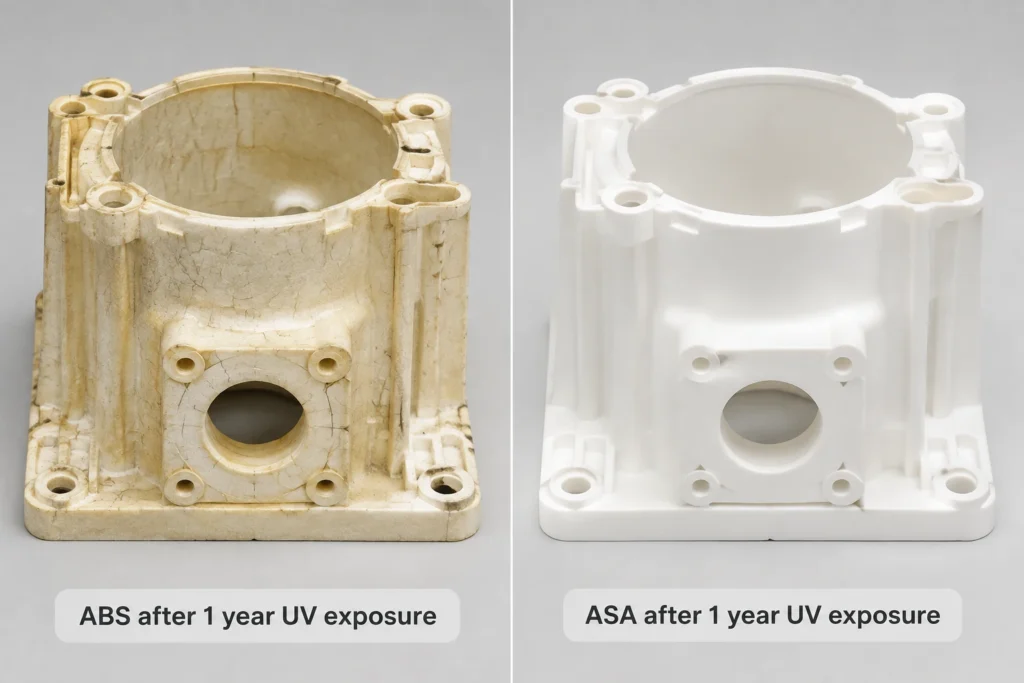
ASA and ABS share a similar backbone chemistry and nearly identical processing behavior, but one critical difference separates them: UV and weathering resistance.
Choose ABS for indoor applications, consumer electronics, and structural prototypes where cost efficiency and initial impact strength are paramount.
Choose ASA for any part exposed to sunlight, marine environments, or outdoor weathering. ASA acts as a direct, UV-stable replacement for ABS without sacrificing mechanical stiffness.
ASA vs ABS Comparison Table
| Property | Standard ABS | ASA | Winner |
| UV & Weather Resistance | Poor (Chalks & Embrittles) | Excellent (5+ Years Exterior) | ASA |
| Initial Impact Strength | 200–300 J/m | 180–280 J/m | ABS (Slightly) |
| Post-UV Impact Strength | 100–150 J/m (40-50% Loss) | 180–260 J/m (Minimal Loss) | ASA |
| Tensile Strength | 40–45 MPa | 38–45 MPa | Tie |
| Heat Deflection (HDT @ 1.82 MPa) | 90–100°C | 90–100°C | Tie |
| Material Cost | Baseline | 10%–20% Premium | ABS |
Values are representative ranges across commercial grades always confirm against the specific manufacturer’s datasheet before finalizing a spec.
ASA and ABS (What’s the Actual Chemical Difference)?
The Chemical Shift: Butadiene vs. Acrylate
The core difference lies entirely in the rubber compound used to give the plastic its impact resistance:
ABS (Acrylonitrile Butadiene Styrene): Uses “Butadiene” rubber. Contains carbon-carbon double bonds that react aggressively with UV light and oxygen (photo-oxidation). This causes the polymer chains to break, turning the plastic brittle and yellow.
ASA (Acrylonitrile Styrene Acrylate): Replaces butadiene with an “Acrylate” elastomer. Acrylate lacks reactive double bonds, making it inherently immune to UV-driven structural breakdown.
- This isn’t an upgrade/downgrade relationship, ASA isn’t “better ABS,” it’s ABS re-engineered for one specific failure mode (UV exposure).
- Indoors, cost-sensitive, or UV-shielded applications often don’t justify the premium for ASA.
UV Resistance and Weathering (The Core Differentiator)
How ABS Degrades Under UV Exposure
- Photo-oxidation attacks the butadiene phase first, starting at the surface and working inward.
- Visible signs: yellowing, surface chalking (a powdery residue), and reduced surface gloss within weeks to months of direct sun exposure, depending on climate.
- Mechanical consequence: surface embrittlement leads to cracking under stress or impact, even if the bulk material is still intact.
How ASA Resists UV Exposure
- The acrylate elastomer phase does not undergo the same photo-oxidative chain scission.
- ASA parts can be used outdoors unpainted/unprotected for years with minimal color shift or surface degradation (weathering-grade automotive and signage applications commonly cite 5+ years exterior exposure).
Weathering Test Data Comparison
| Exposure Condition | Standard ABS | ASA |
| QUV / Xenon-arc (1000 hrs) | Significant yellowing, surface cracking begins | Minimal color change, no cracking |
| Outdoor exposure (12 months, temperate climate) | Noticeable yellowing, surface chalking | Negligible color shift |
| Impact retention after UV exposure | Drops 30–50%+ | Retains 85%+ of original impact strength |
Values are representative ranges across commercial grades always confirm against the specific manufacturer’s UV/weathering datasheet before finalizing a spec.
Does Painting or Coating ABS Solve the UV Problem?
- A UV-stable topcoat or paint can protect ABS from direct UV exposure, but only as long as the coating remains intact.
- Any scratch, chip, or coating failure exposes the underlying ABS, and degradation resumes at that point.
- ASA doesn’t require this dependency, its resistance is inherent to the resin, not a surface treatment.
ASA vs ABS Mechanical and Thermal Property Trade-Offs
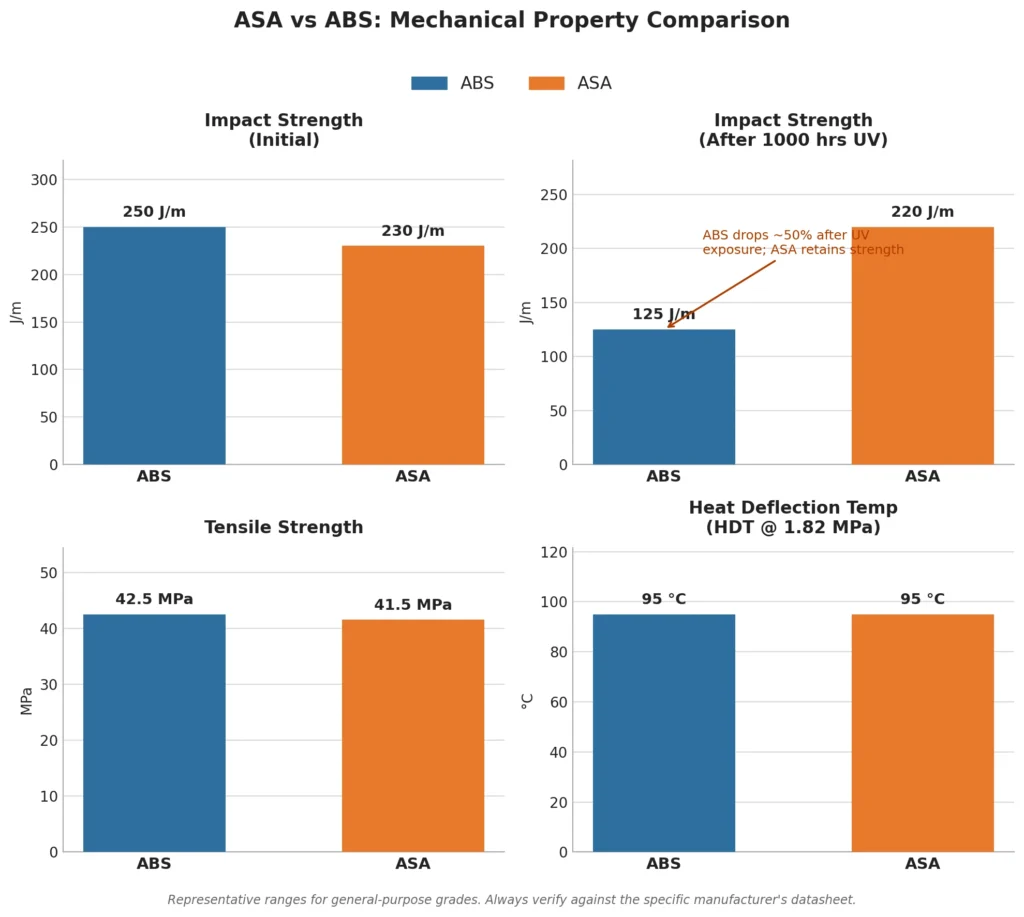
Impact Strength
- Standard ABS typically has slightly higher notched Izod impact strength than ASA at equivalent grade/loading.
- However, ASA retains its impact strength after UV exposure, while ABS’s impact strength degrades significantly outdoors the “advantage” ABS has indoors disappears in outdoor service.
Tensile Strength and Stiffness
- ASA and ABS are broadly comparable in tensile strength and flexural modulus for general purpose grades.
- Neither material has a decisive stiffness advantage; grade-to-grade variation matters more than the ASA/ABS choice itself.
Heat Deflection Temperature (HDT)
- ASA and standard ABS have similar HDT ranges; neither is a “high-heat” material compared to PC-ABS or polycarbonate.
- If elevated heat resistance combined with UV resistance is required, ASA blends (e.g., ASA/PC) exist a distinct sourcing conversation from base ASA.
Processing Considerations (3D Printing, Injection Molding, and Extrusion)
3D Printing (FDM) ABS
- Prone to warping and layer delamination due to a high shrinkage rate; mastering the temperature controls for 3D printing ABS successfully requires a heated bed and an enclosed build chamber.
- Strong, well-understood community data (large hobbyist install base).
- Emits noticeable fumes during printing (ventilation recommended).
3D Printing (FDM) ASA
- Slightly better UV/outdoor durability than ABS for printed parts left outside (drone frames, outdoor enclosures, automotive trim).
- Similar warping behavior to ABS still needs heated bed/enclosure; marginally better layer adhesion in some formulations.
- Fumes are comparable to ABS; same ventilation precautions apply.
Injection Molding
- ASA and ABS have similar processing windows (melt temp, mold temp), meaning that optimizing your tooling parameters for ABS plastic injection molding makes transitioning to ASA relatively straightforward.
- ASA is the standard choice for outdoor injection-molded parts: automotive exterior trim, mirror housings, outdoor furniture components, signage letters.
- ABS remains standard for indoor housings, enclosures, and cost-sensitive high-volume parts with no UV exposure.
Extrusion (Sheet/Profile)
- ASA sheet is widely used for outdoor signage and cladding specifically because it holds color and gloss under sun exposure.
- ABS sheet is more common for indoor point-of-purchase displays, machine guarding, and interior panels.
When to Use ASA vs When to Use ABS
Choose ASA When:
- The part will be exposed to direct or indirect sunlight for extended periods (outdoor enclosures, automotive exterior trim, signage, drone/RC frames used outside).
- Long-term color and gloss retention matters (branded products, visible outdoor components).
- The application requires impact strength that must hold up over years of UV exposure, not just at time of manufacture.
Choose ABS When:
- The part is used indoors or is otherwise UV-shielded (electronics housings, indoor fixtures, internal automotive components).
- Cost is the primary driver and outdoor durability is irrelevant.
- Slightly higher initial impact strength is beneficial and UV exposure is not a factor.
Decision Checklist
- Will this part ever see direct sunlight, even indirectly through a window? → Lean ASA.
- Is this a short-lived prototype or a long-service production part? → Prototypes can often use cheaper ABS regardless of end-use UV exposure; production parts should match final material behavior.
- Is a paint/coating layer already part of the design? → Coated ABS can work outdoors as long as coating integrity is maintained; unpainted parts should default to ASA.
Common Applications
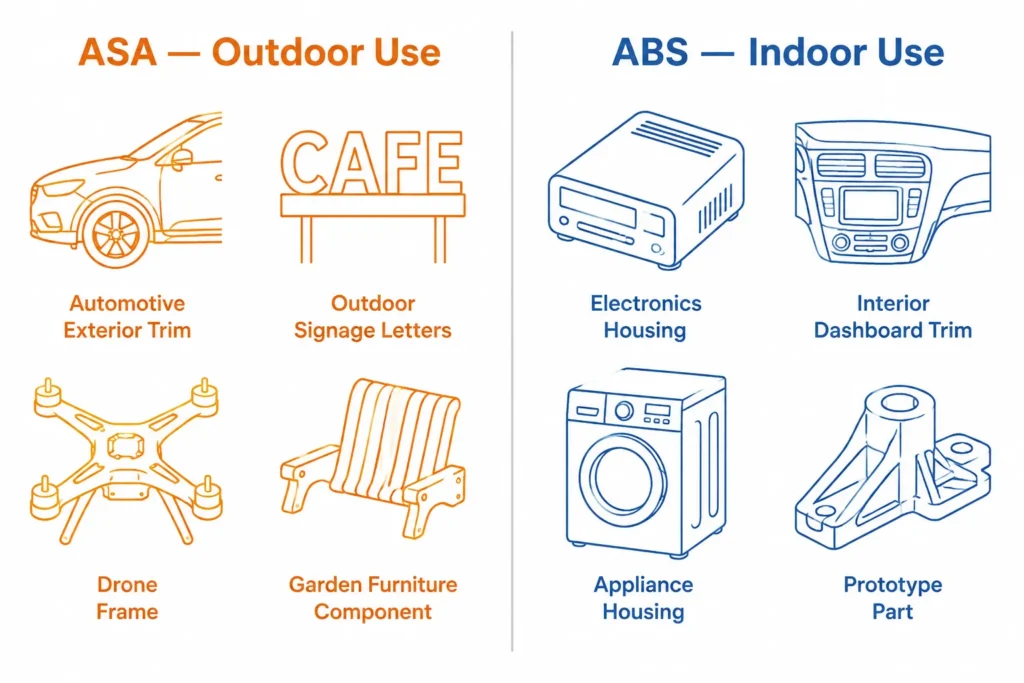
ASA Applications
- Automotive exterior trim, mirror housings, grille components.
- Outdoor signage and letters (extruded sheet).
- Drone and RC vehicle frames (outdoor use).
- Garden/outdoor furniture components, mailbox housings.
- Outdoor electrical enclosure housings (in combination with appropriate UL ratings).
ABS Applications
- Indoor electronics housings and enclosures.
- Automotive interior trim and dashboard components.
- Consumer product housings (appliances, power tools).
- Prototyping and low-cost functional parts (3D printing, Machining).
How to Specify ASA or ABS (Buyer’s Checklist)
Spec Sheet Items to Request
- UV/weathering test data: QUV or Xenon-arc exposure hours and resulting color change (ΔE) / impact retention, not just a marketing claim of “UV resistant.”
- Grade-specific mechanical data: impact, tensile, HDT for the exact grade being quoted, not generic ASA/ABS averages.
- Colorfastness data: if color matching matters for branded outdoor parts, request light fastness ratings for the specific pigment/color.
- UL flammability rating: if the application requires it (same consideration as with Flame Retardant ABS).
Questions to Ask Your Supplier
- What weathering test standard and duration backs your UV resistance claim?
- Is this a UV-stabilized ASA grade, or a base grade, some ASA formulations include additional stabilizer packages for extreme climates.
- What is the expected color/gloss retention timeline for outdoor exposure in my specific climate zone?
- Can you provide batch-to-batch consistency data for impact and weathering performance?
Where to Source ASA and ABS
Sheet & Rod Stock Suppliers
Look for distributors that stock both ASA and ABS with documented weathering/UV test data available on request, not just “UV resistant” marketing copy.
Custom Compounding / Resin Suppliers
For volume production, resin suppliers can tune UV stabilizer packages within ASA formulations for extreme climates (desert, high-altitude, tropical) beyond standard grade performance.
3D Printing Filament Suppliers
For prototyping or low-volume outdoor parts, ASA filament is widely available from major filament manufacturers verify UV-stabilizer content is intact in filament form (some economy ASA filaments cut corners here).
FAQ
Is ASA Stronger Than ABS?
Not universally, standard ABS often has slightly higher initial impact strength. ASA’s advantage is retaining that strength after UV exposure, where ABS degrades significantly.
Can You 3D Print ASA the Same Way as ABS?
Yes, with the same general requirements, heated bed, enclosure to prevent warping, and good ventilation. ASA is a near drop-in replacement for ABS in most FDM printers.
Is ASA More Expensive Than ABS?
Yes, typically 10–20% more, reflecting the acrylate elastomer and UV stabilizer content. The premium is generally justified for any part with real outdoor exposure.
Can I Just Paint ABS Instead of Using ASA?
Painting/coating can protect ABS outdoors, but only as long as the coating remains fully intact, any chip or scratch exposes the underlying ABS to UV degradation. ASA’s resistance doesn’t depend on maintaining a coating.
Does ASA Yellow Over Time Like ABS Does?
Significantly less. ASA is specifically engineered to resist the photo-oxidation that causes ABS to yellow, making it the standard choice where long-term color retention matters.

Usama Ayub is the founder of PlasticSpec and a polymer manufacturing engineer with eight years of hands-on industrial experience in PET, PA6, and PA66 fiber and filament yarn production. He writes material property and selection guides for Delrin, Nylon, PEEK, PTFE, UHMW, Polycarbonate, and ABS.