
PEEK vs PTFE: Material Comparison & Selection Guide
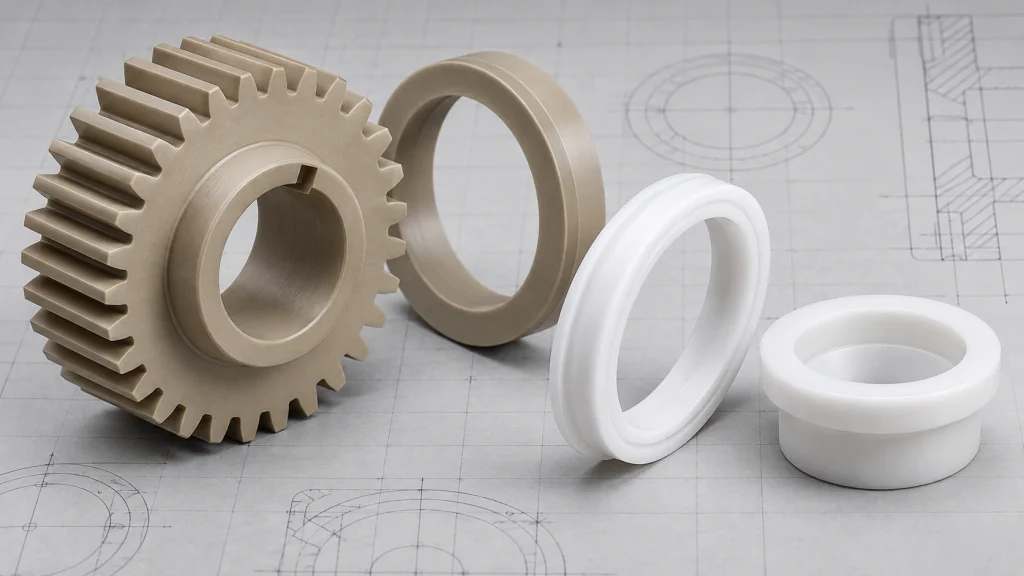
Quick Summary: PEEK vs PTFE at a Glance
PEEK (Polyether Ether Ketone) and PTFE (Polytetrafluoroethylene/Teflon) are both high-performance engineering plastics, but they serve completely different structural roles.
- Choose PEEK when you need high mechanical strength (90–100 MPa tensile), rigidity, and dimensional stability under extreme pressure.
- Choose PTFE when you need ultra-low friction (0.03–0.05 coefficient), continuous flexibility, and universal chemical inertness.
The Rule of Thumb: If the component must bear heavy structural loads or resist crushing without changing shape, specify PEEK.
If the component needs to seal dynamically, slide effortlessly, or withstand harsh acids, specify PTFE.
Don’t decide on temperature alone both handle continuous service up to roughly 250–260°C, nearly identical. The real differentiator is what happens under load while hot: PEEK holds its shape, PTFE can cold-flow and lose sealing geometry over time.
Side-by-Side Material Property Comparison Matrix
| Property | PEEK | PTFE | Technical Impact |
| Tensile Strength | 90–100 MPa | 25–35 MPa | PEEK handles 3x higher mechanical loads |
| Compressive Strength | ~140 MPa | ~30–40 MPa | PEEK resists crushing under pressure |
| Coefficient of Friction | 0.35–0.45 | 0.03–0.05 | PTFE is virtually frictionless |
| Max Continuous Temp | 250°C (482°F) | 260°C (500°F) | Similar thermal limits |
| Deformation Under Load | Extremely Low | High (Creep / Cold Flow) | PTFE distorts under sustained pressure |
| Chemical Resistance | Excellent (Attacked by H₂SO₄) | Nearly Universal | PTFE resists all solvents and acids |
| Relative Cost | Premium (10 times to PTFE) | Moderate | PEEK carries a higher raw material price |
Mechanical Performance & Structural Integrity
Tensile, Compressive, and Creep Resistance
- PEEK Tensile Power: Yields 90–100 MPa tensile strength. Retains rigidity under severe dynamic mechanical stress.
- PTFE Tensile Limits: Reaches 25–35 MPa tensile strength. Stretches and yields easily under load.
Creep Behavior (Cold Flow):
- PTFE suffers from severe cold flow (permanent deformation under continuous pressure).
- PEEK resists creep, holding structural integrity in high-pressure environments.
Hardness, Load Capacities, and Dimensional Stability
- Durometer Hardness: PEEK measures Rockwell M90–M100 (extremely hard). PTFE measures Shore D50–D65 (soft, malleable).
- Load Bearing: PEEK functions as a structural metal-replacement plastic. PTFE works best in non-structural dynamic seals.
- Dimensional Stability: PEEK exhibits minimal thermal movement and flex under mechanical stress.
Friction, Wear, and Tribological Properties
Coefficient of Friction & Self-Lubrication Limits
- PTFE Lubricity: Delivers one of the lowest friction coefficients among solids (0.03–0.05). Ideal for dry-running systems without oil or grease.
- PEEK Lubricity: Higher coefficient of friction (0.35–0.45). Requires friction-modifying fillers (like PTFE, graphite, or carbon) for high speed sliding contact.
Wear Rates and Performance under Sliding Load
- Abrasive Wear: Unfilled PTFE wears down quickly in high velocity dynamic applications.
- High-Load Wear: PEEK handles extreme contact pressure without galling or rapid material loss.
- Best Tribological Combo: PEEK filled with 10–20% PTFE combines low friction with high load capacity.
Thermal Limits & Temperature Resistance
Continuous Operating Temperature Ranges
- PTFE Upper Limit: Operates continuously up to 260°C (500°F).
- PEEK Upper Limit: Operates continuously up to 250°C (482°F), with short-term excursion limits near 300°C.
Glass Transition Temperature (Tg) and Thermal Expansion (CTE)
- Glass Transition (Tg): PEEK has a high Tg of 143°C (289°F), maintaining stiffness through elevated heat.
- Thermal Expansion: PEEK’s CTE is roughly one-third that of PTFE.
- Tolerance Retention: PEEK expands uniformly. PTFE expands rapidly at higher temperatures, causing seal leakage or binding.
Chemical Inertness & Environmental Compatibility
Resistance to Aggressive Solvents, Acids, and Steam
- PTFE Inertness: Resists virtually all chemicals, aggressive solvents, strong acids, and bases.
- PEEK Vulnerability: Resists hydrocarbons, steam, and organic solvents, but dissolves in concentrated sulfuric acid (H₂SO₄) and strong oxidizers.
- Steam Resistance: PEEK tolerates long-term exposure to superheated steam without hydrolysis.
Radiation and Electrical Insulation Performance
- Gamma Radiation: PEEK withstands high radiation doses without brittleness. PTFE degrades quickly under gamma exposure.
- Dielectric Breakdown: PTFE offers exceptional dielectric strength and acts as a superior electrical insulator for high-voltage parts.
Machinability, Processing, and Tight Tolerances
CNC Machining Precision & Fabrication Challenges
- PEEK Machinability: Machines similarly to brass. Produces tight tolerances (0.01mm), clean threads, and crisp burr free edges.
- PTFE Machinability: Soft and gummy. Tends to flex, burr, and creep away from standard cutting tools.
Glass-Filled, Carbon-Filled, and Specialty Fill Grades
- 30% Glass-Filled PEEK: Increases flexural modulus and structural rigidity for extreme heat/load environments.
- 30% Carbon-Filled PEEK: Maximizes compressive strength, thermal dissipation, and wear resistance.
- RPTFE (Reinforced PTFE): Blends glass, carbon, or bronze into virgin PTFE to reduce cold flow and lower thermal expansion.
Common Industrial Applications & Component Uses
High-Pressure Seals, Valve Seats, and Back-Up Rings
- Back-Up Rings & Anti-Extrusion: PEEK prevents soft elastomeric or PTFE seals from extruding through gaps under high pressure (>10,000 psi).
- Valve Seats: PTFE provides soft, bubble-tight sealing in chemical valves. PEEK serves in high-temperature, high-pressure steam/oil ball valves.
Tubing, Gaskets, Aerospace, and Medical Implants
- PTFE Uses: Flexible tubing, chemical pump gaskets, non-stick labware, wire insulation, and low speed bushings.
- PEEK Uses: Aerospace structural brackets, medical spinal implants, semiconductor wafer carriers, and downhole oilwell connectors.
Material Cost, Longevity, and ROI Analysis
Raw Material Price Disparity (PEEK vs PTFE)
- Initial Material Cost: Virgin PEEK raw stock costs roughly $80–$150/kg, whereas virgin PTFE averages $10–$25/kg.
- Machining Overhead: PTFE requires slower feeds and specialized clamping to prevent deflection, increasing unit labor costs.
Total Cost of Ownership & Part Lifespan
- Replacement Intervals: PEEK parts outlast PTFE parts under high stress, reducing maintenance downtime.
- Lifecycle ROI: Paying a high upfront cost for PEEK pays off in high-load, zero-failure critical operations.
Decision Matrix: Which Material Should You Choose?
When to Specify PEEK
- Structural load capacity (>50MPa) is required.
- Maintaining tight CNC tolerances across changing temperatures is critical.
- Preventing seal extrusion under extreme pressure (>5,000 psi) is mandatory.
- Environment includes high gamma radiation or superheated steam.
When to Specify PTFE
- Ultra-low coefficient of friction (<0.10) is essential without lubrication.
- Part encounters aggressive chemicals or strong acids (H₂SO₄).
- Budget constraints require a cost-effective, high-temperature fluoropolymer.
- Maximizing electrical dielectric insulation is the primary goal.
Frequently Asked Questions (FAQs)
Is PEEK better than PTFE?
It depends on the load and friction requirements.
PEEK is significantly better for structural strength, high compressive loads, and dimensional stability under pressure.
PTFE is superior for applications requiring ultra-low friction, self-lubrication, or extreme chemical inertness against aggressive acids.
Is PEEK the same as Teflon?
No. Teflon is the brand name for PTFE (Polytetrafluoroethylene), a soft, ultra-low-friction fluoropolymer.
PEEK (Polyether Ether Ketone) is a rigid, high-strength semi-crystalline thermoplastic that belongs to an entirely different polymer family.
Why is PEEK Plastic so expensive?
PEEK is expensive due to its complex multi-step chemical synthesis, high raw material costs, and extreme processing temperatures (requiring specialized high-temperature tooling).
However, its high tensile strength and long lifespan in critical environments often deliver a lower total cost of ownership compared to frequent part replacements.
What are the main alternatives to PEEK?
Common high-performance alternatives include PEI (Ultem) for cost-effective thermal resistance, PPS (Polyphenylene Sulfide) for chemical exposure under moderate loads, and PTFE or PVDF when maximum chemical inertness and lower friction are required.
Is PEEK FDA approved?
Yes, virgin grades of PEEK comply with FDA regulations (21 CFR 177.2415) for repeated food contact.
Medical grade PEEK is also widely certified for USP Class VI biocompatibility, making it a primary material for surgical instruments and medical implants.
Is PEEK UV resistant?
Yes, PEEK exhibits excellent natural resistance to ultraviolet (UV) radiation and weathering without significant degradation in mechanical properties, making it suitable for long-term outdoor and aerospace applications.
Can PEEK Plastic be injection molded?
Yes. Although PEEK requires high melt temperatures (typically 360°C to 400°C) and heated molds (160°C to 200°C), it can be injection molded into complex, high-precision parts as well as extruded and CNC machined.

Usama is the founder of PlasticSpec and a materials researcher specialising in engineering thermoplastics. He publishes machining parameters, material property data, and selection guides for Delrin, Nylon, PEEK, PTFE, UHMW, Polycarbonate, and ABS.