
UHMW vs Delrin: Wear, Strength, Machining & Material Selection Guide
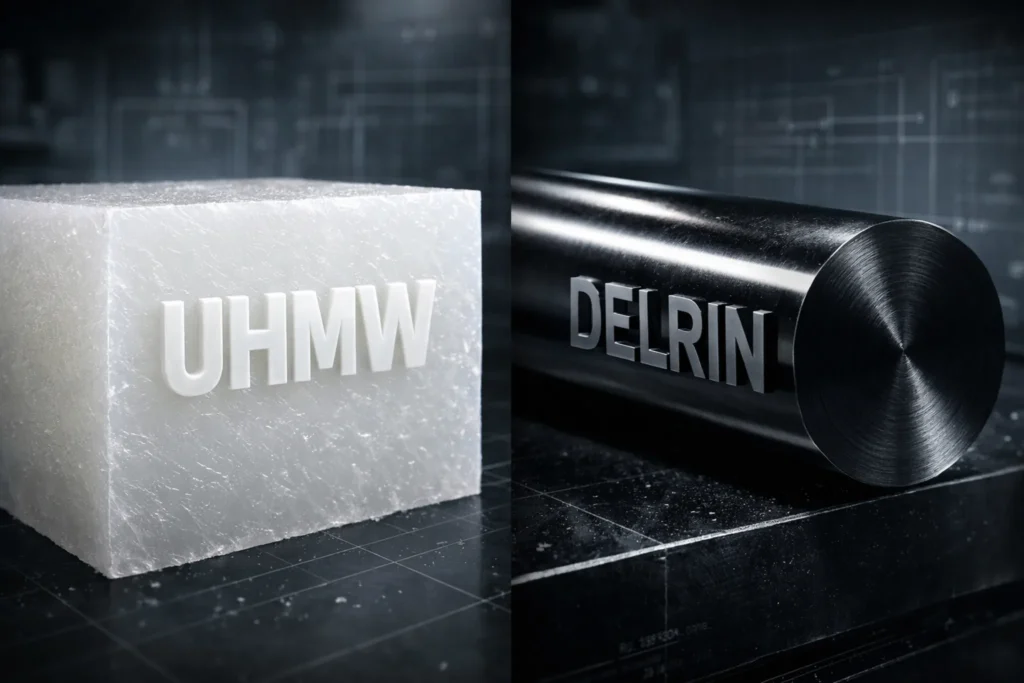
Choosing between UHMW-PE and Delrin® (POM-H) depends on what the part actually needs to do.
UHMW-PE is usually investigated first when the dominant requirements are abrasion resistance, sliding wear, impact resistance, very low water absorption and low-friction service.
Delrin/POM-H is usually investigated first when the part needs higher stiffness, higher tensile strength, better dimensional control and precision mechanical performance.
The simplest engineering decision rule: Choose UHMW when wear, impact and environmental exposure dominate. Choose Delrin when stiffness, precision and mechanical loading dominate. When the requirements overlap, compare the exact grades under the actual load, speed, temperature, counterface, environment and manufacturing process.
The comparison below uses representative published data rather than treating either polymer family as having one universal specification.
UHMW vs Delrin: Side-by-Side Engineering Comparison
For a representative comparison, Röchling’s Polystone M virgin, ASTM (PE-UHMW/PE1000) data can be compared with Ensinger’s TECAFORM AD CAL natural (Delrin 150-equivalent, POM-H) stock-shape data.
These are specific commercial grades, so the numbers should not be treated as universal values for every UHMW or Delrin product [1] [2].
Performance summary table
| Property | UHMW-PE (representative grade) | Delrin/POM-H (representative grade) | Engineering interpretation |
| Density | 0.93 g/cm³ | 1.41 g/cm³ | UHMW is substantially lighter |
| Tensile yield strength | 3,100 psi | 10,400 psi | POM-H is about 3.4× higher in this comparison |
| Tensile modulus | 100,000 psi | ~450,000 psi | POM-H is about 4.5× stiffer |
| Flexural strength | 3,500 psi | 14,500 psi | POM-H has substantially greater flexural strength |
| Notched Izod impact | No Break | 1.4 ft-lb/in | UHMW shows much higher impact resistance in the reported test |
| Water absorption | <0.01% | 0.90% at saturation | UHMW has substantially lower moisture uptake |
| Dynamic coefficient of friction | 0.10–0.22 | Grade/test dependent | Both can be suitable for sliding applications |
| CTE | 1.1 × 10⁻⁴ in/in/°F | 6.8 × 10⁻⁵ in/in/°F | UHMW expands more with temperature |
| HDT at 264 psi | 108°F | 257°F | POM-H has a major advantage in stiffness retention under this test load |
| Melting temperature | 266–275°F | ~347°F | POM-H has the higher melting temperature |
Sources: Röchling Polystone M virgin, ASTM technical data [1]; Ensinger TECAFORM AD CAL natural technical data [2].
Design trade-offs at a glance
| If the design priority is… | Material to investigate first | Why |
| Abrasive wear | UHMW | Strong wear-performance history |
| Repeated impact | UHMW | Very high impact resistance |
| Sliding liners | UHMW | Low friction and wear characteristics |
| Very low moisture uptake | UHMW | <0.01% water absorption reported for representative grade |
| High stiffness | Delrin/POM-H | Much higher modulus |
| High tensile load | Delrin/POM-H | Much higher tensile yield strength |
| Precision mechanical parts | Delrin/POM-H | Better stiffness and dimensional-control profile |
| High-temperature load-bearing | Delrin/POM-H | Higher HDT under the reported 264-psi test |
| Lightweight wear components | UHMW | Lower density |
| Precision gears | Delrin/POM-H | Higher stiffness and established gear applications |
These are starting points, not automatic selections. The actual grade, geometry, temperature, pressure, sliding velocity, counterface, chemical exposure and manufacturing method still need to be checked.
What Performance Problem Are You Trying to Solve?
The first question should not be “which is the better plastic?” It should be: what performance problem is causing this part to fail or limiting the design?
A wear liner and a precision gear can both be made from engineering plastics, but their limiting properties are completely different.
Friction and sliding wear requirements
Röchling’s Polystone M virgin data reports a dynamic coefficient of friction of 0.10–0.22 and a static coefficient of friction of 0.15–0.20 under its specified test conditions [1].
Delrin also has a long history in gears, bearings, bushings and other moving components, with grades specifically developed for tribological applications [3].
Coefficient of friction is not a universal material constant, it changes with counterface material, surface finish, pressure, velocity, temperature, lubrication, grade and test method.
A statement like “UHMW has lower friction than Delrin” shouldn’t be presented as universally true without matched test data.
Load type: static vs dynamic stress
For a continuously loaded structural component, the relevant questions include:
What is the applied stress?
How long is the load maintained?
What is the operating temperature?
How much deflection is acceptable?
Is the load constant or cyclic?
Representative tensile modulus data shows a large stiffness difference, UHMW (100,000 psi) versus POM-H approximately (450,000 psi) [1] [2], meaning POM-H will generally deflect substantially less under the same geometry and elastic loading.
But impact loading tells a different story: UHMW’s representative ASTM D256 result is No Break, illustrating why a material with lower tensile stiffness can still be the better choice for impact heavy service.
Tolerance sensitivity and dimensional control
Tolerance requirements are a system level manufacturing problem, not simply a material specification, the final dimension depends on machine capability, tool geometry, stock condition, temperature, CTE, moisture, residual stress, machining parameters, geometry and inspection method.
Delrin/POM-H has a significant advantage where stiffness and dimensional stability matter: its representative CTE is (6.8 × 10⁻⁵ in/in/°F), compared with (1.1 × 10⁻⁴ in/in/°F) for the representative UHMW grade [1] [2]. The UHMW grade’s reported thermal expansion is about (1.6 times) the POM-H value.
Material Structure Differences That Affect Real-World Performance
UHMW molecular weight and chain entanglement
UHMW-PE is polyethylene with an ultra-high molecular weight. The very long molecular chains contribute to high impact resistance, abrasion resistance, low friction, toughness and low moisture absorption. The same structure also contributes to a relatively low modulus compared with stiffer engineering plastics.
UHMW gains toughness and wear behavior partly at the expense of stiffness. Celanese’s GUR UHMW-PE information describes the material family as used where wear resistance, impact strength and sliding properties matter [4].
Delrin crystalline structure and stiffness
Delrin is an acetal homopolymer (POM-H). Its semi crystalline structure contributes to high strength, high stiffness, low friction, dimensional stability, and wear resistance.
Delrin’s technical documentation specifically discusses precision mechanical applications including gears and bearings where dimensional behavior and mechanical performance matter [3].
| Material | Representative tensile modulus |
| UHMW-PE | 100,000 psi |
| POM-H | ~450,000 psi |
The difference is approximately 4.5× in this specific comparison [1] [2].
How structure directly impacts machining and stability
UHMW is relatively soft and compliant, during machining, the part must be adequately supported and cutting conditions must control heat and deformation.
POM-H’s higher stiffness makes it more suitable for precision machined components where dimensional control matters.
Neither material has a universal machining tolerance: material structure influences machining behavior, but final tolerance is determined by the complete machining process.
Mechanical Performance Comparison Under Load
Compressive strength and creep resistance
Compressive performance requires careful interpretation because suppliers report different test conditions. The representative UHMW grade reports a compressive strength of (3,000 psi), while the POM-H stock grade reports approximately (3,600 psi at 1% strain and (15,500 psi) at 10% strain [1] [2]. These figures shouldn’t be treated as a simple head-to-head ratio because the reporting conditions differ.
Creep is even more application dependent. Both UHMW and POM-H are thermoplastics that can deform progressively under sustained stress.
Delrin’s design guidance states that creep depends on composition, stress, temperature and moisture and should be built into design calculations [3].
Impact resistance and fatigue behavior
| Material | Notched Izod | Test |
| UHMW-PE, Polystone M virgin | No Break | ASTM D256 |
| POM-H, TECAFORM AD CAL natural | 1.4 ft-lb/in | ASTM D256 |
This is strong evidence that UHMW should be seriously considered when sudden impact is a major failure mode [1] [2].
Fatigue is more complicated, neither “UHMW has better fatigue” nor “Delrin has better fatigue” is precise without specifying stress amplitude, frequency, temperature, geometry, stress concentration, environment, test method and grade.
Long-term deformation risks in continuous service
Continuous service introduces two separate risks: creep under sustained load, and dimensional change from temperature and environment.
UHMW’s lower modulus means deflection can become important under sustained loading.
POM-H’s greater stiffness gives it a stronger starting position for mechanically constrained components, but POM-H also creeps and shouldn’t be described as creep-free [3].
Friction, Wear, and Sliding Behavior
Coefficient of friction in dry and lubricated systems
Röchling reports dynamic COF of (0.10–0.22) and static COF of ( 0.15–0.20) for Polystone M virgin [1]. Delrin’s friction behavior is strongly grade and application dependent. Standard and tribological grades can behave very differently [3].
Comparing one UHMW COF number against one Delrin COF number without matching load, velocity, counterface, surface finish, temperature and lubrication can produce a misleading conclusion.
Abrasive wear resistance in high-cycle motion
UHMW is particularly attractive where the material itself acts as a wear surface, chute liners, conveyor wear strips, guide rails, material handling liners, sliding pads, impact/wear surfaces.
Delrin is also widely used in wear components, particularly gears, bushings, bearings, rollers and cams.
The distinction isn’t “UHMW wears, Delrin doesn’t”, it’s that UHMW has a particularly strong value proposition for abrasive and impact wear, while POM-H is particularly attractive where wear must be combined with stiffness and precision.
Stick-slip performance in precision assemblies
Stick-slip is influenced by much more than nominal coefficient of friction: the static/dynamic friction relationship, surface roughness, load, speed, temperature, lubrication, mating material and system stiffness all matter.
For precision moving assemblies, Delrin’s higher stiffness can provide a more predictable mechanical response; UHMW may still be preferable where low friction, impact and wear dominate.
Machining Accuracy and Manufacturing Control
Tolerances achievable with UHMW
UHMW can be CNC machined, but its relatively low stiffness (representative modulus of only 100,000 psi, versus ~450,000 psi for the POM-H grade examined [1] [2]) makes workholding and dimensional control important, particularly for thin walls, long parts, significant clamping forces, tight tolerances or temperature sensitive parts. There is no universal claim such as “UHMW can hold ±0.001 inch”, the actual achievable tolerance must be established for the machine, stock, geometry and process.
Dimensional stability advantages of Delrin
Delrin/POM-H has a stronger case for precision mechanical components: its representative CTE (6.8 × 10⁻⁵ in/in/°F) is well below the representative UHMW grade’s (1.1 × 10⁻⁴ in/in/°F) [1] [2], and its much higher modulus reduces elastic deflection during machining and service.
See our detailed machining Delrin guide for parameters.
Post-machining movement and stress relaxation
Machining removes material and can release residual stresses. The resulting dimensional change depends on stock manufacturing history, grade, section thickness, machining sequence, heat generated during cutting, time after machining and storage environment.
UHMW’s lower stiffness and relatively high thermal expansion can make this particularly important for dimensionally sensitive parts. Delrin also requires attention to residual stress and thermal conditions, higher stiffness doesn’t eliminate post machining movement.
Environmental and Chemical Resistance Comparison
Moisture absorption and dimensional change
| Property | UHMW-PE | POM-H |
| Water absorption | <0.01% | 0.90% at saturation |
| Test | ASTM D570 | ASTM D570 |
Because the UHMW value is reported as less than 0.01%, it isn’t scientifically appropriate to claim an exact 90× difference [1] [2].
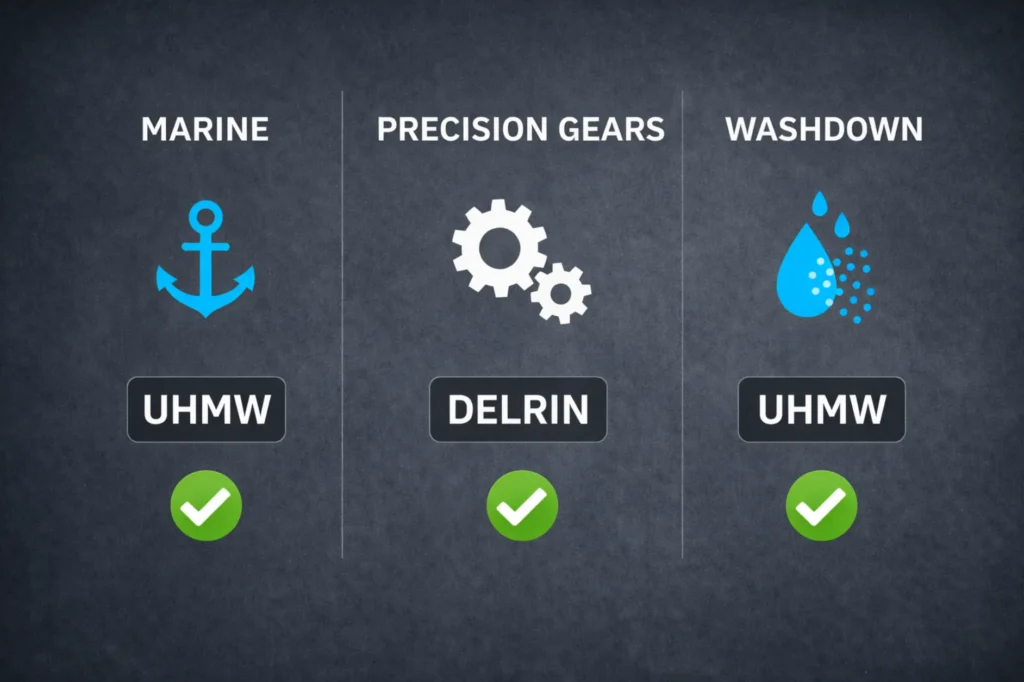
The defensible conclusion: the representative UHMW grade has extremely low water absorption, substantially below the reported saturation value for the representative POM-H grade, relevant in washdown environments, marine service, wet conveyors, outdoor equipment and water exposed sliding components.
Chemical compatibility limits
UHMW has a strong chemical resistance profile but isn’t chemically immune.
Celanese’s GUR UHMW-PE guidance identifies good resistance to many aqueous salt solutions, non-oxidizing acids, alkalis and solvents, with limitations around certain aromatic hydrocarbons, halogenated hydrocarbons, oils/fats/waxes and strong oxidizing chemicals, temperature and mechanical stress can also affect resistance [4].
Delrin also has useful chemical resistance, but compatibility depends on the chemical and exact conditions [3].
The correct qualification for both materials is chemical + concentration + temperature + exposure time + mechanical stress + exact grade, not simply “UHMW is chemically resistant” or “Delrin is chemically resistant.”
A flat compatibility checkmark with no concentration or temperature attached isn’t enough to specify against.
Outdoor, UV, and temperature exposure behavior
Neither material family has one universal outdoor rating.
UHMW is available in UV-stabilized grades, Röchling, for example, offers UV-stabilized Polystone M grades for extended outdoor exposure.
Delrin also has grades designed for particular environmental conditions. The comparison should be UV-stabilized UHMW grade versus UV/weathering qualified Delrin grade, not generic UHMW versus generic Delrin.
| Thermal property | UHMW-PE | POM-H |
| Melting temperature | 266–275°F | ~347°F |
| HDT at 264 psi | 108°F | 257°F |
| CTE | 1.1 × 10⁻⁴ in/in/°F | 6.8 × 10⁻⁵ in/in/°F |
The HDT values demonstrate a substantial POM-H advantage under the specified test load [1] [2], but HDT is not a continuous use temperature guarantee.
Cost, Availability, and Supply Considerations
Material cost vs lifecycle cost
A universal statement like “UHMW is cheaper” or “Delrin is more expensive” isn’t sufficiently useful for B2B material selection, actual cost depends on grade, supplier, stock form, size, quantity, color, certification, region and market conditions.
Lifecycle cost can matter more than purchase price:
| Cost factor | Question |
| Material | What is the current quoted price for the exact grade? |
| Machining | How much machine time is required? |
| Tooling | What tooling is required? |
| Scrap | How much material is rejected? |
| Wear | How often must the component be replaced? |
| Maintenance | Does the component require adjustment/lubrication? |
| Downtime | What does component failure cost? |
| Qualification | What testing/certification is required? |
A UHMW wear liner that lasts significantly longer can have better lifecycle economics even if its purchase price isn’t the lowest.
A Delrin component can justify its material cost when precision, stiffness or machining performance reduces downstream costs.
Sheet, rod, and custom form availability
Both UHMW and POM-H are available in common stock forms, but availability depends on supplier and market.
UHMW is commonly supplied as sheet, plate, rod, profiles, wear-strip products and custom fabricated components.
Delrin/POM-H is commonly available as rod, sheet, plate, tube, machined stock and injection molding resin.
For production procurement, check availability for the exact grade and required dimensions, not just the polymer family.
Waste, scrap rate, and rework implications
For CNC parts, compare material + machine time + tooling + labor + inspection + scrap + rework.
For molded parts, compare resin + tooling + cycle time + machine cost + labor + scrap + quality control.
UHMW’s machining behavior may need extra attention to workholding and dimensional control. Delrin’s higher stiffness can help precision machining, but neither material should be assigned a universal scrap rate advantage without actual process data.
Typical Applications Where Each Material Performs Best
The application decision becomes clearer once the failure mechanism is identified.
UHMW applications where Delrin fails
This should be read as “applications where standard Delrin may be the weaker starting choice,” not situations where Delrin literally cannot work.
UHMW should be investigated first for:
- Abrasive chute liners
- Conveyor wear strips
- Impact-resistant liners
- Bulk-material handling surfaces
- Sliding components exposed to water
- Marine sliding surfaces
- Low-friction guide components
- Components where extremely low water absorption is valuable
The reason is the combination of high impact resistance, wear resistance, low friction and low moisture absorption.
Röchling specifically identifies PE-UHMW/PE1000 for wear and sliding applications [1].
Delrin applications where UHMW fails
Again, “fails” should mean “does not meet the engineering requirement efficiently,” not that UHMW can never be used.
Delrin/POM-H should be investigated first for:
- Precision gears
- Dimensionally sensitive bushings
- Mechanically loaded rollers
- Precision bearings, cams, linkages
- Precision machined components
- Components requiring higher stiffness
The representative modulus comparison is decisive here, UHMW 100,000 psi versus POM-H ~450,000 psi, a 4.5× difference that can substantially affect deflection and dimensional behavior [1] [2].
High-risk misapplication scenarios
The most common material selection mistakes aren’t simply choosing the “wrong plastic.” They’re choosing from the wrong property:
- Selecting UHMW for its excellent wear resistance when the real failure mode is excessive deflection.
- Selecting Delrin for its higher tensile strength when the actual failure mode is impact fracture.
- Selecting either material from a generic chemical-resistance chart without checking concentration and temperature.
- Assuming a material’s nominal machining tolerance is guaranteed on every geometry.
- Treating HDT as a continuous-use temperature.
- Comparing COF numbers obtained under different test conditions as though they were directly interchangeable.
- Selecting a food-contact or outdoor grade based only on the polymer family instead of the exact supplier grade.
FAQs
Which is better for boat trailer bunks or marine slides?
UHMW is generally the material to investigate first for marine sliding applications, the representative grade reports under 0.01% water absorption and a dynamic coefficient of friction of (0.10–0.22) [1].
Delrin can work in marine mechanical components needing greater stiffness, but it is not automatically the better choice simply because it is stronger. Also check load, sliding speed, counterface, temperature, UV exposure, saltwater exposure and required service life.
Can you machine Delrin to tighter tolerances than UHMW?
Delrin/POM-H generally provides a stronger starting point for precision machining, its representative tensile modulus (~450,000 psi) is roughly 4.5× that of the representative UHMW grade (100,000 psi) [1] [2].
But the final tolerance is a manufacturing capability, not a guaranteed material property; machine capability, tooling, stock condition, geometry and inspection method all matter.
Is Delrin or UHMW better for high-temperature applications?
Delrin/POM-H generally has the advantage where the part must hold stiffness under load at elevated temperature, representative HDT at 264 psi is 108°F for UHMW versus 257°F for POM-H [1] [2].
HDT is not a continuous-use-temperature guarantee for either material, the exact grade, stress, temperature and duration still need to be checked.
Why does UHMW seem to last longer in abrasive environments?
UHMW combines high impact resistance, low friction, good wear performance and low moisture absorption, which is why it’s commonly used for liners, chutes, guides and bulk material handling surfaces [1] [4]
“UHMW always lasts longer” is too broad, though actual wear life depends on abrasive particle size and hardness, pressure, sliding speed, counterface, temperature and the exact grade.
Which material should I use for food processing equipment UHMW or Delrin?
Neither polymer should be selected just because the family is commonly used in food processing, compliance is grade-specific.
Verify the exact resin grade, the applicable food contact regulation, temperature, cleaning chemicals and procedure, wear requirements, and supplier documentation before specifying either material.
Related Guides
- Delrin® (POM): Properties, Grades, Applications & Material Selection Guide
- Delrin vs. Nylon
- Delrin vs. Teflon
- Delrin vs. Acetal (POM-H vs. POM-C)
- Delrin vs. ABS
- HDPE vs. Delrin
- Machining Delrin
- UHMW vs HDPE
- UHMW vs PTFE
Technical Sources
- [1] Röchling — Polystone® M virgin, ASTM (PE-UHMW/PE1000) technical data sheet
- [2] Ensinger — TECAFORM AD CAL natural (Delrin 150-equivalent POM-H) technical data
- [3] Craftcloud — Delrin (POM-H) CNC material guide (creep, dimensional stability, chemical limits)
- [4] Resinex / Celanese — GUR® UHMW-PE brand information (chemical resistance)
Data-use note
The numerical values in this guide belong to the specific grades and test methods cited.
They should not be converted into universal specifications for all UHMW-PE or Delrin/POM-H materials, stock-shape materials and injection molding grades can have different published properties even under a similar material designation.
Before using a value for design, qualification, regulatory approval or procurement, verify the current technical datasheet for the exact grade, form and supplier.
Last reviewed: October 2026

Usama Ayub is the founder of PlasticSpec and a polymer manufacturing engineer with eight years of hands-on industrial experience in PET, PA6, and PA66 fiber and filament yarn production. He writes material property and selection guides for Delrin, Nylon, PEEK, PTFE, UHMW, Polycarbonate, and ABS.