
Delrin vs. Acetal: Are They Even Different Materials?
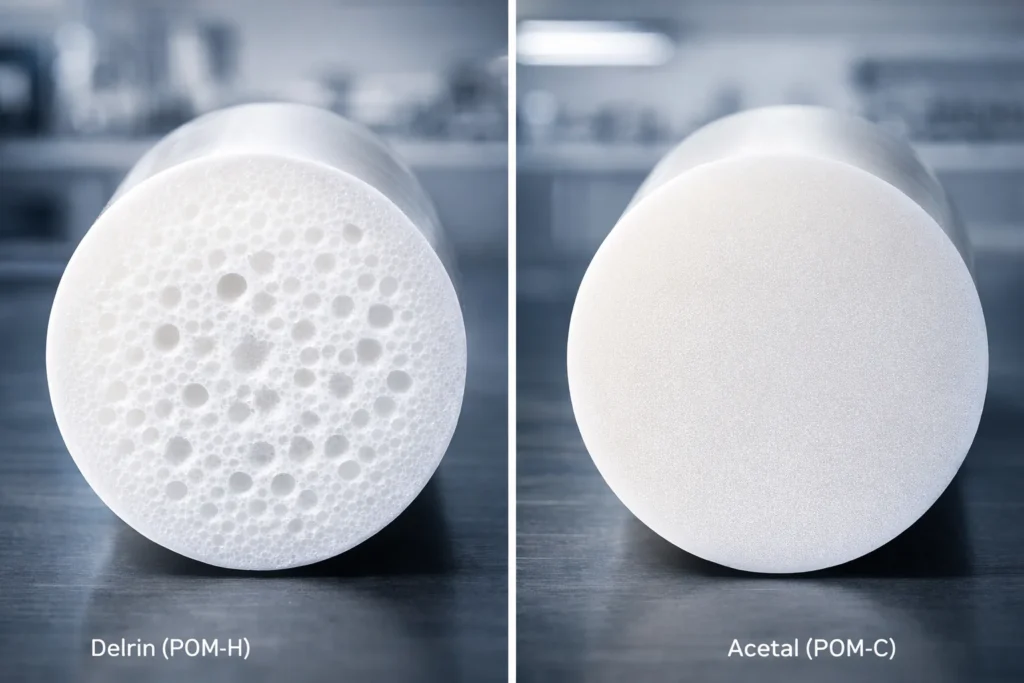
“Delrin” is a brand name for one specific type of acetal. It belongs to the acetal homopolymer family, generally shortened to POM-H.
“Acetal” itself is the broader umbrella term, covering both POM-H and the other major branch, acetal copolymer (POM-C), sold under names like Hostaform, Celcon and Tecaform.
So the real question isn’t “Delrin or acetal”, it’s POM-H or POM-C.
Both are close on impact strength and friction, genuinely different on tensile strength, and diverge most clearly on heat and chemical resistance, not always the properties assumed first.
This guide walks through what the two acetal families actually are, what matched data shows, where they diverge in practice, and how to choose between them by grade.
POM-H vs. POM-C: Matched Data From the Same Test Lab
Most “Delrin vs. acetal” comparisons mix numbers from different suppliers, which makes small differences look bigger or smaller than they are.
The table below uses POM-H and POM-C data sheets from the same supplier, tested by the same lab, so the comparison is genuinely apples-to-apples.
| Property (73°F / 23°C, ASTM methods) | POM-H (Delrin-type) | POM-C (acetal copolymer) | What it means |
| Water absorption at saturation | ~0.90% [1] | 0.8–0.9% [2] | Statistically the same. Moisture resistance isn’t the reason to pick one over the other. |
| Tensile yield strength | 10,500–11,000 psi (72–76 MPa) [1] | 8,800–9,500 psi (61–66 MPa) [2] | A genuine gap, POM-H is roughly 15–20% stronger on these sheets. |
| Tensile modulus | 350,000–450,000 psi (2.4–3.1 GPa) [1] | 380,000–400,000 psi (2.6–2.8 GPa)[2] | Ranges overlap. Stiffness isn’t a clean differentiator here. |
| Notched Izod impact | 1.0–1.2 ft-lb/in [1] | 1.0–1.2 ft-lb/in [2] | Identical on these sheets. “POM-C is tougher” doesn’t hold up against this data. |
| Dynamic coefficient of friction | 0.12–0.35, grade-dependent [1] [4] | 0.21–0.25[2] | Overlapping. Compare at your actual load and counterface, not the family name. |
| Continuous service temperature, air | 185–190°F [1] | 180–210°F [2] | POM-C’s upper end runs higher its real edge shows up under sustained heat, not at room temperature. |
| Heat deflection temp. @ 264 psi | 242–257°F [1] | 220–230°F[2] | Under load, POM-H’s sheet lists the higher figure, the opposite of what “POM-C handles heat better” implies. |
| Melting point | ~347°F [1] | 329–335°F[2] | POM-H melts higher, but that doesn’t translate to a heat-deflection advantage under load, see above. |
Sources [1] and [2] are the same supplier’s own POM-H and POM-C stock-shape sheets, reviewed September 2026. Grades, colors and lot-to-lot variation still apply, verify the current sheet for your exact grade before design or procurement.
What the matched data actually shows
- The strength gap is real, but the toughness gap isn’t. POM-H’s tensile advantage holds up on matched data. The common claim that POM-C is meaningfully tougher does not, notched impact is identical on these sheets.
- “POM-C for heat” is only true at the top of its range, and only in one sense. Its continuous service ceiling (210°F) is higher than POM-H’s (190°F). But under a 264 psi load, POM-H actually shows the higher heat deflection temperature. Which one matters depends on whether your part is loaded or just warm.
- Melting point is the wrong numbers to compare by. POM-H melts about 12–18°F higher, but that has no direct bearing on the heat deflection result above, don’t select by melting point for either family.
Where POM-H and POM-C Genuinely Diverge
Chemical and hot-water resistance
This is the clearest, best supported difference between the two families.
Protolabs’ own POM-C sheet specifically lists resistance to hot water as a product benefit; its POM-H sheet does not make that claim [1] [2].
Celanese’s documentation for Hostaform/Celcon states that its copolymer chemistry gives higher stability to thermal and oxidative degradation compared with acetal homopolymer, and lists excellent resistance to fuels, solvents and strong alkalis [8].
Separately, Goodfellow’s POM-C compatibility data rates the material “Good” against alkalis and aromatic hydrocarbons, “Good-Fair” against dilute acids, and “Poor” against concentrated acids and halogens [6].
Thermal and oxidative stability
Beyond the headline service temperature numbers, POM-C’s manufacturer literature specifically claims better long term stability under heat and oxidative exposure than homopolymer [8].
For parts that see sustained warm conditions rather than a brief peak, this is arguably more relevant than either family’s peak temperature spec.
Centerline porosity in stock shapes
Thicker POM-H rod and slab stock carries a documented risk of centerline porosity, small internal voids from the extrusion process [7].
Protolabs’ own design guidance recommends choosing POM-C for thicker parts specifically to avoid this [5].
It’s a manufacturing consideration, not a mechanical property one, and it only applies to certain stock forms, check with your supplier for the section thickness in question.
Grade Selection: What You’re Actually Buying
“Delrin” and “acetal” are family names, not purchase orders. Within each family, specific grades change the numbers above substantially.
Common Delrin (POM-H) grades
| Grade | What changes | Sourced values |
| Delrin 100 (high viscosity) | Higher viscosity homopolymer generally used where the stock form and processing suit it. | See supplier sheet for grade-specific mechanicals [13]. |
| Delrin 500 / 500P (medium viscosity, general purpose) | Balanced stiffness, strength and processability, the closest to the “standard” POM-H figures in the table above. | ~72 MPa yield, 3,200 MPa modulus, 9 kJ/m² notched Charpy (ISO, injection-molding resin) [11] [14]. |
| Delrin 500T (toughened) | Trades yield strength for impact resistance. | ~54 MPa yield, 2,300 MPa modulus, versus ~72 MPa / 3,200 MPa for standard 500 [12]. |
Common POM-C grades and brands
- Hostaform® / Celcon® (Celanese): the most widely referenced POM-C brand family, with basic, glass-reinforced, high-impact, low-friction and medical-technology (MT) variants, most grades comply with FDA/EU food contact regulations and MT grades are documented against USP Class VI [8].
- Tecaform® / TECAFORM AH (Ensinger): a stock-shapes POM-C line with published mechanical data comparable to the Protolabs figures above [3].
Comparing equivalent grades: a same-method wear example
Ensinger’s own sheets let you compare a specific POM-H grade against a specific POM-C grade under the identical ASTM D3702 wear test (40 psi, 50 fpm).
Delrin 511 (POM-H) lists a wear factor of 55 × 10⁻¹⁰ in³·min/ft·lb·hr, while TECAFORM AH (POM-C) lists 65 × 10⁻¹⁰ under the same method [3] [4].
POM-H comes out modestly ahead here a small, real difference, not the large “wear-resistance win” sometimes claimed for one family over the other.
Manufacturing: CNC Machining, Molding, and 3D Printing
CNC machining
Both machine well and are common choices for precision parts.
- Delrin (POM-H): Produces harder, more brittle chips. It allows for faster spindle speeds and higher feed rates without melting. It achieves a superior surface finish (Ra) directly off the tool.
- Acetal (POM-C): Slightly “gummier” than Delrin. It requires sharp tooling and proper chip evacuation to prevent re-welding. However, it is more dimensionally stable; parts are less likely to “walk” or warp after being released from the fixture.
See our detailed guide on machining Delrin guide for cutting parameters.
Injection molding
Both families are injection molded at volume.
- Processing Window: Acetal (Copolymer) has a much wider processing window. It is less sensitive to temperature fluctuations in the barrel, leading to fewer rejected parts.
- Mold Shrinkage: Delrin has a higher shrink rate (up to 2.2%). If you switch from Acetal to Delrin in the same mold, your final part will likely be undersized.
- Degradation: Delrin is more prone to thermal degradation if left in a hot barrel too long, which can lead to “splay” (silver streaks) on the part surface.
3D printing
3D printing POM is notoriously difficult due to extreme first-layer adhesion issues and high thermal contraction.
- The Warping Risk: Both materials shrink significantly. You must use an enclosed chamber (100°C+) and a specialized build plate (e.g., cellulose-based or PP) to prevent the part from peeling.
- Safety Warning: Delrin (POM-H) is more sensitive to overheating. If your nozzle exceeds 235°C, the material can rapidly decompose and release Formaldehyde gas. Proper ventilation or filtration is mandatory.
CNC machining or injection molding remain the more practical production routes for either family.
Where Each Is Commonly Used
- POM-H / Delrin: gears, bushings, rollers, bearings, cams, precision mechanical parts, and electrical insulating components, where its stiffness and machinability are the draw [1].
- POM-C: bushings, rollers, wear strips, gears, pump parts and fittings, particularly where hot water or chemical exposure is part of the service environment [2].
The exact grade still matters more than the family name for either list.
Choosing Between POM-H and POM-C by Requirement
| If the primary requirement is… | Investigate first | Check before deciding |
| Maximum tensile strength or stiffness | POM-H | The exact grade’s data sheet, the gap is real but grade dependent. |
| Hot water, steam, or sustained chemical exposure | POM-C | Manufacturer chemical compatibility data for your exact fluid. |
| Thick rod, slab, or plate stock | POM-C | Whether centerline porosity is a real concern for your section thickness and supplier. |
| Impact resistance | Either, matched data shows no clear winner | Notched impact at your temperature; consider toughened POM-H (500T) if impact is the driver. |
| Sliding or wear applications | Either, compared under the same test method | Wear factor and friction data from the same test standard for both candidates. |
| Food contact or medical use | A certified grade of either family | Documentation for the exact grade and color, Hostaform MT and specific Delrin grades both have certified options. |
| Lowest cost | Current supplier quotations | Total manufactured part cost, not price per kilogram. |
This is a screening tool, not a ranking. The limiting requirement should decide which family and grade deserve further investigation.
Cost: Material Price vs. Total Part Cost
Neither family has a fixed universal price advantage.Pricing depends on grade, supplier, region, stock form and volume. What does vary predictably is total part cost.
POM-H’s stiffness and machinability can reduce cycle time and scrap in CNC production, while POM-C’s broader grade portfolio and processing robustness can reduce tooling and rework risk in molded parts. Compare current quotations for the exact candidate grades and the full manufactured part cost, not price per kilogram.
When Neither POM-H Nor POM-C Is the Right Answer
- Continuous structural load well above 200°F: investigate PEEK or another high performance thermoplastic, or a reinforced grade of either acetal family, once the load and temperature exceed what standard POM-H or POM-C data supports.
- Aggressive or concentrated acids: both families rate poorly here on the data reviewed [6]. Look at a material selected for that specific chemistry.
- Extreme wear or unlubricated low friction beyond either family’s range: consider UHMW-PE or a PTFE-based material.
- Regulated food, drinking-water, or medical use: compliance is grade and color-specific for both families, Delrin 150 natural lists FDA/NSF compliance while the black version does not [9] [10]. Hostaform MT is documented against USP Class VI [8]. Specify the exact certified grade, not the family.
Final Decision Checklist
- Strength or stiffness the limiting factor? Compare matched tensile and modulus data, POM-H typically leads, grade for grade.
- Hot water, steam, or chemical exposure involved? Check POM-C’s compatibility data and the exact chemical, concentration and temperature.
- Thick stock (rod, slab, plate)? Ask your supplier about centerline porosity risk before defaulting to POM-H.
- Impact or shock loading? Don’t assume POM-C wins by default, compare notched impact data at your temperature, and consider toughened POM-H grades.
- Sliding, rotating, or bearing use? Compare wear factor and friction under the same test method for both candidates.
- Food, medical, or drinking-water application? Specify the exact certified grade and color, and verify current documentation.
- Manufacturing process? CNC, molding, or extrusion, select the grade suited to that process, not the family name alone.
- Procurement clarity? Confirm the exact brand, grade, and stock form can actually be sourced at your volume and lead time.
Frequently Asked Questions
Is Delrin the same as acetal?
Not exactly. Delrin® is a brand name for one type of acetal, the homopolymer (POM-H).
“Acetal” is the broader family name, covering both POM-H and copolymer acetal (POM-C).
So Delrin is acetal, but not all acetal is Delrin
Which handles hot water better, Delrin or acetal copolymer?
POM-C. Protolabs’ own copolymer sheet specifically lists resistance to hot water as a benefit, while its POM-H sheet does not make that claim.
Celanese’s Hostaform/Celcon documentation also states its copolymer offers higher thermal and oxidative stability than homopolymer acetal.
Why does thick Delrin stock sometimes have voids in the center?
It’s called centerline porosity, and it’s a known risk in thicker POM-H (homopolymer) rod and slab stock. Protolabs’ own design guidance recommends POM-C for thicker parts specifically to avoid this.
Are Hostaform and Celcon the same as Delrin?
No. Hostaform and Celcon are Celanese’s brand names for acetal copolymer (POM-C), the other major acetal family, not the one Delrin belongs to.
Check our other delrin Related Guides
- Delrin® (POM): Properties, Grades, Applications & Material Selection Guide
- Delrin vs. Nylon
- Delrin vs. ABS
- Delrin vs. Teflon
- UHMW vs. Delrin
- HDPE vs. Delrin
- Delrin 100 vs. 150
- Machining Delrin
- Delrin 3D printing
Technical Sources
Values in this guide come from the manufacturer and supplier data sheets below, reviewed September 2026.
Stock-shape sheets and injection-molding resin sheets report different values; verify the current datasheet for your exact grade before using a number for design, qualification or procurement.
- [1] Protolabs — POM-H (Acetal Homopolymer) CNC material data sheet (2026)
- [2] Protolabs — POM (Acetal Copolymer) CNC material data sheet (2026)
- [3] Ensinger / Polymershapes — TECAFORM AH Black (acetal copolymer) stock-shapes data sheet
- [4] Ensinger / Polymershapes — DELRIN 511 series (acetal homopolymer) stock-shapes data sheet
- [5] Protolabs — POM plastic guide (terminology and centerline-porosity design guidance)
- [6] Goodfellow — POM Copolymer Rod technical data (chemical resistance table)
- [7] Craftcloud — Delrin (POM-H) CNC material guide (centerline porosity, base resistance)
- [8] Resinex / Celanese — Hostaform® / Celcon® acetal copolymer brand information
- [9] Trident Plastics — Delrin 150 NC010 (POM-H natural, extruded shapes) technical data
- [10] Trident Plastics — Delrin 150 BK (POM-H black, extruded shapes) technical data
- [11] Delrin 500 NC010 product information (DuPont, ISO data, injection-molding resin)
- [12] Material Data Center — Delrin 500T BK602 (toughened medium-viscosity homopolymer)
- [13] UL Prospector — Delrin 100 BK602 (high-viscosity homopolymer)
- [14] UL Prospector — Delrin 500P BK602 (medium-viscosity homopolymer)
Last reviewed: September 2026

Usama Ayub is the founder of PlasticSpec and a polymer manufacturing engineer with eight years of hands-on industrial experience in PET, PA6, and PA66 fiber and filament yarn production. He writes material property and selection guides for Delrin, Nylon, PEEK, PTFE, UHMW, Polycarbonate, and ABS.