
Laser Cut Delrin: Is It Safe, and What Settings Work?
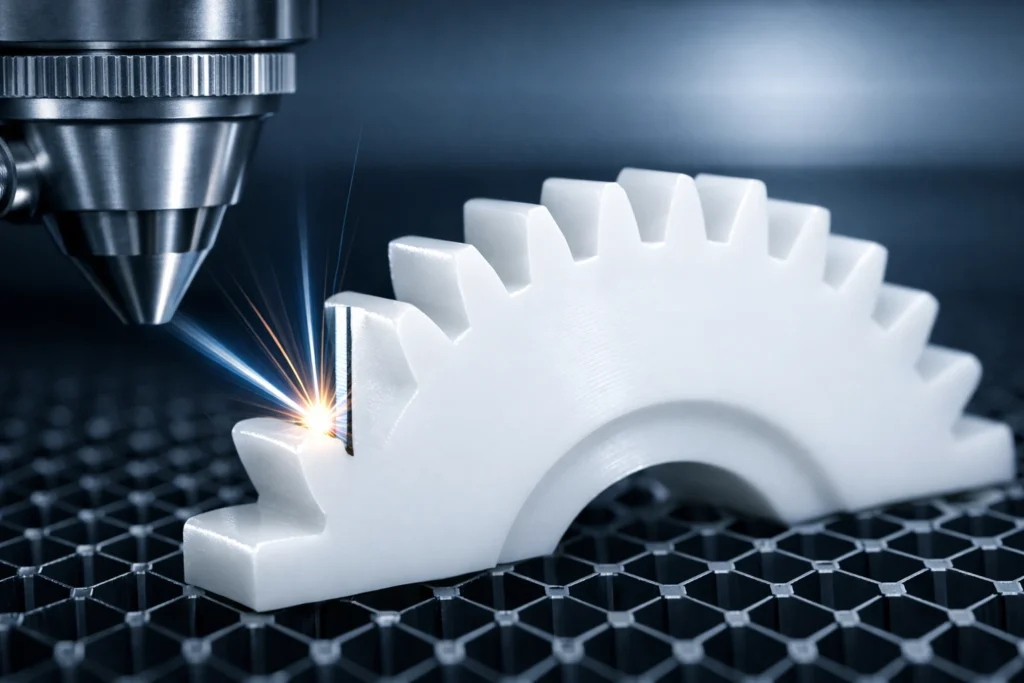
Yes, you can laser cut Delrin (POM-H acetal), and several commercial services do it.
A 10.6 micron CO2 laser is reported to give clean cuts with smooth edges.[1] But the cut zone produces formaldehyde, some university makerspaces ban the material, and no published setting transfers from one machine to another.
This guide covers the safety gate first, then documented starting points, vendor limits and tolerances, and where CNC is the better route.
Quick answer
- Laser cut Delrin if: the sheet is thin (vendors offer 0.125 in to 0.270 in, with one service capping at 1/4 in), the machine is enclosed with extraction, and the policy governing your laser allows acetal.
- Do not if: you cannot control formaldehyde at the machine, or your facility or machine maker lists Delrin as banned.
- Settings: start from a documented recipe or the machine maker’s library, then run a test coupon. Controller power and speed numbers do not transfer between machines.
- Switch to CNC when: the stock is thick, or the part has pockets, threads, or a critical bore or press fit.
Who Laser Cuts Delrin, and Who Does Not
Published policies split sharply. The table shows each source’s position and the limit it sets.
| Source | Position on Delrin / acetal | Limit or reason given |
| Universal Laser Systems | Cuts | 10.6 micron CO2 laser gives clean cuts with smooth edges [1] |
| Pololu (cutting service) | Cuts | Maximum 1/4 in (6.4 mm); described as cutting cleanly with a laser-polished edge [2] |
| SendCutSend (cutting service) | Cuts | Delrin 150 offered in 0.125 in (3.18 mm) and 0.270 in (6.9 mm); laser for most 0.125 in parts, otherwise routed depending on thickness and geometry [3] |
| Boss Laser tested-materials library | Lists Delrin (POM, acetal) | As referenced on NC State’s laser settings page [17] |
| University of Twente DesignLab | Cuts thin sheet only | High fire risk and formaldehyde release [7] |
| UVic laser cutter materials list | Lists Delrin with formaldehyde as its laser-generated air contaminant | Check the entry for current conditions [6] |
| UC Merced engineering makerspace | Banned | Produces formaldehyde gas [4] |
| Emory TechLab | Prohibited | Creates formaldehyde [5] |
The practical reading: commercial services with enclosed, extracted machines cut Delrin in thin gauges, while shared and hobby spaces often prohibit it.
Check which side of that line your machine and facility sit on before you worry about parameters.
The Formaldehyde Gate
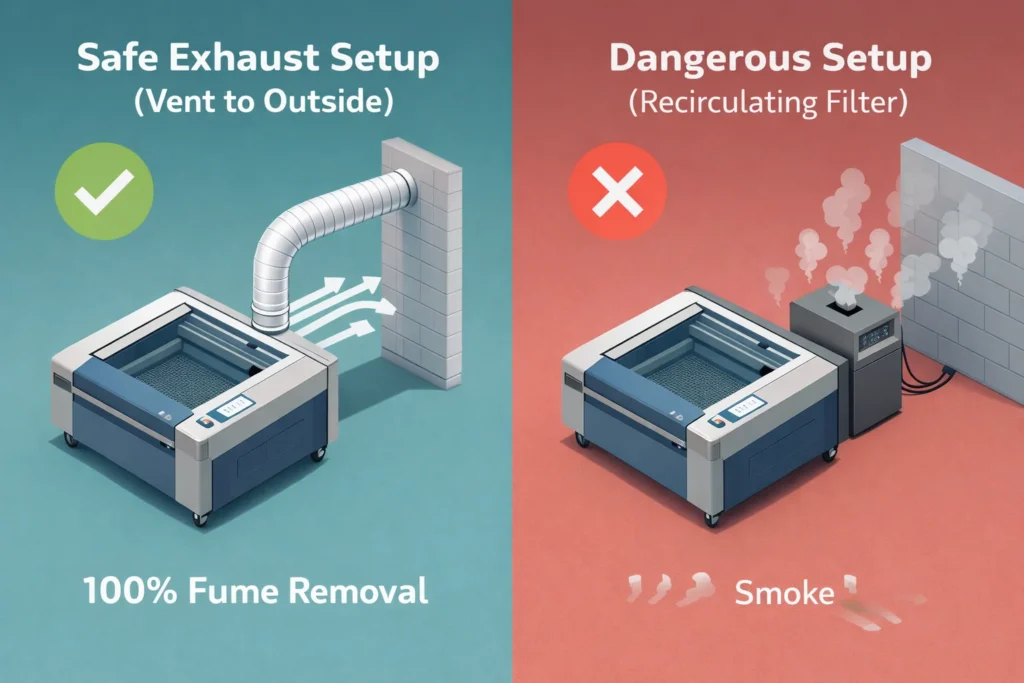
Safety data sheets for acetal homopolymer (Delrin 100AF and Acetron AF POM-H) list formaldehyde among the hazardous decomposition products,[10] [11] and one states that heavy formaldehyde fuming occurs above 230 °C (446 °F).[11]
A laser heats the kerf far above that, so assume formaldehyde is generated at the cut edge.
The Delrin 100AF sheet notes that OSHA lists formaldehyde as a potential cancer hazard and that exposure should be kept below the OSHA permissible exposure limit.[10]
| OSHA formaldehyde limit (29 CFR 1910.1048) | Value |
| Permissible exposure limit, 8-hour time-weighted average | 0.75 ppm |
| Short-term exposure limit, 15 minutes | 2 ppm |
| Action level (triggers exposure monitoring and medical surveillance) | 0.5 ppm, 8-hour TWA |
Sources: OSHA formaldehyde fact sheet[13] and the standard text.[12]
These are U.S. occupational limits; other countries set their own.
Controls to have before the first cut
- An enclosed machine with extraction that exhausts outdoors, or a documented gas phase filter stage if you recirculate. HEPA alone captures particulates, not gases.
- Written approval from whoever governs the laser: your facility, the machine maker and your insurer.
- No unattended cutting. Twente DesignLab cites fire risk as a reason it cuts only thin sheets,[7] and one maker reports heavy flames at full power with slow speeds on 1/4 in sheet.[9]
- Do not use smell as a measurement. The same maker reported a strong odor after a long cut despite heavy filtering and ventilation.[9] That is one anecdote, but it shows odor tells you exposure has already happened. Measure instead.
Starting Settings and the Test Coupon
No sourced setting transfers between machines, because controller power and speed percentages mean different things on different lasers. The documented recipes below show how far results spread. None of them is a specification for your machine.
| Source | Laser (as stated) | Material | Power | Speed | Notes |
| UPenn MEAM makerspace [8] | ULS PLS4.75 | Acetal, 0.045 in | 80 | 16 (PPI 750) | Page says acetal cuts fairly similarly to acrylic and that extruded acetal tends to warp from internal stress |
| NYC Resistor wiki [15] | 60 W, 2 in lens | Acetal, 3/16 in | 100 | 10 (frequency 500) | Entry notes two passes with these settings works. Same page: 0.02 in white sheet must be taped absolutely flat or it will not cut through, and higher settings incinerate it |
| Glowforge community post [9] | Glowforge (model not stated) | Black Delrin, 1/4 in nominal (0.275 in measured) | 60% | 100, 3 passes back to back | Single user, anecdotal. Focus set manually to the measured thickness. At full power, speeds of 400 or less gave lots of flames |
| Sawmill Creek forum post [16] | 40 W CO2 | Delrin, 6 mm | 27% | 1.5%, 60 passes | Single user, anecdotal. Same poster cut 6 mm acrylic in one pass at 100% power and 1.2% speed |
If your sheet is 1/8 in (3 mm), we found no documented number for that thickness. The closest are 0.045 in and 3/16 in above.
Forum posters on the Sawmill Creek thread report starting from the same thickness acrylic recipe, and one cites a laser supplier’s page listing Delrin as 25% slower than acrylic.[16]
Treat that only as a first coupon guess, since the 6 mm example above needed far more passes than any acrylic rule would predict.
Test coupon protocol
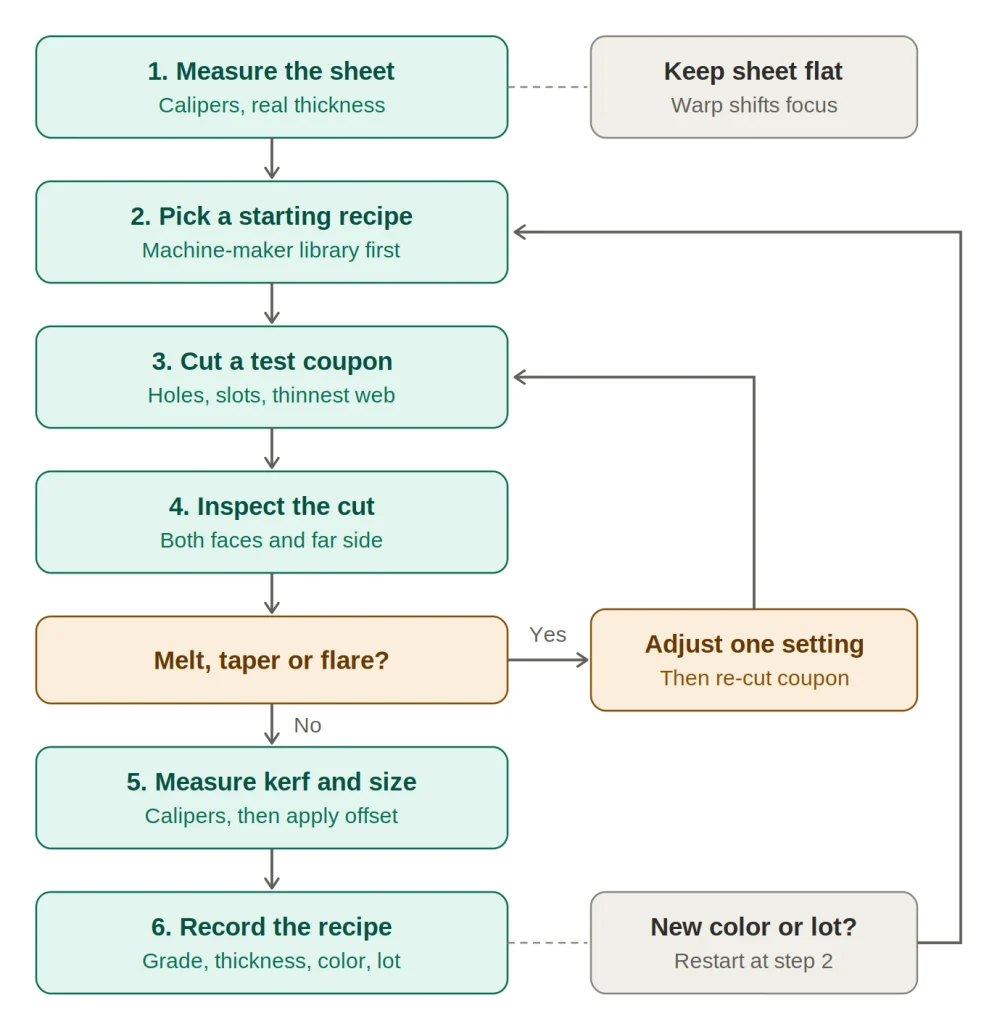
- Measure the sheet. Nominal 1/4 in stock measured (0.275 in) in the Glowforge example, and focus depends on the real thickness.[9]
- Start from a documented recipe, ideally your machine maker’s tested-materials library, as Xometry and the sources above advise, then run test cuts.[18]
- Cut a coupon with real features: holes, slots and the thinnest web in your part. SendCutSend advises holes no smaller than the material thickness.[3]
- Inspect both faces and the far side for melt, taper, flaring and discoloration.
- Measure kerf and critical dimensions with calipers, then apply the offset in your laser software. For scale, one hackerspace tells users to add 0.056 mm to each line on its 60 W laser. Yours will differ. [15]
- Record the recipe by grade, thickness, color and lot. Treat a color change as a new material: carbon pigment in black Delrin absorbs laser energy differently[1]
Keep the sheet flat. Pololu notes that warped or bowed material causes problems in cutting,[2] and extruded acetal is reported to warp.[8]
Thickness, Tolerance and Edge
| Vendor-published figure | Value |
| Pololu maximum Delrin thickness | 1/4 in (6.4 mm) [2] |
| SendCutSend Delrin 150 thicknesses | 0.125 in (3.18 mm) and 0.270 in (6.9 mm) [3] |
| SendCutSend laser-cut tolerance | ±0.005 in (±0.13 mm) [3] |
| SendCutSend CNC-routed tolerance | ±0.009 in (±0.23 mm) [3] |
On thin flat sheet, this vendor publishes a tighter tolerance for laser cutting than for its own routing. That describes flat 2D profiles in one vendor’s process, not machining capability. It does not cover pockets, threads, bores or 3D features, and it is not a guarantee for your part.
Edge quality is described as smooth or laser polished,[1] [2] but a thermally cut edge is still thermally modified, so measure anything that must fit.
Sheet stock for these services is typically Delrin 150; for grade background see our Delrin 100 vs. 150.
Laser cut Delrin or CNC?
| Your part | Start with | Why |
| Thin flat profile, many repeats | Laser, with a validated coupon | No tooling, fast nesting; vendors quote tight flat-sheet tolerances above |
| Stock thicker than your vendor’s cap (1/4 in at Pololu) | CNC routing or milling | Outside the published laser range |
| Pockets, counterbores, threads, 3D contours | CNC | Not laser-cutting operations |
| Critical bore, press fit or sealing face | CNC, or laser plus a finishing pass | Measure the laser edge before trusting the fit |
| You cannot control formaldehyde at the machine | Any cold process | Safety gate not met |
Engineering guidance built on the vendor figures above, not a published standard. We found no vendor that publishes comparable per-part pricing for laser versus CNC, so quote both routes.
If Your Laser Cannot Run Delrin
- Order cut parts. Pololu cuts to 1/4 in [2] and SendCutSend offers 0.125 in and 0.270 in Delrin 150 with laser or routed cutting. [3]
- Machine it. For thick stock, pockets, threads or critical fits, CNC from sheet, rod or plate is the controlled route. See our complete guide on Machining Delrin.
- Change material only if the application allows. UPenn’s makerspace calls acrylic probably the ideal plastic for laser cutting, [8] but Delrin is chosen for strength and low friction in gears and bushings, [3] and acrylic is more brittle. Verify wear, friction and impact needs first.
Machining Delrin Components for a Current Project?
Skip the shop-floor trial and error. Upload your STEP, IGES, or DXF files for an instant manufacturability review, tight-tolerance verification, and fast production quotation.
Request a Precision Machining Quote →🔒 NDA Compliant • 1 to 10,000+ Production Parts • Fast Turnaround
Troubleshooting
| Symptom | Likely cause | First fix |
| Melted, rounded or beaded edge | Too much energy per unit length, or everything done in one pass | Re-run the coupon at lower energy. One maker reports overheating when the job is done all at once [9] |
| Far side distorted or not cut through | Focus off for the real thickness, beam spreading at depth | Re-measure the sheet and reset focus; the Glowforge example set focus to the measured thickness [9] |
| Flames | High power with slow travel, or beam focused on the surface | Stop the job and never cut unattended. Full power at speed 400 or less gave lots of flames in one report,[9] and another poster saw much larger flames with the laser aimed at the surface [16] |
| Thin sheet will not cut through, or incinerates | Sheet not flat to the bed | Tape the sheet absolutely flat; higher settings incinerated 0.02 in sheet in one wiki entry [15] |
| Part or sheet warps | Internal stress or bowed stock | Use flat sheet and support it. Extruded acetal tends to warp [8] |
| Odor in the room | Extraction or enclosure not capturing emissions | Stop and inspect the enclosure, ducting and exhaust before cutting again |
Buying Laser Cut Delrin Parts
If you are ordering parts instead of running a laser, send the vendor this checklist:
- Exact grade and form. For example, extruded Delrin 150 sheet.[3]
- Your thickness against their offering. Published caps range from 0.125 in to 1/4 in.[2][3]
- Quoted tolerance on your thickness and geometry, not the headline number (for example ±0.005 in at one vendor).[3]
- Edge condition and deburring, and whether the edge is as-cut.
- Flatness and warp allowance for the sheet size.
- Minimum feature rules, such as hole diameter no smaller than thickness.[3]
Engraving and Marking
CO2 engraving can give a high degree of detail and relief in Delrin.
A 1.06 micron fiber laser can mark it only in certain cases.
In black Delrin, the carbon based pigment heats and foams the surrounding polymer, which scatters light and leaves an off-white mark.[1]
On natural material, one service reports that engraved areas and lines keep nearly the same color as the sheet, so they are almost invisible.[14]
If you need a legible mark, choose black stock or another marking method, and validate on the exact sheet.
FAQ
Does laser cutting Delrin release toxic fumes?
What laser works best for Delrin?
The sources point to a 10.6 micron CO2 laser for cutting and engraving,[1] [18] and a 1.06 micron fiber laser for marking only in certain cases.[1]
We found no manufacturer guidance for diode lasers cutting Delrin, so check your machine maker’s tested materials list. Wattage alone does not predict results.
How thick can you laser cut Delrin?
Why is my Delrin melting instead of cutting cleanly?
Usually too much energy for the thickness, or wrong focus. See the troubleshooting table and re-run the coupon, changing one setting at a time.
Related Guides
- Delrin (Acetal Homopolymer): Properties, Grades and Applications
- Delrin 3d Printing
- Delrin 100 vs. 150: Which Grade for Machining and Molding
- Delrin vs. Nylon
- UHMW vs. Delrin
- Delrin vs Acetal
- Delrin vs ABS
Sources
All sources last checked October 7, 2026. Vendor, university and forum figures describe those operations only. They are not universal specifications.
- ulsinc.com/materials/delrin
- pololu.com/docs/0j24/5
- sendcutsend.com/materials/delrin
- makerspace guide (PDF)
- prohibited materials (PDF)
- laser-cutter-materials (PDF)
- utwente.nl
- medesign.seas.upenn.edu
- community.glowforge.com
- Delrin 100AF SDS (PDF)
- Acetron AF POM-H SDS (PDF)
- osha.gov
- formaldehyde fact sheet (PDF)
- laserlokaal.nl
- wiki.nycresistor.com
- sawmillcreek.org
- design.ncsu.edu
- xometry.com
Last Reviewed: October 2026

Usama is the founder of PlasticSpec and a materials researcher specialising in engineering thermoplastics. He publishes machining parameters, material property data, and selection guides for Delrin, Nylon, PEEK, PTFE, UHMW, Polycarbonate, and ABS.