
Delrin 3D Printing: Filaments, Settings and When to Machine Instead
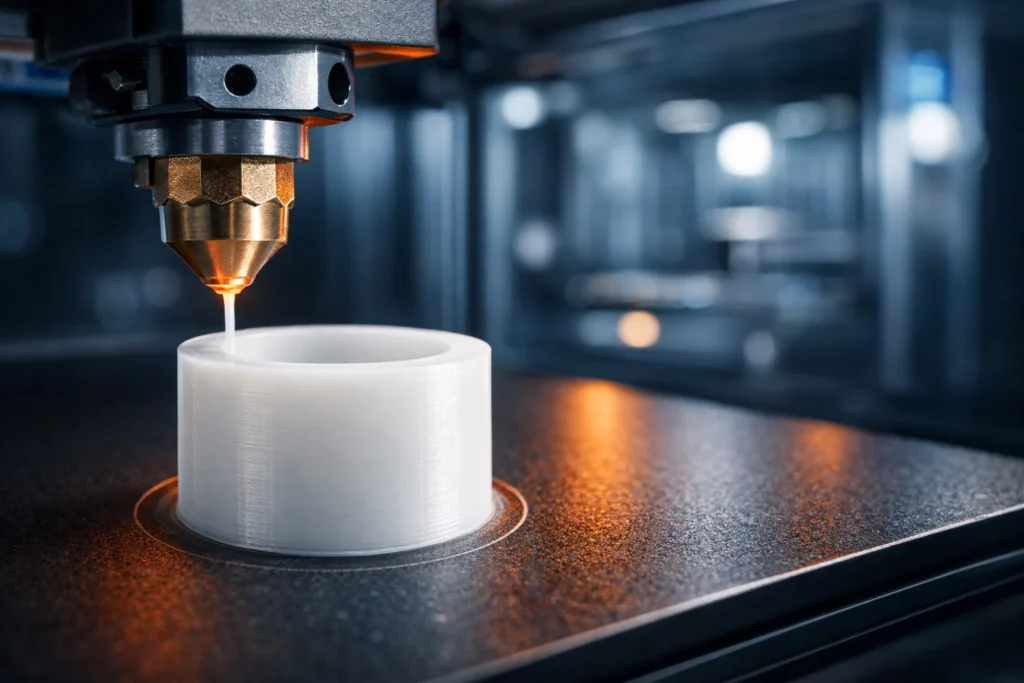
You can 3D print POM (acetal) filament, but “Delrin filament” usually is not Delrin.
Delrin is a homopolymer brand, while the POM filaments with published data are copolymer [1][3][7].
Their settings come from the filament maker and differ widely: nozzle ranges run from 195 to 250 °C, and bed ranges from 100 to 130 °C [1][2][4][5][6].
Printed values are also lower than stock: one maker lists 50 MPa and 1,870 MPa (XY) for printed POM, against 73 MPa and 3,100 MPa for Delrin 150 resin [2][10].
This guide gives the published settings, the safety limits, and a way to choose between printing, machining and a tribofilament.
Quick answer
- Print POM when: you need a one off functional prototype, the part is small (one maker designs its filament for parts up to 100 mm), the load is light, and you own an enclosed printer with a heated bed [2][3].
- Machine from Delrin stock when: you need stock shape properties, a certified grade, or a held tolerance. One service publishes ±0.005 in as standard [11].
- Use a tribofilament when: you need printed wear parts on a less demanding printer. igus lists i150 with a 230 to 250 °C nozzle and a bed of 20 to 60 °C [13].
- Safety: an acetal safety data sheet reports heavy formaldehyde fuming above 230 °C [8]. Ventilate, and do not rely on smell.
What “Delrin Filament” Means
Which filaments exist
| Filament | Type | Notes | Source |
| Ensinger TECAFIL POM-C | Polyacetal copolymer | 1.75 mm, white, 500 g | [1] |
| Grupa Azoty Tarfuse POM NAT | Polyacetal copolymer | Designed for functional parts up to 100 mm | [2][3] |
| Gizmo Dorks Acetal | Type not stated | Sold as “Acetal Delrin Filament” | [4] |
| Retailer POM filaments | Type not stated | Sold as standard POM | [5][6] |
In our search we found no filament sold by Delrin USA. The filaments above are sold as POM or acetal, and some retailers use the Delrin name.
Why the type matters
“Acetal” can mean homopolymer (Delrin) or copolymer.
Boedeker reports homopolymer is about 10 to 15% stronger, while copolymer holds up substantially better in hot water, steam and chlorine sanitizers [7].
Check the datasheet before you assume you are printing Delrin. See our detailed guide on Delrin vs. Acetal.
Published delrin 3d Printing Settings by Filament
Settings table
| Filament | Nozzle | Bed | Chamber | Speed | Drying | Source |
| Ensinger TECAFIL POM-C | 195 to 205 °C (max melt 230 °C) | 110 to 130 °C | Not stated | Not stated | 80 °C for 4 h | [1] |
| Tarfuse POM NAT | 210 to 240 °C | 100 to 130 °C | 70 to 140 °C | 10 to 30 mm/s | 4 to 6 h at 140 °C if moist | [2] |
| Gizmo Dorks Acetal | 210 to 220 °C | 110 °C (at least 100 to 110 °C) | Enclosed printer recommended | 30 mm/s | Airtight container with desiccant | [4] |
| Retailer POM (Canada) | 220 to 250 °C | 100 to 120 °C | Enclosure strongly recommended | Not stated | Not stated | [5] |
| Retailer POM (USA) | 230 to 250 °C | 100 to 120 °C | Enclosure strongly recommended | Not stated | Not stated | [6] |
Ensinger states its parameters are indicative and not guaranteed, and Tarfuse says actual values vary by printer, part design and conditions [1] [2].
What the sources agree and disagree on
- Agree: a heated bed in the 100 to 130 °C range, and an enclosure or chamber [1][2][4][5][6].
- Disagree: nozzle temperature (195 to 250 °C), and drying (80 °C for 4 hours versus 140 °C for 4 to 6 hours) [1] [2].
- No source lists a 150 °C bed. If a guide gives one, check it against your filament’s sheet.
Bed surface and moisture
Gizmo Dorks says the hardest part is first layer adhesion, and that POM prefers wood or cellulose-based platforms[4].
One retailer sheet says POM has poor adhesion and calls for mechanical methods such as clamps or custom print surfaces, and another calls adhesion challenging without a specialized surface [5][6].
We found no vendor sheet naming other surfaces, so follow your filament’s own sheet. Keep the filament dry as the sheet directs [1][2][4].
Safety: Heat, Fumes and Ventilation
Temperature and formaldehyde
An acetal safety data sheet reports heavy formaldehyde fuming above 230 °C (446 °F) [8].
Ensinger lists a 230 °C maximum melt temperature, and Gizmo Dorks says not to keep acetal above 230 °C [1] [4].
Vendors differ on how much gas printing produces: Gizmo says acetal may give off small amounts of formaldehyde, while Tarfuse says its filament does not emit toxic gases during printing [2] [4].The second is a manufacturer’s claim.
Exposure limits and controls
OSHA’s formaldehyde limits are 0.75 ppm (8-hour average) and 2 ppm (15-minute short-term) [9]. Vent the enclosure outdoors or through a documented gas phase filter, and do not use smell as your monitor.Stop and ventilate if material smokes or discolors.
See our guide Laser Cut Delrin for the full exposure table and facility-policy examples.
How Good Is a Printed POM Part?
3D Printed vs. molded and machined values
| Property | Tarfuse POM NAT, printed (XY, ISO 527) | Delrin 150 NC010 resin (ISO 527) |
| Tensile strength | 50 MPa | 73.0 MPa (yield) |
| Tensile modulus | 1,870 MPa | 3,100 MPa |
| Elongation at break | 11% | 40 % (nominal strain at break) |
| Density | 1.42 g/cm³ | 1.42 (shapes, Plastics International) |
Sources: Tarfuse [2], Delrin 150 [10] [12]. This is not a like-for-like comparison: it mixes a copolymer printed part with homopolymer resin data.
As a rough scale, the printed modulus is about 60% and the strength about 68% of the Delrin 150 resin values (our arithmetic).
What this means for a design
- Stiffness: a printed part deflects roughly 1.7 times as much as a part with Delrin 150 resin stiffness (3,100 ÷ 1,870), before any layer effects.
- Layer direction: Tarfuse publishes XY values only [2]. Ask the maker for XZ and Z data before loading a part across layers.
- Tolerance and finish: the sheets do not publish printed tolerance. Machining from stock lets you hold a drawing tolerance.
- Size: Tarfuse is designed for parts up to 100 mm. Other vendors state no size limit [3].
Print, Machine or Order
| Your situation | Start with | Why | Read next |
| One-off prototype, small, light load, enclosed printer | Print POM | Filament makers publish settings for this use [1] [2] | This guide |
| Need Delrin 150 stiffness, a held tolerance or certified stock | Machine from stock | Printed XY modulus is about 60% of Delrin 150 resin; ±0.005 in is a published standard machining tolerance [2] [10] [11] | Machining Delrin |
| Part larger than 100 mm | Machine | Tarfuse is designed for parts up to 100 mm [3] | Machining Delrin |
| Printed wear parts on an open or lower-temperature printer | Tribofilament | igus i150 prints with a 230 to 250 °C nozzle and a bed of 20 to 60 °C [13] | Alternatives below |
| High volume | Injection molding | Delrin molding grades are listed with their data in the grade table | Delrin guide |
| Food or drinking-water contact | Certified stock | Natural Delrin 150 shapes list FDA 21 CFR 177.2480 and NSF/ANSI 51 and 61 [15] | Delrin guide |
| Hot water, steam or chlorine | POM-C stock or filament | Copolymer holds up better [7] | Delrin vs. Acetal |
Cost note. Retail snapshot, October 2026: Gizmo Dorks acetal filament $26.95 per kg [4], and Tarfuse POM NAT €44.95 per kg excluding VAT [16].
Filament price is only part of the cost of a printed part, so compare machine time and failed prints against a machining quote.
Machining Delrin Components for a Current Project?
Skip the shop-floor trial and error. Upload your STEP, IGES, or DXF files for an instant manufacturability review, tight-tolerance verification, and fast production quotation.
Request a Precision Machining Quote →🔒 NDA Compliant • 1 to 10,000+ Production Parts • Fast Turnaround
Alternatives for Printed Wear Parts
| Material | Nozzle | Bed | Temperature and friction | Source |
| igus iglidur i150 | 230 to 250 °C | 20 to 60 °C, or none with the igus adhesive | Long-term above 65 °C; designed for low friction and wear | [13] |
| igus iglidur i180 | 250 to 265 °C | 90 to 110 °C | Long-term 100 °C; dynamic friction 0.17 against steel; closed chamber recommended | [14] |
igus’s friction value (0.17) and Delrin’s (0.2) come from different tests, so do not rank them. Ask each maker for wear data at your pressure and speed.
FAQ
Can you 3D print Delrin?
What temperature do you print POM at?
Do you need an enclosed printer?
Is printed POM as strong as machined Delrin?
Related Guides
- Machining Delrin: Feeds, Speeds, Tolerances and Fixes
- Laser Cut Delrin: Is It Safe, and What Settings Work?
- Delrin (Acetal): Properties, Grades and How to Decide
- Delrin vs. Acetal
Sources
All sources last checked October 9, 2026. Settings are the makers’ indicative values, not guarantees.
- https://filaments.ensingerplastics.com/a/l/de/products/pom-3d-printing-tecafil-pom-c-natural-1-75-mm-500g
- https://filament2print.com/en/advanced/2241-tarfuse-pom-nat-filament.html
- https://nowetechnologie.grupaazoty.com/en/tarfuse-pom
- https://woodartsupply.com/collections/3d-printer-filaments/products/gizmo-dorks-1-75mm-acetal-delrin-filament-pom-1kg-2-2lbs-for-3d-printers-white
- https://3dprintingcanada.com/products/white-standard-pom-filament-1-75mm-1kg
- https://3dprintingusa.com/products/white-standard-pom-filament-1-75mm-1kg
- https://www.boedeker.com/Portals/0/Documents/Acetals-Understanding-the-Differences-POMC-POMH-Boedeker-Technical-Guide-Acetals-New-Logo.pdf
- https://www.mcam.com/mam/29867/MCAM-ACETRON-POM-H-AF-EN-SDS-1000-220818.pdf
- https://ehs.prod.fbweb.psu.edu/sites/ehs/files/formaldehyde_-_osha_fact_sheet.pdf
- https://plastics.tridentplastics.com/Asset/TDS_Delrin_150_NC010_(E_71946).pdf
- https://www.protolabs.com/services/cnc-machining/cnc-turning/design-guidelines/
- https://www.plasticsintl.com/media/05oith4t/delrin-150-data-sheet.pdf
- https://3dstisk.com/produkt/iglidur-i150-tribo-filament-for-3d-printing/
- https://docs.rs-online.com/a022/A700000015790034.pdf
- https://plastics.tridentplastics.com/Asset/TDS_Delrin150%20NC010.pdf
- https://filament2print.com/pt/avancados/2241-filamento-tarfuse-pom-nat.html
Last Reviewed: October 2026

Usama Ayub is the founder of PlasticSpec and a polymer manufacturing engineer with eight years of hands-on industrial experience in PET, PA6, and PA66 fiber and filament yarn production. He writes material property and selection guides for Delrin, Nylon, PEEK, PTFE, UHMW, Polycarbonate, and ABS.