
Delrin 100 vs 150: Which Grade for Machining and Molding?
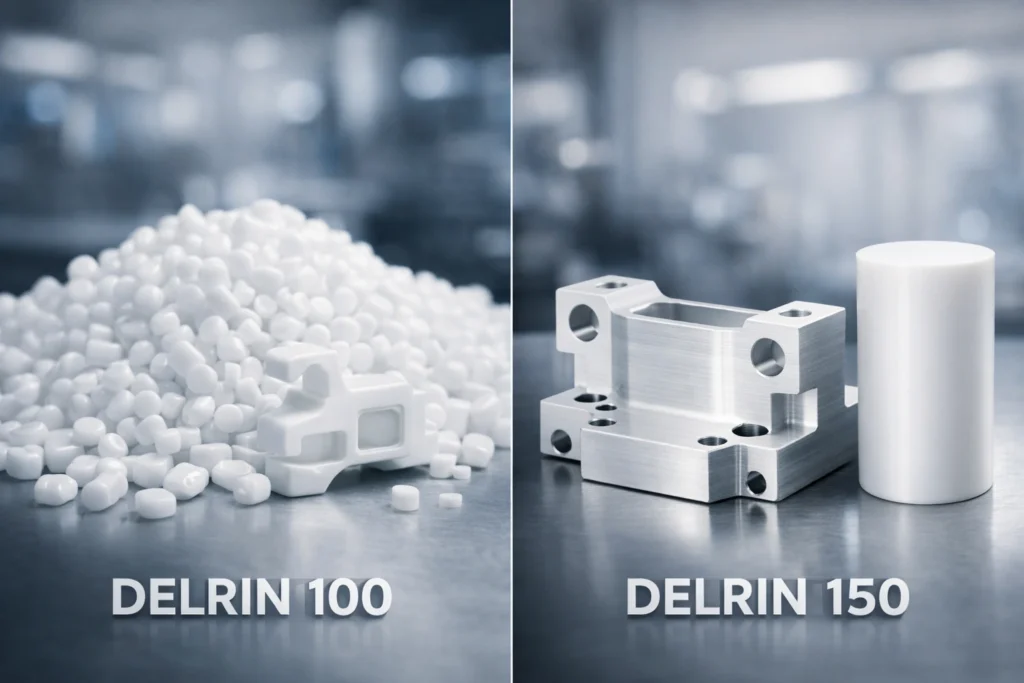
Delrin 100 and Delrin 150 are both high viscosity acetal homopolymers (POM-H), and their datasheets list the same melt flow: 1.9 cm³/10 min (ISO 1133, 190 °C / 2.16 kg) [1] [2]
What differs is what each was developed for.
Delrin 100 is described as a high viscosity grade for easy to fill molds [2].
Delrin 150 is a nucleated grade developed for extrusion [1] and it is the POM-H grade that Trident Plastics and Sterling Plastics list for rod and plate [4] [6].
Quick answer
- Machining from rod, plate or sheet: start with a Delrin 150 stock shape, and design from the stock shape datasheet, not the resin datasheet.
- Injection molding: start with the 100 family, then pick the toughness and flow variant that fits your mold.
- Thick stock, large diameters, or sealing/wetted parts: check centerline porosity before you worry about the grade number.
What the Datasheets Say: Matched Resin Data
Delrin 100 NC010 is described as a high viscosity homopolymer for easy to fill molds, with a balance of toughness and strength [2].
Delrin 150 NC010 is described as designed for extrusion, with low die deposit, good thermal stability, and enhanced crystallization for low porosity [3].
The table below puts both on the same ISO test methods.
| Property (resin, 23 °C) | Delrin 100 NC010 | Delrin 150 NC010 | Test method |
| Melt volume-flow rate, 190 °C / 2.16 kg | 1.9 cm³/10 min [2] | 1.90 cm³/10 min [1] | ISO 1133 |
| Tensile modulus | 2,900 MPa [2] | 3,100 MPa [1] | ISO 527 |
| Tensile stress at yield | 71 MPa [2] | 73.0 MPa [1] | ISO 527 |
| Tensile strain at yield | 26 % [2] | 22 % [1] | ISO 527 |
| Notched impact | 15 kJ/m² (Charpy) [2] | 10 kJ/m² (Izod) [1] | ISO 179/1eA vs ISO 180/1A: different tests, not comparable |
| Tensile creep modulus, 1,000 h | 1,600 MPa [2] | Not on the free datasheet | ISO 899-1 |
| Processing methods listed | Injection molding (easy-to-fill molds) [2] | Extrusion, profile and sheet extrusion, injection molding [1] | n/a |
The two columns come from different databases (Material Data Center for 100, Delrin USA/UL Prospector data sheet for 150). Confirm against the current Delrin USA datasheet for the lot you buy.
How to read it:
On resin data, 150 is about 7% stiffer and about 3% higher in yield stress than 100. That is a small gap, and it sits inside the normal spread between lots and test labs.
The impact row is the trap:15 kJ/m² (Charpy) and 10 kJ/m² (Izod) are different tests on different notch setups, so neither number says one grade is tougher.
If impact or creep decides the job, ask the supplier for the exact grade values and test the part.
Machining: What You Are Actually Buying
When you machine Delrin, you are buying an extruded stock shape, not resin pellets.
Delrin 150 NC010 stock shapes are listed in rod from 0.187 to 10.00 in diameter and plate from 0.031 to 5.00 in thick, with plate sizes of 24 × 48 and 48 × 120 in [4].
Delrin 150 is also the base resin in the 13% PTFE “AF blend” rod and plate, a 2:1 blend of 20% PTFE-filled Delrin and unfilled 150 [16].
Stock-Shape Data (Delrin 150 NC010, Natural, ASTM Methods)
| Property | Value | Method |
| Density | 1.41 g/cm³ | n/a |
| Tensile modulus | 350,000 psi (about 2,410 MPa) | ASTM D638 |
| Tensile strength at yield | 11,000 psi (about 76 MPa) | ASTM D638 |
| Tensile elongation at break | 25 % | ASTM D638 |
| Flexural modulus | 470,000 psi (about 3,240 MPa) | ASTM D790 |
| Shear strength | 9,800 psi (about 68 MPa) | ASTM D732 |
| Notched Izod impact | 2 ft·lb/in (about 107 J/m) | ASTM D256 |
| Water absorption, 24 h / saturation, 73 °F | 0.25 % / 0.9 % | ASTM D570 |
| Standards and compliance listed | ASTM D6778-20 POM0111; ASTM D6100-17 S-POM0111; FDA 21 CFR 177.2480; NSF/ANSI 51 and 61 | Distributor listing |
Source: Trident Plastics Delrin 150 NC010 extruded shapes data sheet [4]. Metric values are our unit conversions.
Do not mix the two tables: The stock shape tensile modulus (about 2,410 MPa, ASTM D638) is lower than the resin value (3,100 MPa, ISO 527).Different test method, different specimen, different material form.
For a machined part, use the stock shape numbers, and get the certificate for the lot. Even the same distributor’s natural and black 150 sheets differ: elongation is listed as 25% for natural[4] and 40% for black,[5] and the black listing shows no FDA or NSF line.[5]
Centerline Porosity: The Check That Matters More Than the Grade Number
Homopolymer acetal stock can have a low density center, especially in large cross sections. The Delrin 150 shape data sheets say so directly [4].
Trident’s acetal comparison guide calls it the biggest difference between homopolymer and copolymer shapes, most prominent in thick slab and large diameter rod, and attributes it to shrinkage [7].
Boedeker describes it as interconnected micro porosity of about 100 to 150 microns in homopolymer stock [8].
The 150 resin is marketed with enhanced crystallization for low porosity [3] but that does not remove the effect in thick shapes.
One distributor states that Delrin 150 is not USP Class VI compliant because of it [6].
The practical question is whether the center of the stock ends up inside your finished part.
| Finished part | Is the center in the part? | What to do |
| Bored bushing or sleeve | Usually no, the bore removes it | Low concern; confirm bore diameter clears the affected zone |
| Solid shaft, gear blank, disc | Yes | Ask the supplier for a porosity statement for that diameter or thickness |
| Part that holds pressure, fluid or a seal face | Yes, and it matters most | Treat the center as a possible leak path; require a porosity statement, or consider copolymer stock |
Copolymer acetal (POM-C) stock is reported to have little or no centerline porosity [9] at the cost of some strength and stiffness.
Homopolymer is roughly 10 to 15% higher [8] If your load case allows it.
See our detailed guide on Delrin vs. Acetal (POM-H vs. POM-C).
Molding: Start With the 100 Family
For injection molding, Delrin 100 is the datasheet described easy to fill high viscosity grade [2].
The 100 family is wider than one grade, and the property spread inside it is far larger than the 100 versus 150 gap
| Grade | Positioning | Tensile modulus (ISO 527) | Notched Charpy, 23 °C |
| Delrin 100 NC010 | High viscosity, strength and toughness balance | 2,900 MPa [2] | 15 kJ/m² [2] |
| Delrin 100ST NC010 | Super-toughened high viscosity | 1,400 MPa [11] | 90 kJ/m² [11] |
If a molded part must survive impact, the toughened 100 family grades are the lever, not 100 versus 150.
If a high viscosity grade fills your geometry poorly, Delrin also offers medium viscosity grades such as the 500 series [15]
Neither grade is locked to one process. The 150 data sheet lists injection molding with a melt temperature of 210 to 220 °C, and extrusion at 195 to 205 °C [1].
Other 100 family grades, 100T and 100TL, are listed for profile and sheet extrusion.[12] [13]
Cost: Utilization and Tooling Breakeven
We do not publish resin or stock prices because they move by supplier, size and quantity.
Two calculations you can run with your own quotes are more useful.
Material utilization for a machined part
Utilization = finished volume ÷ stock volume consumed.
Illustrative example (assumes 1¾ in rod is stocked):
A solid Ø40 × 30 mm part cut from Ø44.45 mm rod with a 3 mm facing and part off allowance.
- Finished volume: about 37,700 mm³, or about 53 g at 1.41 g/cm³ [4].
- Stock slug (33 mm long): about 51,200 mm³, or about 72 g.
- Utilization: about 74%, with about 19 g removed as chips per part.
Multiply the stock mass by your quoted price per kilogram to get material cost per part, and compare stock sizes by utilization, not by price per rod.
This part also keeps its center, so the porosity check above applies to it.
Molding versus machining breakeven
Breakeven quantity = mold cost ÷ (machined cost per part − molded cost per part), with both per part costs excluding tooling.
Below that quantity, machining from stock usually wins; above it, molding does.
Quick Decision Guide
| Situation | Start with | Check before ordering |
| CNC part from rod or plate, bored or thin-walled | Delrin 150 stock shape | Stock size and the certified ASTM D6100 edition |
| Solid part from large rod or thick plate | Delrin 150 stock, or POM-C if the load allows | Porosity statement for that diameter or thickness |
| Food, potable water or medical adjacent | The exact listed compliant grade | Compliance for the specific form and color; FG150 is the food contact resin grade [14] |
| High volume molded part | Delrin 100 family | Mold fill, toughness variant, tooling breakeven |
| Impact loaded molded part | 100T or 100ST class | Stiffness loss against impact gain (table above) |
| Sliding or wear part | PTFE-filled or AF-blend stock | Friction and wear data for that exact stock |
FAQ
Is Delrin 150 stronger than Delrin 100?
Not in a way that matters for selection.
On ISO resin data, 150 is about 7% stiffer and 3% higher in yield stress (tables above).
The stock shape numbers are measured by a different method and are not comparable with the 100 resin values.
Can Delrin 100 be extruded, and can Delrin 150 be injection molded?
Is Delrin 150 food safe or USP Class VI?
Does Delrin 150 eliminate centerline porosity?
No. The 150 shape data sheets still warn about it in large cross sections [4]. See the porosity section above for what to ask your supplier.
Related Guides
- Delrin (Acetal Homopolymer): Properties, Grades and Applications
- Delrin vs. Nylon
- UHMW vs. Delrin
- Delrin vs. Acetal (POM-H vs. POM-C)
- Delrin vs. ABS
- Machining Delrin: Speeds, Feeds and Tooling
- Laser-cut-delrin
- Delrin-3d-printing
Sources
All sources last checked October 6, 2026. Datasheet values are typical values, not specifications.
- TDS_Delrin_150_NC010
- materialdatacenter.com, Delrin 100 NC010
- Data Sheet 45-F
- TDS_Delrin150 NC010
- TDS_Delrin150 BK
- sterlingplasticsinc.com
- Acetal comparison guide
- Technical guide (PDF)
- professionalplastics.com
- ASTM D6100-25. standards catalogue listing
- materialdatacenter.com, Delrin 100ST NC010
- specialchem.com
- specialchem.com
- materialdatacenter.com, Delrin FG150 NC010
- specialchem.com, Delrin
- Delrin 100AF blend
Last Reviewed: October 2026

Usama Ayub is the founder of PlasticSpec and a polymer manufacturing engineer with eight years of hands-on industrial experience in PET, PA6, and PA66 fiber and filament yarn production. He writes material property and selection guides for Delrin, Nylon, PEEK, PTFE, UHMW, Polycarbonate, and ABS.