
Delrin (Acetal): Properties, Grades and How to Decide
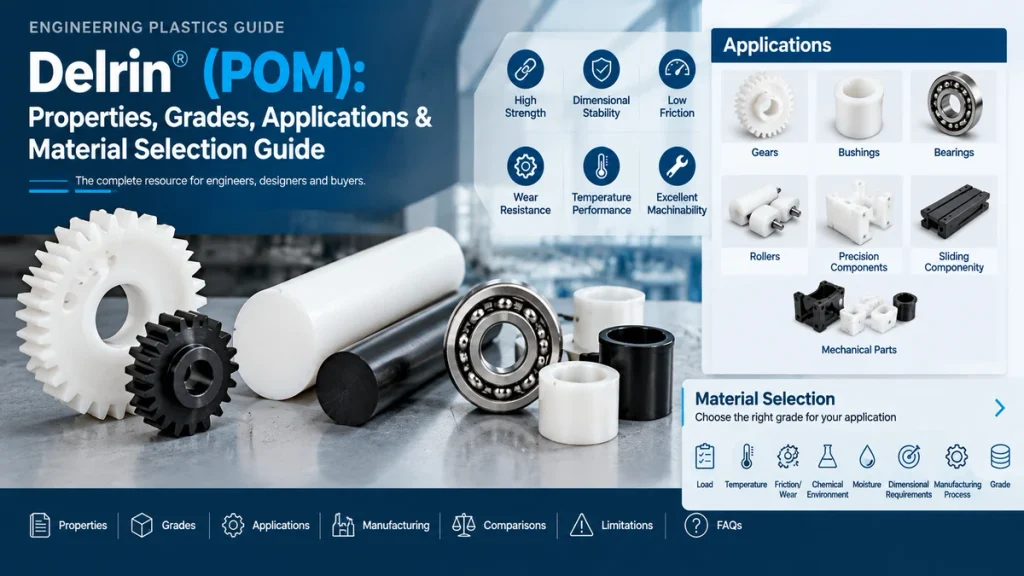
Delrin is a brand of acetal homopolymer (POM-H), and the grades most people compare list nearly the same strength: a yield stress of 71 to 73 MPa and a tensile modulus of 2,900 to 3,300 MPa on ISO resin datasheets [3] [4] [5] [6].
The differences that decide a job are elsewhere: long term service is only 185 °F,[1] acids and bleach attack it,[15] [16] thick stock can have a porous center,[2] and the wrong grade changes stiffness or toughness by a factor of two or more [4] [7].
This guide gives sourced numbers and a way to decide.
Quick answer
- Choose Delrin when you need a stiff, strong, low friction part that carries sustained load: gears, bushings, rollers and precision machined parts in dry or moist service with mild chemistry.
- Look elsewhere when the part sees strong acids or bleach (HDPE), hot water, steam or chlorine (POM-C), wet abrasive wear (UHMW), or continuous heat above 185 °F.
- Check first: the exact grade, centerline porosity in thick stock, and the certificate for food or water contact.
What Delrin Is, and the Name Confusion
| Term | What it means |
| Delrin | A brand of acetal homopolymer resins and stock shapes, marketed by Delrin USA LLC (formerly DuPont) [2] [9] |
| POM, polyacetal, acetal | Generic names for polyoxymethylene plastics. The word “acetal” alone can mean homopolymer or copolymer [11] |
| POM-H | Homopolymer. Boedeker reports it is about 10 to 15% stronger than copolymer [12] |
| POM-C | Copolymer. Boedeker reports it holds up substantially better in hot water, steam and chlorine containing sanitizers, and distributors report little or no centerline porosity in copolymer stock [11] [13] |
So all Delrin is acetal homopolymer, but not all acetal is Delrin.
If a drawing says only “acetal,” ask which one.
Properties of Delrin: Representative Datasheet Values
These are Delrin 150 extruded shape values from one distributor, Plastics International, on ASTM methods at 73 °F.
Delrin 150 is the stock shape grade for rod and plate [2].
| Property | Delrin 150 (shapes) |
| Specific gravity | 1.42 |
| Tensile strength at yield | 11,100 psi (about 76 MPa) |
| Tensile modulus / flexural modulus | 450,000 psi / 420,000 psi |
| Tensile elongation at break | 25 % |
| Dynamic coefficient of friction | 0.2 (ASTM D3702, 40 psi, 50 fpm) |
| Wear factor | 55 × 10−10 in³·min/ft·lb·hr |
| Water absorption | 0.25 % (24 h), 0.9 % (saturation) |
| Thermal expansion | 6.8 × 10⁻⁵ in/in/°F |
| Heat deflection temperature | 336 °F at 66 psi; 257 °F at 264 psi |
| Service temperature | 185 °F long term; 300 °F intermittent |
| Melting point | 347 °F |
Source: Plastics International Delrin 150 data sheet [1]. Typical values, not design allowables.
There is no single “Delrin strength.” Even two distributors’ sheets for the same Delrin 150 shapes differ: tensile modulus 450,000 psi at Plastics International [1] vs 350,000 psi at Trident, and flexural modulus 420,000 vs 470,000 psi [2].
Use the certificate for your lot.
What the numbers mean for a design
- Heat: the 185 °F long term limit, not the 347 °F melting point, is the number to design to. Under load, heat deflection is 257 °F.
- Moisture: 0.9% saturation uptake is small but not zero. Ask for conditioned dimensions on tight fits.
- Sliding: a 0.2 coefficient of friction and a published wear factor suit gears and bushings, but friction and wear depend on pressure, speed, counterface and temperature. Ask for wear data on your system.
- Expansion: 6.8 × 10⁻⁵ in/in/°F means a 3 in feature moves 0.0020 in per 10 °F.
Delrin Grades: Which One for Which Job
| Grade | Positioning | Tensile modulus (ISO 527) | Notched impact |
| Delrin 100 NC010 | High viscosity, strength and toughness [4] | 2,900 MPa | 15 kJ/m² (Charpy) |
| Delrin 150 NC010 | High viscosity, nucleated, developed for extrusion and stock shapes [3] | 3,100 MPa | 10 kJ/m² (Izod, a different test) |
| Delrin 500P NC010 | General-purpose medium viscosity for injection molding [5] | 3,100 MPa | 9 kJ/m² (Charpy) |
| Delrin 900P NC010 | Low viscosity for multicavity and thin-wall molding [6] | 3,300 MPa | 8 kJ/m² (Charpy) |
| Delrin 100ST NC010 | Super-toughened high viscosity [7] | 1,400 MPa | 90 kJ/m² (Charpy) |
| Delrin 570 | 20% glass fiber, medium viscosity [8] | 4,900 MPa | 3.5 kJ/m² (Charpy) |
| Delrin 100AF Blend | 13% PTFE fiber for low friction; retains about 90% of unmodified strength, stiffness and toughness [9] | Not listed | Slightly lower than unfilled |
ISO resin values from Material Data Center, DuPont and Prospector datasheets, cited in the Positioning column.
The 100 and 150 Charpy and Izod values are different tests and cannot be ranked against each other.
How to choose a grade
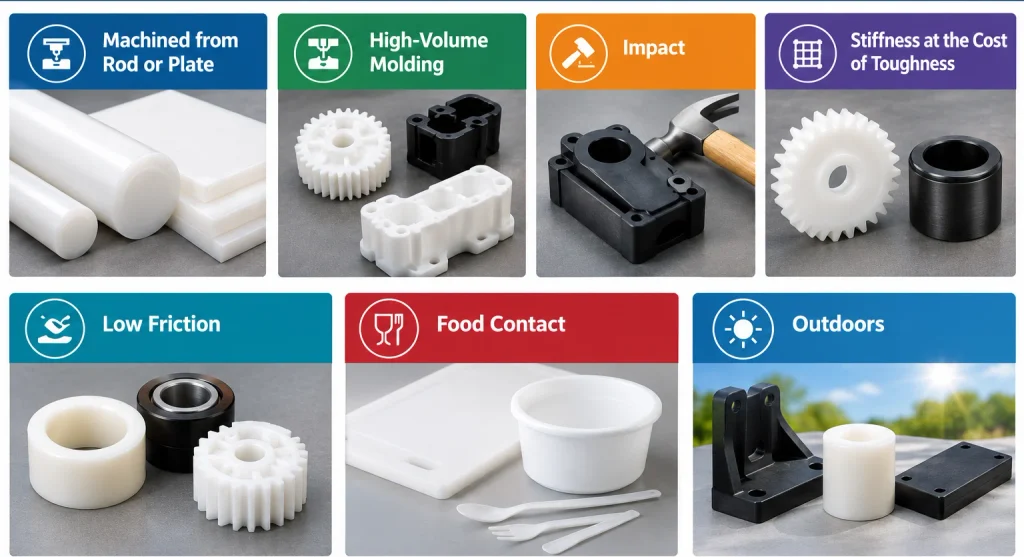
- Machined from rod or plate: start with a Delrin 150 stock shape [2].
- High-volume molding: 500P is the general purpose grade, and 900P for thin walls and multi cavity tools [5] [6].
- Impact: 100ST gives six times the notched impact of Delrin 100 but under half the stiffness, so check the part still holds its shape [4] [7]
- Stiffness at the cost of toughness: glass filled 570 raises modulus to 4,900 MPa and drops notched impact to 3.5 kJ/m² [8]
- Low friction: an AF PTFE blend, accepting slightly lower impact and wear capability than unfilled Delrin [9]
- Food contact: a food contact grade such as FG150 [10].
- Outdoors: a UV-stabilized grade such as Delrin 527 UV [12].
Grades are not interchangeable: swapping 100 for 100ST halves stiffness, and swapping 100 for 570 cuts notched impact from 15 to 3.5 kJ/m² [4] [7] [8].
Where Delrin Is Used
- Moving parts: gears, bearings, bushings and rollers, the classic list on distributor data sheets [1] [2]. Trident singles out small diameter, thin walled bushings that benefit from homopolymer strength and rigidity [2].
- Fluid and electrical parts: pump and valve components in moist or wet environments, fittings, and electrical insulator parts [1].
- Precision machined parts and fixtures: glass-filled Delrin 570 is listed for gear manufacturing and fixture construction [21].
Delrin or Something Else?
| Your priority | Start with | Why | Read next |
| Strong acids, bleach, caustic, wet service | HDPE | Acetal is rated fair at 1% sulfuric acid, and calcium hypochlorite has a severe effect [15] [16] | HDPE vs. Delrin |
| Hot water, steam, chlorine sanitizer | POM-C | Copolymer holds up substantially better [11] | Delrin vs. Acetal |
| Stiffness, sustained load, press fits | Delrin | 1,000 h creep modulus 1,600 MPa for Delrin 100 vs 360 MPa for a PE-HD pipe resin (resin-level data) [4] [20] | HDPE vs. Delrin |
| Wet, abrasive wear | UHMW | Compare matched data before you switch | UHMW vs. Delrin |
| More toughness | Nylon, or Delrin 100ST | 100ST has 90 vs 15 kJ/m² notched impact but half the stiffness [4] [7] | Delrin vs. Nylon |
| Low cost, non-wear parts | ABS | Compare matched data | Delrin vs. ABS |
| Extreme chemical resistance or lowest friction | PTFE | Compare matched data | Delrin vs. Teflon |
Limits of delrin You Should Know
| Limit | Number or fact | What to do |
| Temperature | 185 °F long term, 257 °F heat deflection at 264 psi, 347 °F melting [1] | Design to the long-term figure, and check heat deflection if the part is loaded |
| Acids and bleach | Fair at 1% sulfuric acid; severe for calcium hypochlorite [15] [16] | Compare HDPE |
| Hot water and chlorine | Copolymer holds up substantially better [11] | Compare POM-C |
| Centerline porosity | The Delrin 150 sheet warns of a low-density center in large sections; Boedeker describes 100 to 150 micron interconnected pores; one distributor says 150 is not USP Class VI because of it [2] [11] [14] | Get a porosity statement if a bore or seal face crosses the center |
| Heat and fumes | Heavy formaldehyde fuming above 230 °C (446 °F); OSHA limits 0.75 ppm (8 h) and 2 ppm (15 min) [17] [18] | Ventilate any hot process |
| Moisture | 0.25% in 24 h, 0.9% at saturation [1] | Ask for conditioned dimensions on tight fits |
| Sunlight | UV-stabilized grades exist [12] | Specify one for outdoor parts |
Manufacturing Routes
| Route | Key fact | Read next |
| CNC machining | Published ranges for milling, turning, drilling and sawing; one service publishes ±0.005 in as standard tolerance [22] | Machining Delrin |
| Injection molding | Delrin 500P lists molding shrinkage of 2.0% (parallel) and 1.9% (normal), so design the tool to the grade [5] | Grade table above |
| Laser cutting | Heating produces formaldehyde, and some shared makerspaces ban it (sources in the guide) | Laser Cut Delrin |
| 3D printing | Printer and material specific | Delrin 3D Printing |
What to Put on the Drawing and PO
- Grade, not the brand name alone: for example Delrin 150 NC010 for machined stock, or 500P for molding.
- The right standard: ASTM D6778 classifies POM molding and extrusion materials (the resin), and ASTM D6100 covers POM shapes such as sheet, plate, rod and tubular bar. The 150 shapes sheet cites both (POM0111 and S-POM0111).[2][19] A standard callout does not guarantee a porosity-free center, so ask separately.
- Homopolymer or copolymer stated explicitly.
- Color and form, and certificates (FDA, NSF, USP) matched to the exact grade, form and color. The natural 150 listing cites FDA 21 CFR 177.2480 and NSF/ANSI 51 and 61 [2]
- Porosity statement for thick stock, and the inspection temperature for tight tolerances.
FAQ
Is Delrin the same as acetal?
Is Delrin strong?
Is Delrin good for gears?
Can Delrin be machined?
Yes. See our complete guide on Machining Delrin for sourced speed, feed and tolerance ranges.
Can Delrin be laser cut?
It can, but heating produces formaldehyde [17] and some shared makerspaces ban it. See our detailed guide on Laser Cut Delrin before you try.
What is the difference between Delrin grades?
Viscosity class (flow), toughness, reinforcement and friction modification. See the grade table above, and do not swap grades without checking the datasheet.
Sources
All sources last checked October 9, 2026. Datasheet values are typical values for the named grade and test, not design allowables.
- delrin-150-data-sheet (PDF)
- TDS_Delrin150 NC010 (PDF)
- TDS_Delrin_150_NC010 (PDF)
- materialdatacenter.com
- materialdatacenter.com
- Delrin 900P NC010 (PDF)
- materialdatacenter.com
- materialdatacenter.com
- Delrin 100AF Blend
- materialdatacenter.com
- technical guide (PDF)
- boedeker.com
- professionalplastics.com
- sterlingplasticsinc.com
- Acetal.pdf
- blog.darwin-microfluidics.com
- Acetron AF POM-H SDS (PDF)
- formaldehyde fact sheet (PDF)
- ASTM D6100-25. standards catalogue listing
- materialdatacenter.com
- Delrin 570 data sheet (PDF)
- protolabs.com, CNC turning
Last Reviewed: October 2026

Usama Ayub is the founder of PlasticSpec and a polymer manufacturing engineer with eight years of hands-on industrial experience in PET, PA6, and PA66 fiber and filament yarn production. He writes material property and selection guides for Delrin, Nylon, PEEK, PTFE, UHMW, Polycarbonate, and ABS.